
Holographic geodesic composition of the geometric field applied in modeling codes for complex physical systems
Abstract
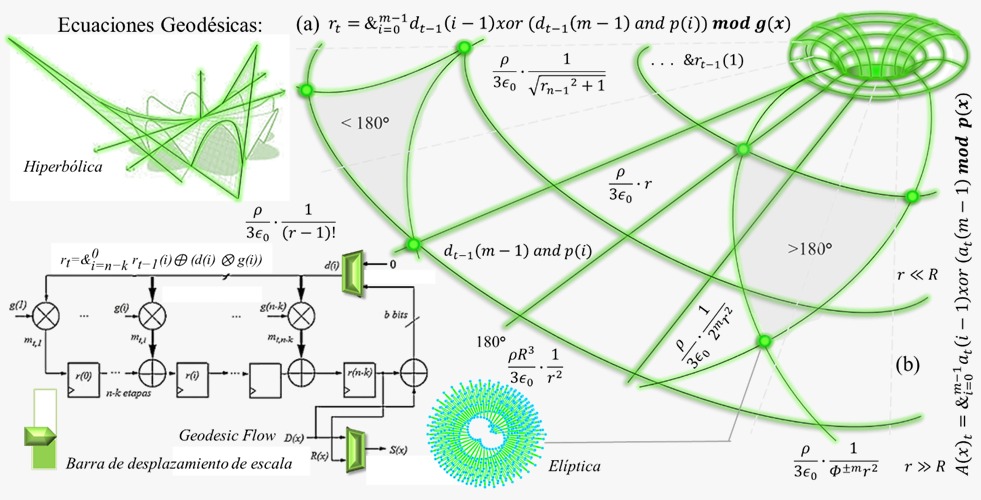
The holographic principle of geometric entanglement allows us to state that the interaction between particles, geodesic flow, or waves in a region can be described by the projective mathematical operator model of its boundary surface, considering the remainder reflected by the medium. The objective is to recognize a geometric field operator, defined by the geodesic equations of space, that allows describing the output of a system based on the topological state and energy memories, compressing the model into n-1 dimensions, which unfold in a geometric-physical composition arrangement. The method used was the inference of theoretical statements, based on concepts from abstract algebra. The contribution of this research is the identification of the convolution encoder of the LFSR circuit as a functional—mathematical object—for the development of classical-quantum models, incorporating all the parameters that define the behavior of complex systems, with applications in emerging technologies in the NCRE energy sector and engineering solutions
Downloads
References
Falcón, N., Pitter, W., Muñoz, A., Barros, T., Viloria, A., Nader, D. (2000). Modelo Electroatmosférico del Relámpago sobre el Río Catatumbo. Ciencia, 8(2), 155-167.
Ferrero, R., Han, M., Liu, H. (2025). The one-loop effective action from the coherent state path integral of loop quantum gravity.
González Freites, D., Zambrano Mendoza, O. y Barrios, J. (2024). DInSAR para Análisis Geomecánico de Yacimientos – Aplicación al Yacimiento Lagunillas Inferior 07, Lago de Maracaibo, Venezuela, Rev. Téc. Fac. Ing. Univ. Zulia, 47, p. e244708.
Han, M., Liu, H., Qu, D., Vidotto, F., Zhang, C. (2025). Cosmological dynamics from covariant loop quantum gravity with scalar matter. Physical Review D, 111(8), 086012.
Heikkilä S., Pankka P. (2025) De Rham algebras of closed quasiregularly elliptic manifolds are Euclidean. Ann. of Math. 201 (2) 459-488.
Kang, M., Kim, S., Qian, Y., Neves, P., Ye, L., Jung, J., ...Comin, R. (2025). Measurements of the quantum geometric tensor in solids. Nature Physics, 21(1), 110-117.
Maraschin, M., Askari, M., Chauhan, V., Feistel, L. H., Olusegun, S., Ortega-Ramos, J., Gauthier, J. A. (2025). Recent developments in modeling the electric double layer with density functional theory. Current Opinion in Electrochemistry, 101654.
Pacheco Gil, H. A. y Zamora Ledezma, E. (2020) Variaciones de la cobertura vegetal empleando el índice normalizado de diferencia de vegetación para monitorear ODS en Manabí - Ecuador, Rev. Téc. Fac. Ing. Univ. Zulia, 43(2), 12-18.
Pendás, E. (2024). Zermelo's problem, Finsler spacetimes and applications. Tesis Doctoral, España.
Rolón, J., y Ulloa, S. (2009). Procesos cuánticos en islas semiconductoras: manipulación óptica y control de estados coherentes. Rev. Interdisciplinaria nanociencias y nanotecnología, 2(1), 24-36.
Sandoval-Ruiz, C. (2025a). Modeling renewable energy systems on convolution codes using interference patterns. UCT, 29(126), 111-122.
Sandoval-Ruiz, C. (2025b). Modeling of Physical Systems by applying convolutional interleaving code. Revista Brasileira de Ensino de Física, 47, e20240315.
Sandoval-Ruiz, C. (2024a). Unificación de la ecuación de modelado de sistemas de energías renovables. Ciencia y Tecnología, 3-16.
Sandoval-Ruiz, C. (2024b). e-KiteLab: investigación en física aplicada para mantenimiento y optimización de sistemas de energías renovables. Investigación & Desarrollo, 24(1), 95-105.
Sandoval-Ruiz, C. (2024c). Operador matemático para caracterización y optimización de etapas de sistemas físicos. Revista Colegiada de Ciencia, 5(2), 88-98.
Sandoval-Ruiz, C. (2024d). RSE Laboratorio de modelado de sistemas físicos con ciencia aplicada. Revista Eduweb, 18(4), 9-25.
Sandoval-Ruiz, C. (2024e). ZPF para arreglo de proyección de onda: φ-LFSR en modelado Fp[x]/f(x) de Sistemas de energías renovables. Revista de la Univ. del Zulia, 15(42), 281-305.
Sandoval-Ruiz, C. (2024f). Ω-Vórtices y acoplamientos resonantes en modelo de patrón de flujo toroidal regenerativo mediante física moderna y ondas. Revista Calibre, 9(1), 1-20.
Sandoval-Ruiz, C. (2024g). xyz Modelo de optimización de arreglos de cometas captadoras de energías sostenibles. Rev. Téc. Fac. Ing. Univ. Zulia, 46(2).
Sandoval-Ruiz, C. (2021). Fractal mathematical over extended finite fields Fp[x]/f(x). Proyecciones (Antofagasta), 40(3), 731-742.
Sandoval-Ruiz, C. (2020a). Arreglos fotovoltaicos inteligentes con modelo LFSR-reconfigurable. Revista Ingeniería Univ. de Costa Rica, 30(2), 32-61.
Sandoval-Ruiz, C. (2020b) Smart PV Solar Concentration Arrays for MPPT using FPGA Technology, Rev. Téc. Fac. Ing. Univ. Zulia, 43(3), 122-133.
Stutz, A., Schwan, G., Studer, C. (2025). Efficient and Physically Consistent Modeling of Reconfigurable Electromagnetic Structures. IEEE Open Journal of the Communications Society.
Tyagi, D. y Schmitz, S. (2025). Glauert's optimum rotor disk revisited a calculus of variations solution and exact integrals for thrust and bending moment coefficients. Wind Energy SCI, 10, 451-460.
Villas-Boas, C., Máximo, C., De Souza, P., Bachelard, R., Rempe, G. (2021). Bright and dark states of light: The quantum origin of classical interference

This work is licensed under a Creative Commons Attribution-NonCommercial-ShareAlike 4.0 International License.
Copyright
La Revista Técnica de la Facultad de Ingeniería declara que los derechos de autor de los trabajos originales publicados, corresponden y son propiedad intelectual de sus autores. Los autores preservan sus derechos de autoría y publicación sin restricciones, según la licencia pública internacional no comercial ShareAlike 4.0


_2.04__.27_p__._m__.__.png)


