Effect of sectioning, drying, and shading on the propagation of Opuntia cochenillifera (L.) Mill. cladodes
Abstract
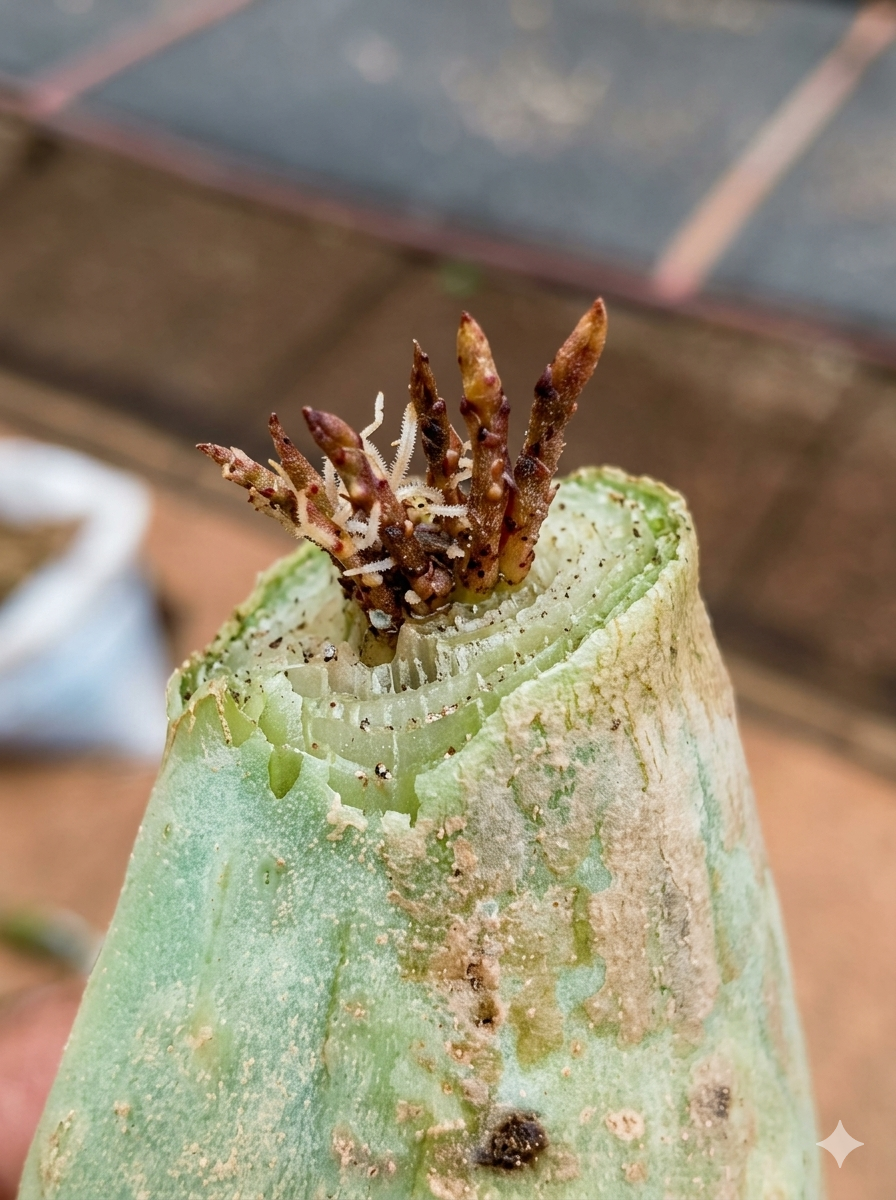
Opuntia cochenillifera (L.) Mill. has a forage potential in arid areas. Because pastures are insufficient to meet livestock's nutritional demands during the dry season, this research aimed to evaluate the effects of sectioning (S), drying (D), and shading (Sh) of cladodes on the propagation of Opuntia cochenillifera (L.) Mill. The S factors (whole cladode and apical, middle, and basal sections), D (pre-drying at room temperature on mesh under shade for 14 days), and Sh (with and without shading under 80 % density raffia mesh), resulted in a combination of 16 treatments, arranged in a split-plot treatment design and a completely randomized experimental design. Percentages of living, rooted, and sprouted cladodes, number of shoots per cladode, and number and length of roots were evaluated 35 days after establishment. An analysis of variance and a means test were applied to determine differences among treatments. An increase in the percentage of rooted cladodes was obtained with the middle, apical, and basal fractions compared to the whole cladode, regardless of the drying process. Prior shading was counterproductive for cladode survival; high environmental humidity, combined with their water content, may have favored the appearance of secondary rots. In general, considering most of the variables evaluated, cladode sectioning without drying emerged as the best technique for asexual propagation of the species, due to the yield of vegetative material and its practicality.
Downloads
References
Ferrer-Paris J.R., I. Stachowicz, L. Morán, L. Gonz´alez, AY Sánchez-Mercado, C. Lozano, J. Soto, A. Cardozo-Urdaneta y T. (2015). Caracterización ambiental del Ecoparque “Ojo de Agua El Cardón”, municipio Miranda, estado Zulia. Laboratorio de Ecología Espacial, Centro de Estudios Botánicos y Agroforestales, Instituto Venezolano de Investigaciones Científicas. Informe técnico LEE.EPZ.2015.1. DOI:10.6084/m9.figshare.1418273.
Gallardo, J., Y. Terán, Y. Mujica, E. Rodríguez, H. Barazarte, D. Petit y R. D’Aubeterre. (2016). Análisis de las características físico‑químicas de la pulpa del fruto de Opuntia elatior Miller. Agroindustria, Sociedad Y Ambiente, 1(6), 54-67. https://revistas.uclave.org/index.php/asa/article/view/3542.
Homrani A., C. Alem, L. Ichir y H. El Mzouri (2016). Cladode planting methods improves the initial growth and production of cactus pear (Opuntia ficus‑indica (L.) Mill). AAB Bioflux, 8(3),111–128. https://aab.bioflux.com.ro/docs/2016.111-128.pdf
Khalafalla, M. M., E. Abdellatef, M. Mohameed y M. Osman. (2007). Micropropagation of cactus (Opuntia ficus‑indica) as a strategic tool to combat desertification in arid and semi-arid regions. International Journal of Sustainable Crop Production, 2(4), 1–8. https://ggfjournals.com/content/papers/V2I41-8
Khanna S. (2024). Plant Metabolism during Water Deficit Stress: A Review. Agricultural Reviews, 45 (3), 448-455. doi: 10.18805/ag.R-2381
Mateus-Arango, C.H. (2018). Evaluación de métodos de propagación asexual del nopal (Opuntia ficus indica), y respuesta a diferentes sustratos en el municipio Los Santos Santander. Agricolae & Habitat, 1(1), 27-31. DOI: 10.22490/26653176.2341.
Mondragón Jacobo, C., S. de J. Méndez Gallegos y G. Olmos Oropeza. (2003). En: Mondragón-Jacobo y Pérez-González (Eds.). El cultivo de Opuntia para la producción de forraje: de la reforestación al cultivo hidropónico. Estudio FAO Producción y Protección Vegetal 169. FAO, Roma, Italia. ISSN 1014-1227 ISBN 92-5-304705-4. https://www.fao.org/4/y2808s/y2808s0f.htm
Mulas M. y L. Dessena. (2019). Propagation of Opuntia ficus-indica by cladode fragments. Acta Horticulturae. 1247, 149-154. DOI: 10.17660/ActaHortic.2019.1247.21
Owen, N. A., K. F. Fahy y H. Griffiths. (2015). Crassulacean acid metabolism (CAM) offers sustainable bioenergy production and resilience to climate change. In Global Climate Change. GCB Bioenergy 8(4). DOI: 10.1111/gcbb.12272.
Reynolds, S. G. y E. Arias Jiménez (2003). En: Mondragón-Jacobo, L. y S. Pérez González (Eds.). El Nopal (Opuntia spp.) como forraje. Estudio FAO Producción y Protección Vegetal 169. FAO, Roma, Italia. ISSN 1014-1227 ISBN 92-5-304705-4. https://www.fao.org/4/y2808s/y2808s00.htm
Snyman H. A. (2006). Root distribution with changes in distance and depth of two-year-old cactus pears Opuntia ficus-indica and O. robusta plants. South African Journal of Botany, 72, 434–441. https://doi.org/10.1016/j.sajb.2005.12.008.
Stambouli‑Essassi, S., A. El Mousadik y R. Bouabid (2015). Evaluation of the Efficiency of Opuntia ficus-indica Cladode Cuttings for Vegetative Multiplication. Notulae Botanicae Horti Agrobotanici Cluj-Napoca, 43(2), 521–527. https://doi.org/10.15835/nbha43210049
Vázquez Mendoza, P., T. C. Sousa, M. V. F. Dos Santos, O. V. Vázquez Mendoza, J. C. B. Dubeux Junior y M. A. Lira (2019). Morfología de nopal forrajero cv. Miúda (Nopalea cochenillifera Salm Dyck) en sistemas de cultivo del agreste de Pernambuco, Brasil. Revista Mexicana de Ciencias Pecuarias 10(3), 756–766. https://doi.org/10.22319/rmcp.v10i3.4386
Copyright (c) 2026 Rafael Llinás Vergara, Carlos Atencio León, Andy González Atencio, Gisela Rivero Maldonado, Jorge Ortega Alcalá, Ciolys Colmenares, Rubén León

This work is licensed under a Creative Commons Attribution-NonCommercial-ShareAlike 4.0 International License.