Effect of tillage and seeding density on Camelina sativa (L.) Crantz under a semi-arid climate
Abstract
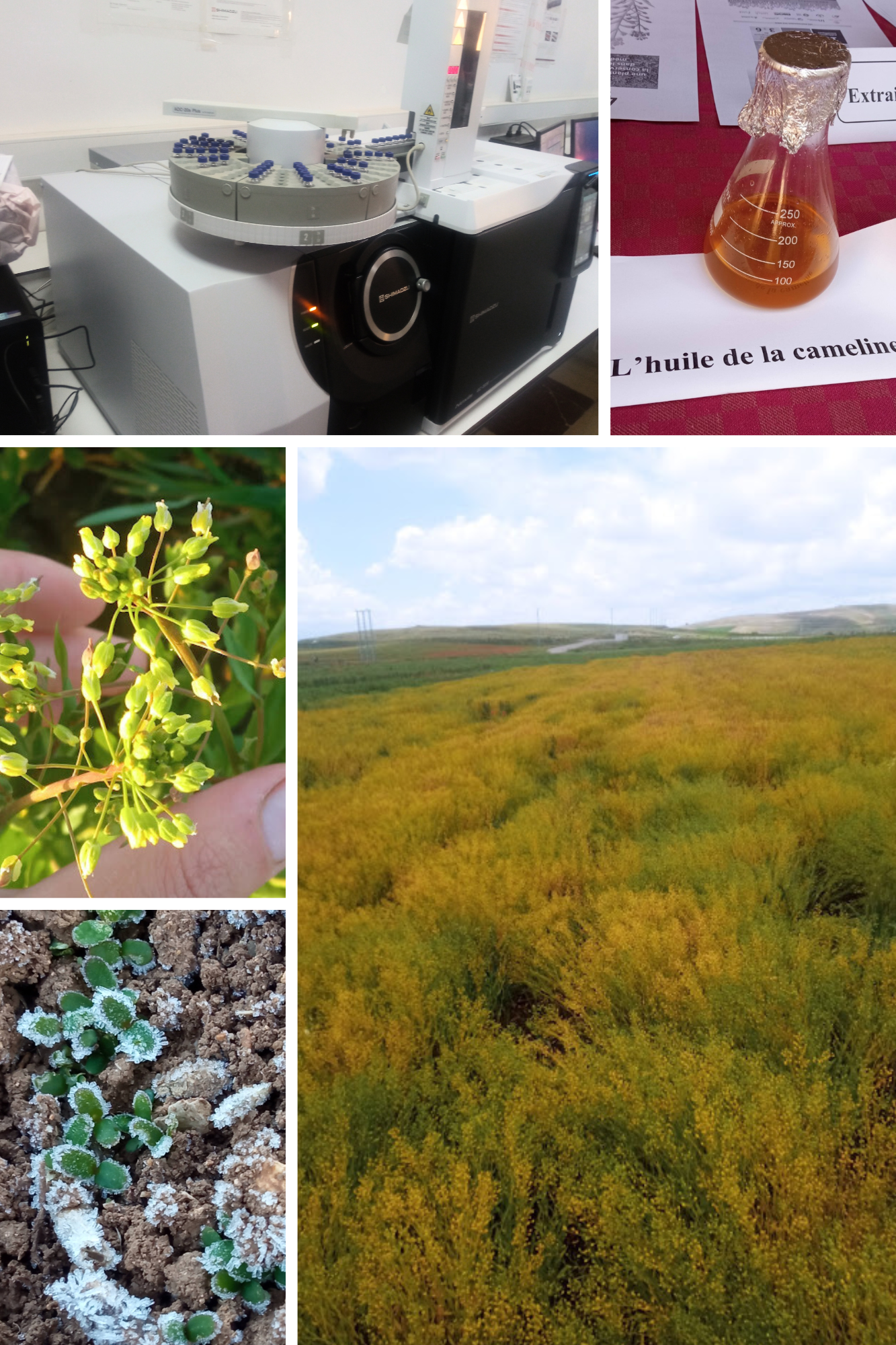
The Mediterranean Basin is warming at a rate approximately 20 % faster than the global average. In the southern Mediterranean countries, there is an urgent need to identify and adopt alternative crops that combine profitability with adaptability for local farmers. Camelina (Camelina sativa) has been proposed as a candidate for diversification. However, its agronomic performance under local semi-arid conditions remains poorly understood. To address this gap, a field study was conducted in the Setif region of Algeria over two growing seasons, examining the effects of three tillage systems (conventional tillage, minimum tillage, and direct seeding) and two seeding rates (600 and 800 seeds.m2). Results showed that tillage significantly impacted plant stand establishment, with the highest seedling emergence (436.28 plants.m-2) and final plant density at harvest (332.22 plants.m-2) obtained under conventional tillage. Seed yield was similar between conventional (120.74 g.m-2) and minimum tillage (106.94 g.m-2), and both systems significantly outperformed direct seeding (72.35 g.m-2). The growing season was identified as the predominant factor influencing the fatty acid composition of camelina oil, with α-linolenic acid ranging from 30.94 % to 35.22 % and oleic acid from 14.33 % to 18.82 %. These findings demonstrate that camelina is a resilient and promising oilseed crop capable of diversifying and strengthening agricultural systems in Algeria and similar semi-arid regions.
Downloads
References
Bakhshandeh, E., Sanehkoori, F. H., Ghorbani, H., Nematzadeh, G. A., Sekrafi, M., Abdellaoui, R., Khanghahi, M. Y., & Crecchio, C. (2023). Quantifying plant biomass and seed production in camelina (Camelina sativa (L.) Crantz) across a large range of plant densities: Modelling approaches. Annals of Applied Biology, 183(1), 23-32. https://doi.org/10.1111/aab.12830
Berti, M., Gesch, R., Eynck, C., Anderson, J., & Cermak, S. (2016). Camelina uses, genetics, genomics, production, and management. Industrial Crops and Products, 94(8), 690-710. https://doi.org/10.1016/j.indcrop.2016.09.034
Berzuini, S., Zanetti, F., Alberghini, B., Leon, P., Prieto, J., Yambanis, Y. H., Trabelsi, I., Hannachi, A., Udupa, S., & Monti, A. (2024). Assessing the productivity potential of camelina (Camelina sativa L. Crantz) in the Mediterranean basin: Results from multi-year and multi-location trials in Europe and Africa. Industrial Crops and Products, 219, 119080. https://doi.org/10.1016/j.indcrop.2024.119080
Benvenuti, S., & Mazzoncini, M. (2018). Soil physics involvement in the germination ecology of buried weed seeds. Plants, 8(1), 7. https://doi.org/10.3390/plants8010007
Bobrecka-Jamro, M. C. (2018). The effects of varied plant density and nitrogen fertilization on quantity and quality yield of Camelina sativa L. Emirates Journal of Food and Agriculture, 29(12), 988-992. https://doi.org/10.9755/ejfa.2017.v29.i12.1569
Brock, J. R., Scott, T., Lee, A. Y., Mosyakin, S. L., & Olsen, K. M. (2020). Interactions between genetics and environment shape Camelina seed oil composition. BMC Plant Biology, 20(1), 423. https://doi.org/10.1186/s12870-020-02641-8
Cheţan, F., Rusu, T., Cheţan, C., Urdă, C., Rezi, R., Şimon, A., & Bogdan, I. (2022). Influence of soil tillage systems on the yield and weeds infestation in the soybean crop. Land, 11(10), 1708. https://doi.org/10.3390/land11101708
Czarnik, M., Jarecki, W., & Bobrecka-Jamro, D. (2017). The effects of varied plant density and nitrogen fertilization on quantity and quality yield of Camelina sativa L. Emirates Journal of Food and Agriculture, 29(12), 988-993. https://doi.org/10.9755/ejfa.2017.v29.i12.1569
Food and Agriculture Organization of the United Nations. (1988). Salt-affected soils and their management (FAO Soils Bulletin No. 39). https://www.fao.org/4/x5871e/x5871e00.htm
Gawęda, D., & Haliniarz, M. (2022). The yield and weed infestation of winter oilseed rape (Brassica napus L. ssp. oleifera Metzg) in two tillage systems. Agriculture, 12(4), 563. https://doi.org/10.3390/agriculture12040563
Gesch, R. W., & Cermak, S. C. (2011). Sowing date and tillage effects on fall-seeded Camelina in the Northern Corn Belt. Agronomy Journal, 103(4), 980-987. https://doi.org/10.2134/agronj2010.0485
Guendouz, A., Hannachi, A., Benidir, M., Fellahi, Z. E. A., & Frih, B. (2022). Agro-biochemical characterisation of Camelina sativa: A Review. Agricultural Reviews, 43(3), 278-287. https://doi.org/10.18805/ag.RF-230
Jankowski, K. J., Sokólski, M., Szatkowski, A., & Załuski, D. (2024). The effects of tillage systems on the management of agronomic factors in winter oilseed rape cultivation: a case study in North-Eastern Poland. Agronomy, 14(3), 437. https://doi.org/10.3390/agronomy14030437
Kurt, O., & Gore, M. (2020). Effects of sowing date and genotype on oil content and main fatty acid composition in camelina [Camelina sativa L. (crantz)]. Turkish Journal of Field Crops, 25(2), 227-235. https://doi.org/10.17557/tjfc.798890
Lange, M. A. (2019). Impacts of climate change on the Eastern Mediterranean and the Middle East and North Africa region and the water-energy nexus. Atmosphere, 10(8), 455. https://doi.org/10.3390/atmos10080455
Lionello, P., & Scarascia, L. (2018). The relation between climate change in the Mediterranean region and global warming. Regional Environmental Change, 18(5), 1481-1493. https://doi.org/10.1007/s10113-018-1290-1
Malek, Ž., & Verburg, P. H. (2017). Adaptation of land management in the Mediterranean under scenarios of irrigation water use and availability. Mitigation and Adaptation Strategies for Global Change, 23(6), 821-837. https://doi.org/10.1007/s11027-017-9761-0
Mathieu, C., & Pieltain, F. (1998). Analyse physique des sols : Méthodes choisies. TEC & DOC Lavoisier.
Mathieu, C., & Pieltain, F. (2003). Analyse chimique des sols : Méthodes choisies. TEC & DOC Lavoisier.
McGregor, K. C., Rcullum, R., & Mutchler, C. K. (1999). Long-term management effects on runoff, erosion, and crop production. Transactions of the ASAE, 42(1), 99-105. https://doi.org/10.13031/2013.13213
McVay, K. A., & Khan, Q. A. (2011). Camelina yield response to different plant populations under dryland conditions. Agronomy Journal, 103(4), 1265-1269. https://doi.org/10.2134/agronj2011.0057
Obour, A. K., Obeng, E., Mohammed, Y. A., Ciampitti, I. A., Durrett, T. P., Aznar-Moreno, J. A., & Chen, C. (2017). Camelina seed yield and fatty acids as influenced by genotype and environment. Agronomy Journal, 109(3), 947-956. https://doi.org/10.2134/agronj2016.05.0256
Ratusz, K., Symoniuk, E., Wroniak, M., & Rudzińska, M. (2018). Bioactive compounds, nutritional quality and oxidative stability of cold-pressed Camelina (Camelina sativa L.) oils. Applied Sciences, 8(12), 2606. https://doi.org/10.3390/app8122606
Ropelewska, E., & Jankowski, K. J. (2020). The physical and chemical properties of camelina (Camelina sativa (L.) Crantz) seeds subjected to sulfur fertilization. OCL, 27, 46. https://doi.org/10.1051/ocl/2020038
Sametoglu, H. H., & Önder, M. (2023). Effect of potassium doses on agricultural characteristics of Camelina sown in winter and summer season. Selcuk Journal of Agricultural and Food Sciences. 37(2), 363-372. https://doi.org/10.15316/sjafs.2023.035
Seddaiu, G., Iocola, I., Farina, R., Orsini, R., Iezzi, G., & Roggero, P. P. (2016). Long term effects of tillage practices and N fertilization in rainfed Mediterranean cropping systems: Durum wheat, sunflower and maize grain yield. European Journal of Agronomy, 77, 166-178. https://doi.org/10.1016/j.eja.2016.02.008
Smith, B. E., & Lu, C. (2024). Heat stress during reproductive stages reduces camelina seed productivity and changes seed composition. Heliyon, 10(4), e26678. https://doi.org/10.1016/j.heliyon.2024.e26678
Stefanoni, W., Latterini, F., Ruiz, J., Bergonzoli, S., Attolico, C., & Pari, L. (2020). Mechanical harvesting of camelina: work productivity, costs and seed loss evaluation. Energies, 13(20), 5329. https://doi.org/10.3390/en13205329
Tahasin, A., Haydar, M., Hossen, Md. S., & Sadia, H. (2024). Drought vulnerability assessment and its impact on crop production and livelihood of people: An empirical analysis of Barind Tract. Heliyon, 10(20), e39067. https://doi.org/10.1016/j.heliyon.2024.e39067
Tulkubayeva, S. A., & Vasin, V. G. (2018). Camelina (Camelina sativa) cultivation in the north of Kazakhstan. International Journal of Pharmaceutical Research, 10(4), 798-802. https://doi.org/10.31838/ijpr/2018.10.04.138
Waraich, E. A., Ahmed, Z., Ahmad, R., & Shabbir, R. N. (2017). Modulating the phenology and yield of Camelina sativa L. by varying sowing dates under water deficit stress conditions. Soil and Environment, 36(1), 84-92. https://doi.org/10.25252/SE/17/20937
Zanetti, F., Gesch, R. W., Walia, M. K., Johnson, J. M. F., & Monti, A. (2020). Winter camelina root characteristics and yield performance under contrasting environmental conditions. Field Crops Research, 252, 107794. https://doi.org/10.1016/j.fcr.2020.107794
Copyright (c) 2026 Mohamed Seddik Benattia, Ramdane Benniou, Amar Mebarkia, Abderrahmane Hannachi, Dahbia Izountar, Mouna Dib

This work is licensed under a Creative Commons Attribution-NonCommercial-ShareAlike 4.0 International License.