Evaluación de las lesiones hepáticas en hígados de cerdos decomisados en el centro de faenamiento municipal de Pasaje, Ecuador
Resumen
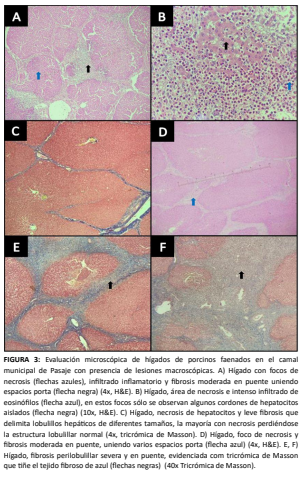
La porcicultura ecuatoriana crece, pero enfrenta desafíos sanitarios. Las lesiones hepáticas porcinas detectadas en mataderos afectan calidad, inocuidad y economía, evidenciando deficiencias de manejo y necesidad de estudios locales específicos. El objetivo de este estudio fue caracterizar las lesiones macroscópicas y microscópicas presentes en hígados de cerdos sacrificados en el centro de faenamiento municipal de Pasaje, Ecuador. Se inspeccionaron 3.200 hígados mediante evaluación post mortem oficial y se seleccionaron 80 (2,5 %) con alteraciones visibles para su análisis histopatológico. Las principales lesiones macroscópicas correspondieron a hepatomegalia, cambios de coloración y adherencias fibrosas; mientras que, a nivel microscópico, se observaron con alta frecuencia necrosis, infiltrado inflamatorio, fibrosis, hiperplasia y congestión, con patrones compatibles con procesos crónicos de daño hepático. La presencia marcada de infiltrado eosinofílico asociado a áreas de necrosis y fibrosis en puente sugiere la participación de etiologías parasitarias, probablemente vinculadas a infecciones por Ascaris suum y al desarrollo de lesiones tipo “manchas de leche”, descritas como una causa relevante de decomiso hepático. Estos hallazgos confirman que, aun con baja frecuencia relativa, las lesiones hepáticas representan una vía sensible de detección de problemas sanitarios en las granjas de origen y una fuente de pérdidas económicas, resaltando el papel de la inspección post mortem como herramienta de vigilancia epidemiológica y la necesidad de fortalecer los programas de control parasitario, bioseguridad y buenas prácticas de manejo en la producción porcina de la región.
Descargas
Citas
Acosta A, Cespedes-Cardenas N, Imbacuan C, Lentz HHK, Dietze K, Amaku M, Burbano A, Gonçalves VSP, Ferreira F. Modelling control strategies against classical swine fever: Influence of traders and markets using static and temporal networks in Ecuador. Prev. Vet. Med. [Internet]. 2022; 205:105683. doi: https://doi.org/qz9j DOI: https://doi.org/10.1016/j.prevetmed.2022.105683
Čobanović N, Janković L, Vasilev D, Dimitrijević M, Teodorović V, Kureljušić B, Karabasil N. Slaughterline records of various postmortem pathological lesions and their influence on carcass and meat quality in slaughtered pigs. Anim. Sci. J. [Internet]. 2019; 90(11):1475-1483. doi: https://doi.org/qz9k DOI: https://doi.org/10.1111/asj.13287
Jacobs P, Berends B, Lipman L. The value of current Ante Mortem meat inspection and food chain information of dairy cows in relation to Post Mortem findings and the protection of public health: A case for a more risk-based meat inspection. Foods. [Internet]. 2023; 12(3):616. doi: https://doi.org/qz9m DOI: https://doi.org/10.3390/foods12030616
Comin A, Jonasson A, Rockström U, Kautto AH, Keeling L, Nyman A-K, Lindberg A, Frössling J. Can we use meat inspection data for animal health and welfare surveillance? Front. Vet. Sci. [Internet]. 2023; 10:1129891. doi: https://doi.org/gstnbp DOI: https://doi.org/10.3389/fvets.2023.1129891
García-Díez J, Saraiva S, Moura D, Grispoldi L, Cenci-Goga BT, Saraiva C. The importance of the slaughterhouse in surveilling animals and public health: A systematic review. Vet. Sci. [Internet]. 2023; 10(2):167. doi: https://doi.org/qz9n DOI: https://doi.org/10.3390/vetsci10020167
Allievi C, Lana E, Rizzi R, Zanon A, Mortarino M, Manfredi MT. Abattoir monitoring of liver lesions caused by Ascaris suum larvae: A longitudinal study conducted in northern Italy. Prev. Vet. Med. [Internet]. 2025; 241:106553. doi: https://doi.org/qz9p DOI: https://doi.org/10.1016/j.prevetmed.2025.106553
Baquerre C, Montillet G, Pain B. Liver organoids in domestic animals: An expected promise for metabolic studies. Vet. Res. [Internet]. 2021; 52:47. doi: https://doi.org/grprdk DOI: https://doi.org/10.1186/s13567-021-00916-y
Valkova L, Voslarova E, Nincakova S, Passantino A, Vecerek V. The incidence of liver damage found during postmortem examination at the slaughterhouse. Animals. [Internet]. 2023; 13(5):839. doi: https://doi.org/qz9q DOI: https://doi.org/10.3390/ani13050839
Malhi H, Guicciardi ME, Gores GJ. Hepatocyte death: A clear and present danger. Physiol. Rev. [Internet]. 2010; 90(3):1165–1194. doi: https://doi.org/fqf3fh DOI: https://doi.org/10.1152/physrev.00061.2009
Olariu-Jurca A, Ilie MS, Lazău A, Ciulan V, Teslici LE, Avram E, Olariu-Jurca I. Morphopathological quantification of hepatopathies in necropsied swine. Agric. Agric. Sci. Procedia. [Internet]. 2015; 6:370–377. doi: https://doi.org/qz9r
Rosell C, Segalés J, Domingo M. Hepatitis and staging of hepatic damage in pigs naturally infected with porcine circovirus type 2. Vet. Pathol. [Internet]. 2000; 37(6):687–692. doi: https://doi.org/fmkwz5 DOI: https://doi.org/10.1354/vp.37-6-687
Vecerek V, Voslarova E, Semerad Z, Passantino A. The health and welfare of pigs from the perspective of post mortem findings in slaughterhouses. Animals. [Internet]. 2020; 10(5):825. doi: https://doi.org/g6xgmg DOI: https://doi.org/10.3390/ani10050825
Vitali M, Luppi A, Bonilauri P, Spinelli E, Santacroce E, Trevisi P. Benchmarking of anatomopathological lesions assessed at slaughter and their association with tail lesions and carcass traits in heavy pigs. Ital. J. Anim. Sci. [Internet]. 2021; 20(1):1103–1113. doi: https://doi.org/qz9s DOI: https://doi.org/10.1080/1828051X.2021.1944339
Ciui S, Morar A, Herman V, Tîrziu E, Imre M, Ban-Cucerzan A, Popa SA, Pătrînjan R-T, Morar D, Imre K. Causes of condemnations of edible parts of slaughtered pigs in Bavaria and their economic implications: A retrospective survey (2021–2022). Vet. Sci. [Internet]. 2025; 12(2):88. doi: https://doi.org/qz9t DOI: https://doi.org/10.3390/vetsci12020088
Olariu-Jurca A, Ilie MS, Lazău A, Ciulan V, Teslici LE, Avram E, Olariu-Jurca I. Morphopathological quantification of hepatopathies in necropsied swine. Agric. Agric. Sci. Procedia. [Internet]. 2015; 6:370–377. doi: https://doi.org/qz9r DOI: https://doi.org/10.1016/j.aaspro.2015.08.098
Zumbado L, de Oliveira JB, Chacón F, Hernández J, Quirós L, Murillo J. Identificación de parásitos gastrointestinales en granjas porcinas y pérdidas económicas por decomiso de hígados parasitados por Ascaris suum en mataderos de Costa Rica. Cienc. Vet. [Internet]. 2009; 27(1):7–21. Disponible en: https://goo.su/OEaLCe
Sánchez P, Pallarés FJ, Gómez MA, Bernabé A, Gómez S, Seva J. Importance of the knowledge of pathological processes for risk-based inspection in pig slaughterhouses (Study of 2002–2016). Asian-Australas. J. Anim. Sci. [Internet]. 2018; 31(11):1818–1827. doi: https://doi.org/gfh4wb DOI: https://doi.org/10.5713/ajas.18.0070
Liangpunsakul S, Chalasani N. Lipid mediators of liver injury in nonalcoholic fatty liver disease. Am. J. Physiol. Gastrointest. Liver Physiol. [Internet]. 2018; 316(1):G75–G81. doi: https://doi.org/gqjt6m DOI: https://doi.org/10.1152/ajpgi.00170.2018
Liang T, Alloosh M, Bell LN, Fullenkamp A, Saxena R, Van Alstine W, Bybee P, Werling K, Sturek M, Chalasani N, Masuoka HC. Liver injury and fibrosis induced by dietary challenge in the Ossabaw miniature swine. PLoS One. [Internet]. 2015; 10(5):e0124173. doi: https://doi.org/f7mnr5 DOI: https://doi.org/10.1371/journal.pone.0124173
Pedersen HD, Galsgaard ED, Christoffersen BØ, Cirera S, Holst D, Fredholm M, Latta M. NASH-inducing diets in Göttingen minipigs. J. Clin. Exp. Hepatol. [Internet]. 2020; 10(3):211–221. doi: https://doi.org/q2gb DOI: https://doi.org/10.1016/j.jceh.2019.09.004
Alizadeh A, Braber S, Akbari P, Garssen J, Fink-Gremmels J. Deoxynivalenol impairs weight gain and affects markers of gut health after low-dose, short-term exposure of growing pigs. Toxins. [Internet]. 2015; 7(6):2071-2095. doi: https://doi.org/f7pxv9 DOI: https://doi.org/10.3390/toxins7062071
Xue X, Wu P, Fan S, Yin Z, Zhang X. Proteomic analysis of liver injury induced by deoxynivalenol in piglets. Biology. [Internet]. 2025; 14(12):1721. doi: https://doi.org/q2gc DOI: https://doi.org/10.3390/biology14121721
Jeong JY, Kim J, Kim M, Park S. Efficacy of high-dose synbiotic additives for deoxynivalenol detoxification: Effects on blood biochemistry, histology, and intestinal microbiome in weaned piglets. Biology. [Internet]. 2024; 13(11):889. doi: https://doi.org/q2gd DOI: https://doi.org/10.3390/biology13110889
Mendes ÂJ, Ribeiro AI, Severo M, Niza-Ribeiro J. A multilevel study of the environmental determinants of swine ascariasis in England. Prev. Vet. Med. [Internet]. 2017; 148:10–20. doi: https://doi.org/q2gf DOI: https://doi.org/10.1016/j.prevetmed.2017.09.012
Fausto MC, Oliveira IC, Fausto GC, de Carvalho LM, Valente FL, Campos AK, de Araújo JV. Ascaris suum in pigs of the Zona da Mata, Minas Gerais State, Brazil. Rev. Bras. Parasitol. Vet. [Internet]. 2015; 24(3):375-378. doi: https://doi.org/q2gk DOI: https://doi.org/10.1590/S1984-29612015047
Wagner B, Polley L. Ascaris suum: Seasonal egg development rates in a Saskatchewan pig barn. Vet. Parasitol. [Internet]. 1999; 85(1):71–78. doi: https://doi.org/d7cgnj DOI: https://doi.org/10.1016/S0304-4017(99)00102-8
Knecht D, Popiołek M, Zaleśny G. Does meatiness of pigs depend on the level of gastro-intestinal parasites infection? Prev. Vet. Med. [Internet]. 2011; 99(2–4):234–239. doi: https://doi.org/bp4q6n DOI: https://doi.org/10.1016/j.prevetmed.2011.01.009
Knecht D, Jankowska A, Zaleśny G. The impact of gastrointestinal parasites infection on slaughter efficiency in pigs. Vet. Parasitol. [Internet]. 2012; 184(2-4):291–297. doi: https://doi.org/dr6jk9 DOI: https://doi.org/10.1016/j.vetpar.2011.09.006
Šoltésová H, Nagyová V, Tóthová C, Nagy O. Haematological and blood biochemical alterations associated with respiratory disease in calves. Acta Vet. Brno. [Internet]. 2015; 84(3):249–256. doi: https://doi.org/f7xm2q DOI: https://doi.org/10.2754/avb201584030249