Efecto de la expresión del estro y del tratamiento con eCG sobre el desempeño reproductivo en vacas lecheras sometidas a un protocolo de Progesterona más Ovsynch
Resumen
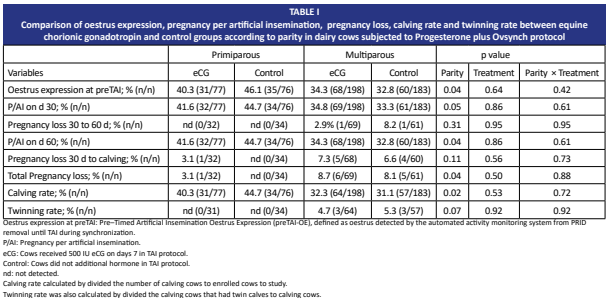
Los objetivos de este estudio fueron evaluar los efectos de la gonadotropina coriónica equina sobre la expresión del estro y la fertilidad en vacas lecheras sometidas a un protocolo de inseminación artificial a tiempo fijo. Vacas Holstein (n = 534) fueron sometidas a un protocolo Ovsynch de 7 días basado en progesterona. El grupo gonadotropina coriónica equina recibió 500 UI de gonadotropina coriónica equina al momento de retirar el dispositivo de progesterona, mientras que el grupo control no recibió tratamiento adicional. La expresión del estro se monitoreó mediante un sistema electrónico de actividad montado en el cuello y se registró durante el periodo de espera voluntario (periodo de espera voluntario-expresión del estro) y durante la sincronización antes de la inseminación artificial a tiempo fijo (Pre-inseminación artificial a tiempo fijo-expresión del estro). La tasa global de expresión del estro Pre-inseminación artificial a tiempo fijo-expresión del estro durante la sincronización fue del 36,3 %. La administración de gonadotropina coriónica equina no influyó (P > 0,05) en la expresión del estro Pre-inseminación artificial a tiempo fijo-expresión del estro ni en la preñez por inseminación artificial al día 30. Asimismo, la pérdida de gestación, la tasa de parto y la tasa de gemelaridad no difirieron entre los grupos gonadotropina coriónica equina y control (P > 0,05). Durante el periodo de espera voluntario, el 59,0 % de las vacas expresó estro. La preñez por inseminación artificial fue mayor en las vacas positivas a periodo de espera voluntario-expresión del estro en comparación con las vacas negativas a periodo de espera voluntario-expresión del estro (41,3 vs. 32,4 %; P = 0,04), independientemente del grupo de tratamiento. Sin embargo, no se observaron diferencias significativas en la expresión del estro Preinseminación artificial a tiempo fijo-expresión del estro entre los grupos gonadotropina coriónica equina y control tanto en vacas periodo de espera voluntario-expresión del estro negativas (P = 0,33) como en vacas periodo de espera voluntario-expresión del estro positivas (P = 0,91). De manera similar, el tratamiento con gonadotropina coriónica equina no afectó la preñez por inseminación artificial ni en vacas periodo de espera voluntario-expresión del estro negativas (P = 0,39) ni en vacas periodo de espera voluntario- expresión del estro positivas (P = 0,69). En conclusión, la expresión del estro durante el periodo de espera voluntario (periodo de espera voluntario-expresión del estro) y antes de la inseminación artificial a tiempo fijo (Pre-inseminación artificial a tiempo fijo-expresión del estro) se asoció fuertemente con una mayor fertilidad. Sin embargo, la gonadotropina coriónica equina no mejoró los resultados reproductivos en hatos lecheros de alta producción que utilizan semen sexado dentro de un protocolo de sincronización optimizado, independientemente de la paridad o del estatus cíclico.
Descargas
Citas
Bruinjé TC, Morrison EI, Ribeiro ES, Renaud DL, Couto- Serrenho R, LeBlanc SJ. Postpartum health is associated with detection of estrus by activity monitors and reproductive performance in dairy cows. J. Dairy Sci. [Internet]. 2023; 106(12):9451–9473. doi: https://doi.org/qqzs DOI: https://doi.org/10.3168/jds.2023-23268
Rial C, Giordano JO. Combining reproductive outcomes predictors and automated estrus alerts recorded during the voluntary waiting period identified subgroups of cows with different reproductive performance potential. J. Dairy Sci. [Internet]. 2024; 107(9):7299–7316. doi: https://doi.org/qqzt DOI: https://doi.org/10.3168/jds.2023-24309
Bretzinger LF, Tippenhauer CM, Plenio J-L, Heuwieser W, Borchardt S. Effect of transition cow health and estrous expression detected by an automated activity monitoring system within 60 days in milk on reproductive performance of lactating Holstein cows. J. Dairy Sci. [Internet]. 2023; 106(6):4429–4442. doi: https://doi.org/qqzv DOI: https://doi.org/10.3168/jds.2022-22616
Laplacette AL, Rial C, Sitko E, Perez MM, Tompkins S, Stangaferro ML, Thomas MJ, Giordano JO. Delaying induction of ovulation and timed artificial insemination in a double-ovsynch protocol increased expression of estrus and altered first-service reproductive outcomes of lactating dairy cows. J. Dairy Sci. [Internet]. 2025; 108(1):1103–1124. doi: https://doi.org/qqzw DOI: https://doi.org/10.3168/jds.2024-24994
Bisinotto RS, Lean IJ, Thatcher WW, Santos JEP. Meta- analysis of progesterone supplementation during timed artificial insemination programs in dairy cows. J. Dairy Sci. [Internet]. 2015; 98(4):2472–2487. doi: https://doi.org/f66jth DOI: https://doi.org/10.3168/jds.2014-8954
Consentini CEC, Melo LF, Abadia T, Gonzales B, Motta JCL, Alves RLOR, Silva LO, Wiltbank MC, Sartori R. Comparison of gonadotropin-releasing hormone and estradiol benzoate plus gonadotropin-releasing hormone to initiate a progesterone-based timed artificial insemination resynchronization protocol in lactating dairy cows. J. Dairy Sci. [Internet]. 2024; 107(7):5122–5131. doi: https://doi.org/qqzx DOI: https://doi.org/10.3168/jds.2023-23923
Guner B, Erturk M, Dursun M, Ozturk B, Yilmazbas- Mecitoglu G, Keskin A, Dikmen S, Gumen A. Effect of oestrous expression prior to timed artificial insemination with sexed semen on pregnancy rate in dairy cows. Reprod. Domest. Anim. [Internet]. 2023; 58(2):342–348. doi: https://doi.org/grc5w3 DOI: https://doi.org/10.1111/rda.14293
Pereira MHC, Wiltbank MC, Vasconcelos JLM. Expression of estrus improves fertility and decreases pregnancy losses in lactating dairy cows that receive artificial insemination or embryo transfer. J. Dairy Sci. [Internet]. 2016; 99(3):2237–2247. doi: https://doi.org/f8bg66 DOI: https://doi.org/10.3168/jds.2015-9903
Tschopp JC, Bó GA. Success of artificial insemination based on expression of estrus and the addition of GnRH to an estradiol/progesterone-based protocol on pregnancy rates in lactating dairy cows. Anim. Reprod. Sci. [Internet]. 2022; 238:106954. doi: https://doi.org/qqzz DOI: https://doi.org/10.1016/j.anireprosci.2022.106954
Souza AH, Gümen A, Silva EPB, Cunha AP, Guenther JN, Peto CM, Caraviello DZ, Wiltbank MC. Supplementation with estradiol-17β before the last gonadotropin-releasing hormone ınjection of the ovsynch protocol in lactating dairy cows. J. Dairy Sci. [Internet]. 2007; 90(10):4623– 4634. doi: https://doi.org/fnkcrj DOI: https://doi.org/10.3168/jds.2007-0172
Wiltbank M, Lopez H, Sartori R, Sangsritavong S, Gümen A. Changes in reproductive physiology of lactating dairy cows due to elevated steroid metabolism. Theriogenology. [Internet]. 2006; 65(1):17–29. doi: https://doi.org/d62shc DOI: https://doi.org/10.1016/j.theriogenology.2005.10.003
Bridges GA, Mussard ML, Pate JL, Ott TL, Hansen TR, Day ML. Impact of preovulatory estradiol concentrations on conceptus development and uterine gene expression. Anim. Reprod. Sci. [Internet]. 2012; 133(1-2):16–26. doi: https://doi.org/f342hp DOI: https://doi.org/10.1016/j.anireprosci.2012.06.013
de la Mata JJ, Núñez-Olivera R, Cuadro F, Bosolasco D, de Brun V, Meikle A, Bo GA, Menchaca A. Effects of extending the length of pro-oestrus in an oestradiol- and progesterone-based oestrus synchronisation program on ovarian function, uterine environment and pregnancy establishment in beef heifers. Reprod. Fertil. Dev. [Internet]. 2018; 30(11):1541-1552. doi: https://doi.org/gffpr8 DOI: https://doi.org/10.1071/RD17473
Jinks EM, Smith MF, Atkins JA, Pohler KG, Perry GA, MacNeil MD, Roberts AJ, Waterman RC, Alexander LJ, Geary TW. Preovulatory estradiol and the establishment and maintenance of pregnancy in suckled beef cows. J. Anim. Sci. [Internet]. 2013; 91(3):1176–1185. doi: https://doi.org/f4zm5f DOI: https://doi.org/10.2527/jas.2012-5611
Brusveen DJ, Souza AH, Wiltbank MC. Effects of additional prostaglandin F2α and estradiol-17β during ovsynch in lactating dairy cows. J. Dairy Sci. [Internet]. 2009; 92(4):1412–1422. doi: https://doi.org/cz6w6r DOI: https://doi.org/10.3168/jds.2008-1289
Cerri RLA, Santos JEP, Juchem SO, Galvão KN, Chebel RC. Timed artificial insemination with estradiol cypionate or insemination at estrus in high-producing dairy cows. J. Dairy Sci. [Internet]. 2004; 87(11):3704–3715. doi: https://doi.org/dfwcs4 DOI: https://doi.org/10.3168/jds.S0022-0302(04)73509-2
Pancarci SM, Jordan ER, Risco CA, Schouten MJ, Lopes FL, Moreira F, Thatcher WW. Use of estradiol cypionate in a presynchronized timed artificial insemination program for lactating dairy cattle. J. Dairy Sci. [Internet]. 2002; 85(1):122–131. doi: https://doi.org/dqpfgj DOI: https://doi.org/10.3168/jds.S0022-0302(02)74060-5
Lane EA, Austin EJ, Crowe MA. Oestrous synchronisation in cattle—Current options following the EU regulations restricting use of oestrogenic compounds in food- producing animals: A review. Anim. Reprod. Sci. [Internet]. 2008; 109(1-4):1–16. doi: https://doi.org/cq4fhs DOI: https://doi.org/10.1016/j.anireprosci.2008.08.009
Murphy BD, Martınuk SD. Equine chorionic gonadotropin. Endocr. Rev. [Internet]. 1991; 12(1):27–44. doi: https://doi.org/b29h8n DOI: https://doi.org/10.1210/edrv-12-1-27
Kenyon AG, Lopes G, Mendonça LGD, Lima JR, Bruno RGS, Denicol AC, Chebel RC. Ovarian responses and embryo survival in recipient lactating holstein cows treated with equine chorionic gonadotropin. Theriogenology. [Internet]. 2012; 77(2):400–411. doi: https://doi.org/b9rbcq DOI: https://doi.org/10.1016/j.theriogenology.2011.08.014
Beasley L, Cogger N, Compton C. Use of equine chorionic gonadotropin in lactating dairy cattle: a rapid review. N. Z. Vet. J. [Internet]. 2023; 71(2):53–64. doi: https://doi.org/g7jtp7 DOI: https://doi.org/10.1080/00480169.2022.2139306
De Rensis F, López-Gatius F. Use of equine chorionic gonadotropin to control reproduction of the dairy cow: A Review. Reprod. Domest. Anim. [Internet]. 2014; 49(2):177–182. doi: https://doi.org/f5vgtv DOI: https://doi.org/10.1111/rda.12268
Núñez-Olivera R, de Castro T, García-Pintos C, Bó G, Piaggio J, Menchaca A. Ovulatory response and luteal function after eCG administration at the end of a progesterone and estradiol’ based treatment in postpartum anestrous beef cattle. Anim. Reprod. Sci. [Internet]. 2014; 146(3- 4):111–116. doi: https://doi.org/f5463f DOI: https://doi.org/10.1016/j.anireprosci.2014.02.017
Núñez-Olivera R, Cuadro F, Bosolasco D, de Brun V, de la Mata J, Brochado C, Meikle A. Bo GA, Menchaca A. Effect of equine chorionic gonadotropin (eCG) administration and proestrus length on ovarian response, uterine functionality and pregnancy rate in beef heifers inseminated at a fixed-time. Theriogenology. [Internet]. 2020; 151:16–27. doi: https://doi.org/qqz2 DOI: https://doi.org/10.1016/j.theriogenology.2020.03.031
Sales JNS, Crepaldi GA, Girotto RW, Souza AH, Baruselli PS. Fixed-time AI protocols replacing eCG with a single dose of FSH were less effective in stimulating follicular growth, ovulation, and fertility in suckled-anestrus Nelore beef cows. Anim. Reprod. Sci. [Internet]. 2011; 124(1-2):12–18. doi: https://doi.org/fngbk6 DOI: https://doi.org/10.1016/j.anireprosci.2011.02.007
Sales JNS, Bottino MP, Silva LACL, Girotto RW, Massoneto JPM, Souza JC, Baruselli PS. Effects of eCG are more pronounced in primiparous than multiparous Bos indicus cows submitted to a timed artificial insemination protocol. Theriogenology. [Internet]. 2016; 86(9):2290–2295. doi: https://doi.org/f89hq9 DOI: https://doi.org/10.1016/j.theriogenology.2016.07.023
Bryan MA, Bó GA, Heuer C, Emslie FR. Use of equine chorionic gonadotrophin in synchronised AI of seasonal- breeding, pasture-based, anoestrous dairy cattle. Reprod. Fertil. Dev. [Internet]. 2010; 22(1):126-131. doi: https://doi.org/fwh47n DOI: https://doi.org/10.1071/RD09225
Bryan MA, Bó G, Mapletoft RJ, Emslie FR. The use of equine chorionic gonadotropin in the treatment of anestrous dairy cows in gonadotropin-releasing hormone/progesterone protocols of 6 or 7 days. J. Dairy Sci. [Internet]. 2013; 96(1):122–131. doi: https://doi.org/f4h2vb DOI: https://doi.org/10.3168/jds.2012-5452
Garcia-Ispierto I, López-Helguera I, Martino A, López- Gatius F. Reproductive performance of anoestrous high-producing dairy cows improved by adding equine chorionic gonadotrophin to a progesterone-based oestrous synchronizing protocol. Reprod. Domest. Anim. [Internet]. 2012; 47(5):752–758. doi: https://doi.org/bt2fcq DOI: https://doi.org/10.1111/j.1439-0531.2011.01954.x
Garcia-Ispierto I, Roselló MA, De Rensis F, López-Gatius F. A Five-day progesterone plus eCG-based fixed-time AI protocol improves fertility over spontaneous estrus in high-producing dairy cows under heat stress. J. Reprod. Dev. [Internet]. 2013; 59(6):544–548. doi: https://doi.org/f5k38v DOI: https://doi.org/10.1262/jrd.2013-041
López-Gatius F, López-Helguera I, De Rensis F, Garcia- Ispierto I. Effects of different five-day progesterone- based synchronization protocols on the estrous response and follicular/luteal dynamics in dairy cows. J. Reprod. Dev. [Internet]. 2015; 61(5):465–471. doi: https://doi.org/f7vt4v DOI: https://doi.org/10.1262/jrd.2015-053
Randi F, Sánchez JM, Herlihy MM, Valenza A, Kenny DA, Butler ST, Lonergan P. Effect of equine chorionic gonadotropin treatment during a progesterone-based timed artificial insemination program on reproductive performance in seasonal-calving lactating dairy cows. J. Dairy Sci. [Internet]. 2018; 101(11):10526–10535. doi: https://doi.org/qqz3 DOI: https://doi.org/10.3168/jds.2018-14495
Sampaio PC, Alves NG, Souza JC, Sales JNS, Carvalho RJ, Lima RR, Teixeira AA. Nogueira GP. Ascari IJ. Comparative efficacy of exogenous eCG and progesterone on endogenous progesterone and pregnancy in Holstein cows submitted to timed artificial insemination. Anim. Reprod. Sci. [Internet]. 2015; 162:88–94. doi: https://doi.org/f7x225 DOI: https://doi.org/10.1016/j.anireprosci.2015.09.014
Souza AH, Viechnieski S, Lima FA, Silva FF, Araújo R, Bó GA, Wiltbank MC, Baruselli PS. Effects of equine chorionic gonadotropin and type of ovulatory stimulus in a timed-AI protocol on reproductive responses in dairy cows. Theriogenology. [Internet]. 2009; 72(1):10–21. doi: https://doi.org/cz47md DOI: https://doi.org/10.1016/j.theriogenology.2008.12.025
NRC. Nutrient requirements of dairy cattle. 7th ed. Washington, DC: The National Academies Press; 2001.
Guner B, Erturk M, Yilmazbas-Mecitoglu G, Keskin A, Karakaya-Bilen E, Cakircali R, Serim E, Orman A. Gumen A. Effect of delaying the time of insemination with sex- sorted semen on pregnancy rate in Holstein heifers. Reprod. Domest. Anim. [Internet]. 2020; 55(10):1411–1417. doi: https://doi.org/g6kjzq DOI: https://doi.org/10.1111/rda.13789
Jobst SM, Nebel RL, McGilliard ML, Pelzer KD. Evaluation of reproductive performance in lactating dairy cows with prostaglandin F2alpha, gonadotropin-releasing hormone, and timed artificial insemination. J. Dairy Sci. [Internet]. 2000; 83(10):2366–2372. doi: https://doi.org/bjtx9t DOI: https://doi.org/10.3168/jds.S0022-0302(00)75125-3
Perry GA, Smith MF, Lucy MC, Green JA, Parks TE, MacNeil MD, Roberts AJ, Geary TW. Relationship between follicle size at insemination and pregnancy success. Proc. Natl. Acad. Sci. U.S.A. [Internet]. 2005; 102(14):5268–5273. doi: https://doi.org/fxckb2 DOI: https://doi.org/10.1073/pnas.0501700102
Lauber MR, Fricke PM. Effect of postpartum body condition score change on the pregnancy outcomes of lactating Jersey cows inseminated at first service with sexed Jersey or conventional beef semen after a synchronized estrus versus a synchronized ovulation. J. Dairy Sci. [Internet]. 2024; 107(4):2524–2542. doi: https://doi.org/g95qdr DOI: https://doi.org/10.3168/jds.2023-23892
Tippenhauer CM, Plenio J-L, Heuwieser W, Borchardt S. Association of activity and subsequent fertility of dairy cows after spontaneous estrus or timed artificial insemination. J. Dairy Sci. [Internet]. 2023; 106(6):4291–4305. doi: https://doi.org/qqz6 DOI: https://doi.org/10.3168/jds.2022-22057
Borchardt S, Tippenhauer CM, Plenio J-L, Bartel A, Madureira AML, Cerri RLA, Heuwieser W. Association of estrous expression detected by an automated activity monitoring system within 40 days in milk and reproductive performance of lactating Holstein cows. J. Dairy Sci. [Internet]. 2021; 104(8):9195–9204. doi: https://doi.org/qqz7 DOI: https://doi.org/10.3168/jds.2020-19705
Pursley JR, Mee MO, Wiltbank MC. Synchronization of ovulation in dairy cows using PGF2α and GnRH. Theriogenology. [Internet]. 1995; 44(7):915–923. doi: https://doi.org/cs8qmm DOI: https://doi.org/10.1016/0093-691X(95)00279-H
Pulley SL, Wallace LD, Mellieon HI, Stevenson JS. Ovarian characteristics, serum concentrations of progesterone and estradiol, and fertility in lactating dairy cows in response to equine chorionic gonadotropin. Theriogenology. [Internet]. 2013; 79(1):127–134. doi: https://doi.org/f4h6qz DOI: https://doi.org/10.1016/j.theriogenology.2012.09.017
Alvarez RH, Pugliesi G, Nogueira-Natal FL, Rocha CC, Ataide-Júnior GA, Ferreira-Melo AJ, Otzuk IP, de Oliveira CA, Humblot P. Reproductive performance of Bos indicus beef cows treated with different doses of equine chorionic gonadotropin at the end of a progesterone-estrogen based protocol for fixed-time artificial insemination. Theriogenology. [Internet]. 2018; 118:150–156. doi: https://doi.org/gd7t9n DOI: https://doi.org/10.1016/j.theriogenology.2018.06.003
Pessoa GA, Martini AP, Carloto GW, Rodrigues MCC, Claro-Júnior I, Baruselli PS, Brauner CC, Rubin MIB, Correa MB, Leivas FG, Sa-Filho MH. Different doses of equine chorionic gonadotropin on ovarian follicular growth and pregnancy rate of suckled Bos taurus beef cows subjected to timed artificial insemination protocol. Theriogenology. [Internet]. 2016; 85(5):792–799. doi: https://doi.org/f8bbmd DOI: https://doi.org/10.1016/j.theriogenology.2015.09.057
Sá-Filho OG, Dias CC, Lamb GC, Vasconcelos JLM. Progesterone-based estrous synchronization protocols in non-suckled and suckled primiparous Bos indicus beef cows. Anim. Reprod. Sci. [Internet]. 2010; 119(1-2):9–16. doi: https://doi.org/c8fsc9 DOI: https://doi.org/10.1016/j.anireprosci.2009.12.011
Wiltbank MC, Gümen A, Sartori R. Physiological classification of anovulatory conditions in cattle. Theriogenology. [Internet]. 2002; 57(1):21–52. doi: https://doi.org/dmz4z4 DOI: https://doi.org/10.1016/S0093-691X(01)00656-2
Garcia-Ispierto I, López-Gatius F. Effects of different five-day progesterone-based fixed-time AI protocols on follicular/luteal dynamics and fertility in dairy cows. J. Reprod. Dev. [Internet]. 2014; 60(6):426–432. doi: https://doi.org/f6wrqh DOI: https://doi.org/10.1262/jrd.2014-063
López-Gatius F, Andreu-Vázquez C, Mur-Novales R, Cabrera VE, Hunter RHF. The dilemma of twin pregnancies in dairy cattle. A review of practical prospects. Livest. Sci. [Internet]. 2017; 197:12–16. doi: https://doi.org/qqz8 DOI: https://doi.org/10.1016/j.livsci.2017.01.001
Andreu-Vázquez C, Garcia-Ispierto I, López-Gatius F. Photoperiod length and the estrus synchronization protocol used before AI affect the twin pregnancy rate in dairy cattle. Theriogenology. [Internet]. 2012; 78(6):1209–1216. doi: https://doi.org/f36vv8 DOI: https://doi.org/10.1016/j.theriogenology.2012.05.014
Andreu-Vázquez C, Garcia-Ispierto I, Ganau S, Fricke PM, López-Gatius F. Effects of twinning on the subsequent reproductive performance and productive lifespan of high-producing dairy cows. Theriogenology. [Internet]. 2012; 78(9):2061–2070. doi: https://doi.org/f4bx2b DOI: https://doi.org/10.1016/j.theriogenology.2012.07.027
Bicalho RC, Cheong SH, Galvão KN, Warnick LD, Guard CL. Effect of twin birth calvings on milk production, reproductive performance, and survival of lactating cows. J. Am. Vet. Med. Assoc. [Internet]. 2007; 231(9):1390– 1397. doi: https://doi.org/b3vbnt DOI: https://doi.org/10.2460/javma.231.9.1390
Echternkamp SE, Gregory KE. Effects of twinning on gestation length, retained placenta, and dystocia. J. Anim. Sci. [Internet]. 1999; 77(1):39-47. doi: https://doi.org/qqz9 DOI: https://doi.org/10.2527/1999.77139x
Prata AB, Pontes GCS, Monteiro PLJ, Drum JN, Wiltbank MC, Sartori R. Equine chorionic gonadotropin increases fertility of grazing dairy cows that receive fixed- time artificial insemination in the early but not later postpartum period. Theriogenology. [Internet]. 2017; 98:36–40. doi: https://doi.org/gbkxf5 DOI: https://doi.org/10.1016/j.theriogenology.2017.04.041
Chebel RC, Veronese A. Associations between genomic merit for daughter pregnancy rate of Holstein cows and metabolites postpartum and estrus characteristics. J. Dairy Sci. [Internet]. 2020; 103(11):10754–10768. doi: https://doi.org/qq2b DOI: https://doi.org/10.3168/jds.2020-18207
Rial C, Laplacette A, Giordano JO. Effect of a targeted reproductive management program designed to prioritize insemination at detected estrus and optimize time to insemination on the reproductive performance of lactating dairy cows. J. Dairy Sci. [Internet]. 2022; 105(10):8411–8425. doi: https://doi.org/gr4khg DOI: https://doi.org/10.3168/jds.2022-22082