Consumer preferences for animal welfare-friendly products in Türkiye: an extended theory of planned behavior approach
Abstract
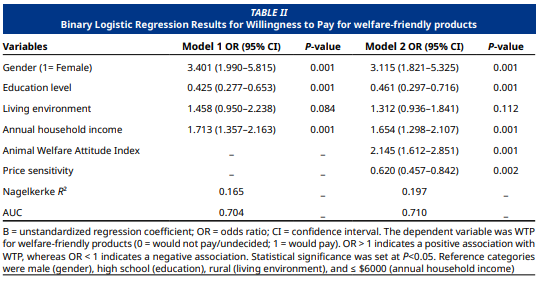
This study aimed to examine the attitudinal, socio-demographic, and economic determinants of consumers’ willingness to pay for animal welfare-friendly products in Türkiye using an extended Theory of Planned Behavior framework. A cross-sectional online survey was conducted in 2022 with 245 consumers residing in Samsun province. Binary logistic regression analysis was employed to evaluate the influence of attitudinal, socio-demographic, and economic variables on stated willingness to pay. The results indicated that pro-welfare attitudes significantly increased the likelihood of premium payment (odds ratio = 2.145, 95% confidence interval: 1.612–2.851, P<0.001), emerging as the strongest predictor in the extended model. Annual household income was positively associated with willingness to pay (odds ratio = 1.713, P = 0.001), whereas price sensitivity significantly reduced premium-paying intention (odds ratio = 0.620, P = 0.002), highlighting the persistence of the attitude-behavior gap. Female consumers were significantly more likely to express willingness to pay compared to male consumers (odds ratio = 3.401, P = 0.001), while higher education level was negatively associated with premium willingness (odds ratio = 0.425, P = 0.001). Among middle and high-income consumers, greater concern for improvements in housing, feeding, transport, slaughter, and farm environmental conditions was associated with increased willingness to pay (odds ratio range: 298–2.342). The extended Theory of Planned Behavior model improved explanatory performance (Nagelkerke R² = 0.197; Area Under the Curve = 0.710), indicating the additional explanatory value of attitudinal and economic variables. The findings demonstrate that welfare-oriented consumption in Türkiye is shaped by the interaction between ethical commitment and economic feasibility. The study provides implications for welfare certification, market segmentation, and evidence-based pricing strategies for welfare-friendly products.
Downloads
References
Broom DM. A history of animal welfare science. Acta Biotheor. [Internet]. 2011; 59(2):121–137. doi: https://doi.org/bgqmv4 DOI: https://doi.org/10.1007/s10441-011-9123-3
Fraser D. Understanding animal welfare. Acta Vet. Scand. [Internet]. 2008; 50(Suppl 1):S1. doi: https://doi.org/cj2bb2 DOI: https://doi.org/10.1186/1751-0147-50-S1-S1
Fraser D, Weary DM, Pajor EA, Milligan BN. A scientific conception of animal welfare that reflects ethical concerns. Anim. Welf. [Internet]. 1997; 6(3):187–205. doi: https://doi.org/rbhm DOI: https://doi.org/10.1017/S0962728600019795
Verbeke WAJ, Viaene J. Ethical challenges for livestock production: Meeting consumer concerns about meat safety and animal welfare. J. Agric. Environ. Ethics [Internet]. 2000; 12(2):141–151. doi: https://doi.org/cmc2v3 DOI: https://doi.org/10.1023/A:1009538613588
Blokhuis HJ, Keeling LJ, Gavinelli A, Serratosa J. Animal welfare’s impact on the food chain. Trends Food Sci. Technol. [Internet]. 2008; 19(1):S79–S87. doi: https://doi.org/c9hskn DOI: https://doi.org/10.1016/j.tifs.2008.09.007
Jiang R, Sharma C, Bryant RH, Mohan MS, Al-Marashdeh O, Harrison R, Torrico DD. Animal welfare information affects consumers’ hedonic and emotional responses towards milk. Food Res. Int. [Internet]. 2021; 141:110006. doi: https://doi.org/rbhn DOI: https://doi.org/10.1016/j.foodres.2020.110006
Ammann J, Mack G, El Benni N, Jin S, Newell-Price P, Tindale S, Hunter E, Vicario-Modroño V, Gallardo-Cobos R, Sánchez-Zamora P, Miškolci S, Frewer LJ. Consumers across five European countries prioritise animal welfare above environmental sustainability when buying meat and dairy products. Food Qual. Prefer. [Internet]. 2024; 117:105179. doi: https://doi.org/gtwth7 DOI: https://doi.org/10.1016/j.foodqual.2024.105179
Gemma P, Nannoni E, Padalino B, Peli A, Alexander FL, Buonaiuto G, Sardi L, Martelli G. Perception and awareness of animal welfare among residents of Malta. Animals [Internet]. 2025; 15(11):1634. doi: https://doi.org/rbhp DOI: https://doi.org/10.3390/ani15111634
María GA. Public perception of farm animal welfare in Spain. Livest. Sci. [Internet]. 2006; 103(3):250–256. doi: https://doi.org/ct2z9x DOI: https://doi.org/10.1016/j.livsci.2006.05.011
European Commission. Special Eurobarometer 442: Attitudes of Europeans towards animal welfare. [Internet]. Brussels (Belgium): European Commission; 2016 [cited 1 Jan 2026]. Available from: https://goo.su/uUlCbC
Grunert KG, Sonntag WI, Glanz-Chanos V, Forum S. Consumer interest in environmental impact, safety, health and animal welfare aspects of modern pig production: Results of a cross-national choice experiment. Meat Sci. [Internet]. 2018; 137:123–129. doi: https://doi.org/gc46pc DOI: https://doi.org/10.1016/j.meatsci.2017.11.022
Harper G. Consumer concerns about animal welfare and the impact on food choice. [Internet]. Proceedings of the dissemination seminar. Reading, United Kingdom: Centre for Food Economics Research, University of Reading. 2001 [cited 1 Jan 2026]. Available in: https://goo.su/ACLi1
Bennett RM, Blaney RJ. Estimating the benefits of farm animal welfare legislation using the contingent valuation method. Agric. Econ. [Internet]. 2003; 29(1):85–98. doi: https://doi.org/dvnqms DOI: https://doi.org/10.1111/j.1574-0862.2003.tb00149.x
McKendree MGS, Croney CC, Widmar NO. Effects of demographic factors and information sources on United States consumer perceptions of animal welfare. J. Anim. Sci. [Internet]. 2014; 92(7):3161–3173. doi: https://doi.org/f588hg DOI: https://doi.org/10.2527/jas.2014-6874
Gorton M, Yeh CH, Chatzopoulou E, White J, Tocco B, Hubbard C, Hallam F. Consumers’ willingness to pay for an animal welfare food label. Ecol. Econ. [Internet]. 2023; 209:107852. doi: https://doi.org/gr8gfv DOI: https://doi.org/10.1016/j.ecolecon.2023.107852
Cao YJ, Cranfield J, Chen C, Widowski T. Heterogeneous informational and attitudinal impacts on consumer preferences for eggs from welfare enhanced cage systems. Food Policy [Internet]. 2021; 99:101979. doi: https://doi.org/g36mm3 DOI: https://doi.org/10.1016/j.foodpol.2020.101979
Denver S, Christensen T, Nordström J, Lund TB, Sandøe P. Is there a potential international market for Danish welfare pork? A consumer survey from Denmark, Sweden, and Germany. Meat Sci. [Internet]. 2022; 183:108616. doi: https://doi.org/gmvfnx DOI: https://doi.org/10.1016/j.meatsci.2021.108616
Alonso ME, González-Montaña JR, Lomillos JM. Consumers’ concerns and perceptions of farm animal welfare. Animals [Internet]. 2020; 10(3):385. doi: https://doi.org/gh5936 DOI: https://doi.org/10.3390/ani10030385
Lagerkvist CJ, Hess S. A meta-analysis of consumer willingness to pay for farm animal welfare. Eur. Rev. Agric. Econ. [Internet]. 2011; 38(1):55–78. doi: https://doi.org/bdsccq DOI: https://doi.org/10.1093/erae/jbq043
Yang W, Renwick A. Consumer willingness to pay price premiums for credence attributes of livestock products: A meta-analysis. J. Agric. Econ. [Internet]. 2019; 70(3):618–639. doi: https://doi.org/rbmq DOI: https://doi.org/10.1111/1477-9552.12323
Clark B, Stewart GB, Panzone LA, Kyriazakis I, Frewer LJ. Citizens, consumers and farm animal welfare: A meta-analysis of willingness-to-pay studies. Food Policy [Internet]. 2017; 68:112–127. doi: https://doi.org/gf9zt3 DOI: https://doi.org/10.1016/j.foodpol.2017.01.006
Miele M, Evans A. When foods become animals: Ruminations on ethics and responsibility in care-full practices of consumption. Ethics Place Environ. [Internet]. 2010; 13(2):171–190. doi: https://doi.org/d6xwwh DOI: https://doi.org/10.1080/13668791003778842
de Jonge J, van Trijp HC. The impact of broiler production system practices on consumer perceptions of animal welfare. Poult. Sci. [Internet]. 2013; 92(12):3080–3095. doi: https://doi.org/rbmr DOI: https://doi.org/10.3382/ps.2013-03334
Olesen I, Alfnes F, Røra MB, Kolstad K. Eliciting consumers’ willingness to pay for organic and welfare-labelled salmon in a non-hypothetical choice experiment. Livest. Sci. [Internet]. 2010; 127(2–3):218–226. doi: https://doi.org/bz6b8b DOI: https://doi.org/10.1016/j.livsci.2009.10.001
Ajzen I. The theory of planned behavior. Organ Behav. Hum. Decis. Process. [Internet]. 1991; 50(2):179–211. doi: https://doi.org/cc3 DOI: https://doi.org/10.1016/0749-5978(91)90020-T
Armitage CJ, Conner M. Efficacy of the theory of planned behaviour: A meta-analytic review. Br. J. Soc. Psychol. [Internet]. 2001; 40(4):471–499. doi: https://doi.org/gbn DOI: https://doi.org/10.1348/014466601164939
Miranda-de la Lama GC, Estévez-Moreno LX, Sepulveda WS, Estrada-Chavero MC, Rayas-Amor AA, Villarroel M, María GA. Mexican consumers’ perceptions and attitudes towards farm animal welfare and willingness to pay for welfare friendly meat products. Meat Sci. [Internet]. 2017; 125:106–113. doi: https://doi.org/gmhgpd DOI: https://doi.org/10.1016/j.meatsci.2016.12.001
Carrington MJ, Neville BA, Whitwell GJ. Why ethical consumers don’t walk their talk: Towards a framework for understanding the gap between the ethical purchase intentions and actual buying behaviour of ethically minded consumers. J. Bus. Ethics. [Internet]. 2010; 97(1):139–158. doi: https://doi.org/b4npn7 DOI: https://doi.org/10.1007/s10551-010-0501-6
Vanhonacker F, Verbeke W, Van Poucke E, Tuyttens FAM. Do citizens and farmers interpret the concept of farm animal welfare differently? Livest. Sci. [Internet]. 2008; 116(1–3):126–136. doi: https://doi.org/dc24sv DOI: https://doi.org/10.1016/j.livsci.2007.09.017
Tüfenk ÖG, Bozkurt Z. Consumer attitudes towards animal welfare and its relation to demographic and socio-economic factors. J. Bahri Dağdaş Anim. Res. [Internet]. 2022 [cited 12 Jan 2026]; 11(2):74–87. doi: Available in: https://goo.su/AElwbu
Sweeney S, Regan Á, McKernan C, Benson T, Hanlon A, Dean M. Current consumer perceptions of animal welfare across different farming sectors on the island of Ireland. Animals [Internet]. 2022; 12(2):185. doi: https://doi.org/rbms DOI: https://doi.org/10.3390/ani12020185
Napolitano F, Girolami A, Braghieri A. Consumer liking and willingness to pay for high welfare animal-based products. Trends Food Sci. Technol. [Internet]. 2010; 21(11):537–543. doi: https://doi.org/djg6qm DOI: https://doi.org/10.1016/j.tifs.2010.07.012
Henchion MM, De Backer CJ, Hudders L, O’Reilly S. Ethical and sustainable aspects of meat production; consumer perceptions and system credibility. In: Toldrá F, editor. New aspects of meat quality [Internet]. Cambridge (UK): Woodhead Publishing. 2022. p. 829–851. doi: https://doi.org/rbmt DOI: https://doi.org/10.1016/B978-0-323-85879-3.00001-5
Çavuş–Alan S, Alan S. Consumers and future veterinarians: Attitudes of veterinary students toward welfare-friendly meat products and labelling in Türkiye. Rev. Cient. FCV-LUZ. [Internet]. 2025; 36(1):e361775. doi: https://doi.org/rbv DOI: https://doi.org/10.52973/rcfcv-e361775