Quinoa ameliorates renal endoplasmic reticulum stress in Glucocorticoid- induced insulin resistant rats
Abstract
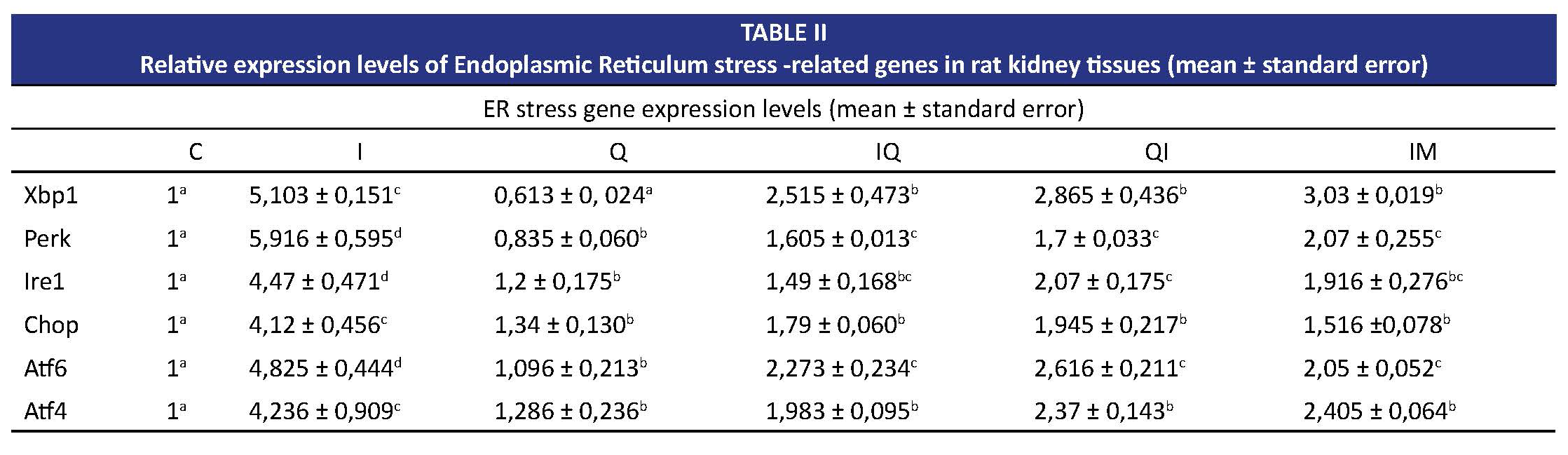
The objective of this study was to investigate the efficacy of quinoa (Chenopodium quinoa) on endoplasmic reticulum stress responses in the kidneys of rats with dexamethasone- induced insulin resistance. In this study, 42 male rats were selected as the subjects for the investigation. These rats were randomly allocated to six groups: a healthy control group, a control group fed with quinoa, an IR group, and three treatment groups that received metformin, quinoa, or quinoa prior to the induction of insulin resistance. Subsequently, the values of fasting glucose, serum insulin, and Homeostatic Model Assessment of Insulin Resistance were recorded. An additional six endoplasmic reticulum stress-related genes (Xbp1, Perk, Ire1, Chop, Atf6, and Atf4) were then quantified. The investigation revealed the presence of rats exhibiting extreme metabolic dysfunction under dexamethasone, and a significant elevation in Homeostatic Model Assessment of Insulin Resistance was observed in the insulin resistance group (7.11 ± 1.12) compared to the control group (2.88 ± 0.13). This metabolic stress was, in turn, correlated with the renal endoplasmic reticulum stress pathway, with all six genes significantly upregulated (Chop: 4.12-fold, and Perk: 5.916- fold). The addition of quinoa resulted in a significant reduction in metabolic molecular dysfunctions. In the insulin resistance + Quinoa group, the Homeostatic Model Assessment of Insulin Resistance was found to be significantly lower (6.33 ± 1.04, P < 0.05), and the pro-apoptotic Chop gene expression in this group of rats was found to be significantly decreased by 59 % (from 4.12-fold to 1.79-fold). The effect of quinoa on Homeostatic Model Assessment of Insulin Resistance and endoplasmic reticulum stress gene expression is comparable to that of metformin. This suggests that the consumption of quinoa may help to counteract the molecular alterations and metabolic disturbances associated with the endoplasmic reticulum stress caused by glucocorticoid-induced insulin resistance. Consequently, quinoa could be a useful dietary addition in cases of insulin resistance-related renal complications.
Downloads
References
Jang KW, Hur J, Lee DW, Kim SR. Metabolic Syndrome, Kidney-Related Adiposity, and Kidney Microcirculation: Unraveling the Damage. Biomedicines. [Internet]. 2024; 12(12):2706. doi: https://doi.org/g9x7xm
Li JX, Cummins CL. Fresh insights into glucocorticoid- induced diabetes mellitus and new therapeutic directions. Nat. Rev. Endocrinol. [Internet]. 2022; 18(9):540-557. doi: https://doi.org/grrwmx
Byun JH, Lebeau PF, Trink J, Uppal N, Lanktree MB, Krepinsky JC, Austin RC. Endoplasmic reticulum stress as a driver and therapeutic target for kidney disease. Nat. Rev. Nephrol. [Internet]. 2025; 21:299–313 doi: https://doi.org/q8hp
He Z, Liu Q, Wang Y, Zhao B, Zhang L, Yang X, Wang Z. The role of endoplasmic reticulum stress in type II diabetes mellitus mechanisms and impact on islet function. PeerJ. [Internet]. 2025; 28;13:e19192. doi: https://doi.org/hbxtkp
Minchenko DO, Khita OO, Viletska YM, Sliusar MY, Rudnytska OV, Kozynkevych HE, Bezrodnyi BH, Khikhlo YP, Minchenko OH. Cortisol controls endoplasmic reticulum stress and hypoxia dependent regulation of insulin receptor and related genes expression in HEK293 cells. Endocr. Regul. [Internet]. 2024; 58(1):1-10. doi: https://doi.org/q8hr
Bhandary B, Marahatta A, Kim H-R, Chae H-J. An Involvement of Oxidative Stress in Endoplasmic Reticulum Stress and Its Associated Diseases. Int. J. Mol. Sci. [Internet]. 2013; 14(1):434-456. doi: https://doi.org/f4gmgm
Yuan S, She D, Jiang S, Deng N, Peng J, Ma L. Endoplasmic reticulum stress and therapeutic strategies in metabolic, neurodegenerative diseases and cancer. Mol. Med. [Internet]. 2024; 30:40. doi: https://doi.org/q8ht
Wu D, Huang LF, Chen XC, Huang XR, Li HY, An N, Tang JX, Liu HF, Yang C. Research progress on endoplasmic reticulum homeostasis in kidney diseases. Cell. Death Dis. [Internet]. 2023; 27; 14(7):473. doi: https://doi.org/q8hx
Chandrasekaran P, Weiskirchen R. Cellular and Molecular Mechanisms of Insulin Resistance. Curr. Tissue Microenviron. Rep. [Internet]. 2024; 5(1):79–90. doi: https://doi.org/g86dh4
Cao Y, Hu L, Chen R, Chen Y, Liu H, Wei, J. Unfolded protein response-activated NLRP3 inflammasome contributes to pyroptotic and apoptotic podocyte injury in diabetic kidney disease via the CHOP-TXNIP axis. Cell. Signal. [Internet]. 2025; 130:111702. doi: https://doi.org/q8hz
Cheng C, Yuan Y, Yuan F, Li X. Acute kidney injury: exploring endoplasmic reticulum stress-mediated cell death. Front. Pharmacol. [Internet]. 2024; 15:1308733. doi: https://doi.org/gtm32h
Salari-Lak Y, Khorram S, Mesgari-Abbasi M, Asghari- Jafarabadi M, Tarighat-Esfanjani A, Bazri E, Omidi H. The effects of natural nano-sized clinoptilolite and Nigella sativa supplementation on serum bone markers in diabetic rats. Bioimpacts. [Internet]. 2019; 9(3):173-178. doi: https://doi.org/q8h2
Chomczynski P, Mackey K. Modification of the TRI reagent procedure for isolation of RNA from polysaccharide- and proteoglycan-rich sources. Biotechniques. 1995 [cited 20 Jan 2026]; 19(6):942-945. Available in: https://goo.su/QueCM
Livak K, Schmittgen JTD. Analysis of Relative Gene Expression Data Using Real-Time Quantitative PCR and the $2^{-DeltaDeltatext{CT}}$ Method. Methods. [Internet]. 2001, 25(4):402-408 doi: https://doi.org/c689hx
Lopes CO, Barcelos MFP, Vieira CNG, de Abreu WC, Ferreira EB, Pereira RC, Angelis-Pereira MC. Effects of sprouted and fermented quinoa (Chenopodium quinoa) on glycemic index of diet and biochemical parameters of blood of Wistar rats fed high carbohydrate diet. J. Food Sci. Technol. 2019; 56(1):40-48. doi: https://doi.org/gnbntx
Abellán-Ruiz MS, Barnuevo-Espinosa MD, Garcia- Santamaria C, Contreras-Fernández CJ, Aldeguer-Garcia M, Soto-Méndez F, Guillén Guillén I, Luque-Rubia AJ, Quinde-Ràzuri FJ, Martínez-Garrido A, López-Román FJ. Effect of quinoa (Chenopodium quinoa) consumption as a coadjuvant in nutritional intervention in prediabetic subjects. Nutr. Hosp. [Internet]. 2017; 34(5):1163-1169. doi: https://doi.org/gf4np2x
Foucault AS, Mathé V, Lafont R, Even P, Dioh W, Veillet S, Tomé D, Huneau JF, Hermier D, Quignard-Boulangé A. Quinoa extract enriched in 20-hydroxyecdysone protects mice from diet- induced obesity and modulates adipokines expression. Obesity. [Internet]. 2012; 20(2):270-277. doi: https://doi.org/bbsc7z
Wei XM, Jiang S, Li SS, Sun YS, Wang SH, Liu WC, Wang Z, Wang YP, Zhang R, Li W. Endoplasmic reticulum stress- activated PERK-eIF2α- ATF4 signaling pathway is involved in the ameliorative effects of ginseng polysaccharides against cisplatin-induced nephrotoxicity in mice. ACS Omega. [Internet]. 2021; 6(13):8958-8966. doi: https://doi.org/q8h4
Wang T, Tao S, Wu Y, An T, Lv B, Liu J, Liu Y, Jiang G. Quinoa Reduces High-Fat Diet-Induced Obesity in Mice via Potential Microbiota-Gut-Brain-Liver Interaction Mechanisms. Microbiol. Spectr. [Internet]. 2022; 10(3):e00329-22. doi: https://doi.org/q8h5
Chen X, Shi C, He M, Xion S, Xia X. Endoplasmic reticulum stress: molecular mechanism and therapeutic targets. Signal Transduct. Target. Ther. [Internet]. 2023; 8:352. doi: https://doi.org/gt24tm
Guo S, Tong Y, Li T, Yang K, Gao W, Peng F, Zou X. Endoplasmic Reticulum Stress-Mediated Cell Death in Renal Fibrosis. Biomolecules. [Internet]. 2024; 14(8): 919. doi: https://doi.org/q8h6
Mu Z, Li B, Chen M, Liang C, Gu W, Su J. Endoplasmic reticulum stress induces renal fibrosis in high-fat diet mice via the TGF-β/SMAD pathway. Mol. Med. Rep. [Internet]. 2024; 30(6):235. doi: https://doi.org/q8h7
Gao Q, Fan M, Qian H, Li Y, Wang L. Quinoa Polyphenols Alleviate Glucose Deprivation-Induced Endoplasmic Reticulum Stress by Enhancing Hepatic Cellular Autophagy and Antioxidant Capacity. Mol. Nutr. Food Res. [Internet]. 2025; 69(23):e70279. doi: https://doi.org/q8h8
Gao Y, Su R, Wu Y, Tie F, Wang H, Hu N, Dong Q. Saponins From Chenopodium Quinoa Willd. Improve Insulin Resistance and Restore Pancreatic β-Cell Function via Anti-Endoplasmic Reticulum Stress Mechanisms. Mol. Nutr. Food Res. [Internet]. 2026; 70(1):e70337. doi: https://doi.org/q8jb
Chen Q, Zhao X, Xu Z, Liu Y. Endoplasmic reticulum stress mechanisms and exercise intervention in type II diabetes mellitus. Biomed. Pharmacother. [Internet]. 2024; 177:117122. doi: https://doi.org/g86dns
An T, Liu JX, Yang X, Lv B, Wu Y, Jiang G. Supplementation of quinoa regulates glycolipid metabolism and endoplasmic reticulum stress in the high-fat diet-induced female obese mice. Nutr. Metab. [Internet]. 2021; 18:95. doi: https://doi.org/q8jc
Taniguchi H, Yoshida H. Endoplasmic reticulum stress in kidney function and disease. Curr. Opin. Nephrol. Hypertens. [Internet]. 2015; 24(4):345-350. doi: https://doi.org/f7qdhx
Liu CM, Yang HX, Ma JQ, Yang W, Feng ZJ, Sun JM, Cheng C, Li J, Jiang H. Role of AMPK pathway in lead- induced endoplasmic reticulum stress in kidney and in paeonol-induced protection in mice. Food Chem. Toxicol. [Internet]. 2018; 122:87-94. doi: https://doi.org/gfp9sv
Mo JS, Choi D, Han YR, Kim N, Jeong HS. Morin has protective potential against ERstress induced apoptosis in renal proximal tubular HK-2 cells. Biomed. Pharmacother. [Internet]. 2019; 112:108659. doi: https://doi.org/q8jd
Gómez-Sierra T, Medina-Campos ON, Solano JD, Ibarra-Rubio ME, Pedraza-haverri J. Isoliquiritigenin pretreatment induces endoplasmic reticulum stress- mediated hormesis and attenuates cisplatin-induced oxidative stress and damage in LLCPK1 cells. Molecules. [Internet]. 2020; 25(19):4442. doi: https://doi.org/q8jf
Sarvani C, Sireesh D, Ramkumar KM. Unraveling the role of ER stress inhibitors in the context of metabolic diseases. Pharmacol. Res. [Internet]. 2017; 119:412-421. doi: https://doi.org/f97xx9
Adams CJ, Kopp MC, Larburu N, Nowak PR, Ali MMU. Structure and molecular mechanism of ER stress signaling by the unfolded protein response signal activator IRE1. Front. Mol. Biosci. [Internet]. 2019; 6:11. doi: https://doi.org/gmxzhv