Fat content and blood lipid profile in guinea pigs feeded with omega-3 fatty acids from fish oil and sacha inchi seeds (plukenetia volubilis)
Abstract
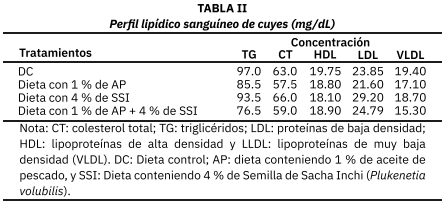
The objective of study was to determine the fat content and blood lipid profile in guinea pigs fed with omega-3 fatty acids from fish oil and sacha inchi (Plukenetia volubilis) seed. Forty-eight male guinea pigs, with an average initial weight of 300 grams, were randomly assigned to four treatments with three replicates (ponds) with four guinea pigs each. The treatments were: 1) Control diet, 2) Diet with 1.0 % fish oil, 3) Diet with 4.0 % sacha inchi seed and 4) Diet with 1.0 % fish oil + 4.0 % sacha inchi seed. Guinea pigs receiving the control diet had a triglyceride concentration of 97 mg/dL, the diet with 1 % fish oil had 85.5 mg/dL (P > 0.05); while the diet with 4 % sacha inchi seed showed a numerical increased to 93.5 mg/dL of triglyceride (P> 0.05), the diet with sacha inchi seed + fish oil showed a decreasing trend to 76.5 mg/dL (P > 0.05). In Total Cholesterol the guinea pigs that received the Control diet showed a concentration of 63 mg/dL, the diet only fish oil had a concentration of 57.5 mg/dL and the diet with 4 % sacha inchi seed had a concentration of 66 mg/dL (P > 0.05); however, with the combination of sacha inchi seed + fish oil the Total Cholesterol concentration was maintained at 59 mg/dL. No effect of the diet on high-density lipoproteins concentration was found, because the values obtained were between 18 and 20 mg/dL. The physiological role of the combination of sacha inchi seed with fish oil in numerically reducing triglyceride and Total Cholesterol with respect to Control diet is highlighted. It is concluded that the combination of sacha inchi seed with fish oil showed a trend towards lower triglyceride levels in the blood of guinea pigs and fish oil showed lower Total Cholesterol and low-density lipoproteins. The diet with sacha inchi seed showed lower amounts of total fat, saturated fatty acid and monounsaturated fatty acid in the guinea pig carcass with respect to the other treatments, although these differences were not statistically significant.
Downloads
References
Li X, Li XJ, Wu Z, Wang K, Qiao R, Han X, Li X, Yang F, Yu T, Wang T, Bai J. Recent advances in nutritional requirements and metabolic homeostasis regulation of animals under stress conditions. Animals. [Internet]. 2025; 15(23):3412. doi: https://doi.org/q8b7 DOI: https://doi.org/10.3390/ani15233412
Ipharraguerre IR, Rosales-Cavaglieri LA, Rimbach G. Bioenergetic signatures of circulating blood cells as biosensors of metabolic health in food-producing animals. Front. Vet. Sci. [Internet]. 2025; 12:1653669. doi: https://doi.org/q8b8 DOI: https://doi.org/10.3389/fvets.2025.1653669
Avilez B, Rugeles C, Jabib L, Herrera Y. Hematological parameters in broilers reared in a closed production farm in the low tropics. Rev. Med. Vet. [Internet]. 2015 [citado 23 Ene 2026]; 29:33-39. Disponible en: https://goo.su/ZKjD
Delfino L, De Souza B, Da Silva R, Silva W. Efeito do estresse calórico sobre o eritrograma de ruminantes. Agropec. Cient. Semiárido. [Internet]. 2012; 8(2):1-7. doi: https://doi.org/q8b9 DOI: https://doi.org/10.30969/acsa.v8i2.170
Xenouli P, Steiner J. Lipid metabolism and hyperlipidemia in dogs. Vet. J. [Internet]. 2010; 183(1):12-21. doi: https://doi.org/cdft69 DOI: https://doi.org/10.1016/j.tvjl.2008.10.011
Bailey A, Mohiuddin SS. Biochemistry, High Density Lipoprotein. In: StatPearls [Internet]. Treasure Island, Florida, USA: StatPearls Publishing; 2026 [citado 23 Ene 2026]. Disponible en: https://goo.su/kF01q6
Darly J, Osorio J. Perfil metabólico de aves comerciales mediante métodos directos. Rev. Investig. Vet. Perú. [Internet]. 2013; 24(2):162-167. doi: https://doi.org/q8cb DOI: https://doi.org/10.15381/rivep.v24i2.2479
Małodobra-Mazur M, Cierzniak A, Pawełka D, Kaliszewski K, Rudnicki J, Dobosz T. Metabolic differences between subcutaneous and visceral adipocytes differentiated with an excess of saturated and monounsaturated fatty acids. Genes. [Internet]. 2020; 11(9):1092. doi: https://doi.org/q8cc DOI: https://doi.org/10.3390/genes11091092
Attia Y, Al-Harthi M, Abo El-Maaty H. The effects of different oil sources on performance, digestive enzymes, carcass traits, biochemical, immunological, antioxidant, and morphometric responses of broiler chicks. Front. Vet. Sci. [Internet]. 2020; 7:181. doi: https://doi.org/q8cd DOI: https://doi.org/10.3389/fvets.2020.00181
Huang C, Chien Y, Chen Y, Ajuwon K, Mersmann H, Ding ST. Role of n-3 polyunsaturated fatty acids in ameliorating the obesity-induced metabolic syndrome in animal models and humans. Int. J. Mol. Sci. [Internet]. 2016; 17(10):1689. doi: https://doi.org/q8cf DOI: https://doi.org/10.3390/ijms17101689
Ibrahim D, El-Sayed R, Khater SI, Said EN, El-Mandrawy S. Changing dietary n-6: n-3 ratio using different oil sources affects performance, behavior, cytokines mRNA expression and meat fatty acid profile of broiler chickens. Anim. Nutr. [Internet]. 2018; 4(1):44-51. doi: https://doi.org/q8cg DOI: https://doi.org/10.1016/j.aninu.2017.08.003
Samrit T, Osotprasit S, Chaiwichien A, Suksomboon P, Chansap S, Athipornchai A, Changklungmoa N, Kueakhai P. Cold-pressed sacha inchi oil: High in omega-3 and prevents fat accumulation in the liver. Pharmaceuticals. [Internet]. 2024; 17(2):220. doi: https://doi.org/q8cj DOI: https://doi.org/10.3390/ph17020220
Corino C, Vizzarri F, Ratti S, Pellizzer M, Rossi R. Long term dietary supplementation with omega-3 fatty acids in Charolais beef cattle reared in Italian intensive systems: Nutritional profile and fatty acids composition of Longissimus lumborum muscle. Animals. [Internet]. 2022; 12(9):1123. doi: https://doi.org/q8ck DOI: https://doi.org/10.3390/ani12091123
Arista M, Zamora-Huamán SJ, Saucedo-Uriarte JA, Fernández-Castro P, Maldonado N, Valle L, Del Solar JC, Arista-Vargas DL, López-Lapa RM, Torres C, Leiva Y, Vásquez HV, Maicelo JL, Bardales W. Oncorhynchus mykiss silage improves meat fatty acids profile, blood parameters, intestinal histomorphometry, productive performance, and modulates the cecal microbiota of Cavia porcellus. Front. Nutr. [Internet]. 2026; 12:1725233. doi: https://doi.org/q8cm DOI: https://doi.org/10.3389/fnut.2025.1725233
Valenzuela R, Barrera C, González-Astorga M, Sanhueza J, Valenzuela A. Alpha linolenic acid (ALA) from Rosa canina, sacha inchi and chia oils may increase ALA accretion and its conversion into n-3 LCPUFA in diverse tissues of the rat. Food Funct. [Internet]. 2014; 5(7):1564-1572. doi: https://doi.org/ckck DOI: https://doi.org/10.1039/C3FO60688K
Mendoza-Almeida T, Ramírez-Roca EG, Suárez-Cunza S. Fatty acid profile and effect of Plukenetia volubilis L. (sacha inchi) oil on lipid metabolism in rats fed a high-fat diet. Braz. J. Med. Biol. Res. [Internet]. 2025; 58:e14684. doi: https://doi.org/q8cn DOI: https://doi.org/10.1590/1414-431x2025e14684
Oriundo K, Delgadillo P, Arévalo R, Alfaro M, Bautista S. Parámetros hematológicos de referencia de cuyes nativos (Cavia porcellus). Rev. Investig. Vet. Perú. [Internet]. 2021; 32(5):e18417. doi: https://doi.org/q8cp DOI: https://doi.org/10.15381/rivep.v32i5.18417
Gómez E, Jimenez A, Ruperez P. Effect of the red seaweed Mastocarpus stellatus intake on lipid metabolism and antioxidant status in healthy Wistar rats. Food Chem. 2012; 135(2):806–811. doi: https://doi.org/f38txs DOI: https://doi.org/10.1016/j.foodchem.2012.04.138
Blas-Bazán SE, Ortiz-Gómez CP. Efecto del aceite de Plukenetia volubilis “sacha inchi” en la concentración LDL-colesterol en Cavia porcellus Laboratorio UPAO 2023. [Tesis de pregrado]. Trujillo, Perú: Universidad Privada Antenor Orrego. 2023 [citado 23 Ene 2026]; 66 p. Disponible en: https://goo.su/wSuoU
Sokoła-Wysoczańska E, Wysoczański T, Wagner J, Czyż K, Bodkowski R, Lochyński S, Patkowska-Sokoła B. Polyunsaturated fatty acids and their potential therapeutic role in cardiovascular system disorders-a review. Nutrients. [Internet]. 2018; 10(10):1561. doi: https://doi.org/gms83m DOI: https://doi.org/10.3390/nu10101561
Aybar M. Perfil lipídico sanguíneo de cuyes en crecimiento en el C.E. Pampa del Arco – Ayacucho. [Tesis de pregrado]. Ayacucho, Perú: Universidad Nacional San Cristóbal de Huamanga. 2011 [citado 23 Ene 2026]; 99 p. Disponible en: https://goo.su/JrUQ7f
Ramos-Mamani L, Telles R, Padilla M. Análisis de perfil lipídico en cuyes (Cavia porcellus) suplementados con vitamina E y selenio orgánico. Rev. Investig. Cienc. Agron. Vet. ALFA. [Internet]. 2022; 6(16):140–144. doi: https://doi.org/q8cs DOI: https://doi.org/10.33996/revistaalfa.v6i16.156
Huamán J. Niveles séricos de lípidos totales, triglicéridos, colesterol y correlaciones en cuyes (Cavia porcellus L.) del CIP Majes, Arequipa. [Tesis de pregrado]. Puno, Perú. Universidad del Altiplano; 2019 [citado 23 Ene 2026]; 76 p. Disponible en: https://goo.su/RCTqR
Gutiérrez-Zorrilla I, Bernuy-Osorio N, Zea-Mendoza O, Vilchez-Perales C. Influencia de ácidos grasos en parámetros sanguíneos y adipogénesis: estudio experimental en pollos eclosionados. Arch. Latinoam. Nutr. [Internet]. 2022; 72(4):285-293. doi: https://doi.org/g5mdk9 DOI: https://doi.org/10.37527/2022.72.4.006
Almeida E, Sabino CP, Leão APD, Rodrigues I, Diniz AS, Arruda IK. Razón entre grasa visceral y subcutánea como predictor de alteraciones cardiometabólicas. Rev. Chil. Nutr. [Internet]. 2018; 45(1):28-36. doi: https://doi.org/q8cv DOI: https://doi.org/10.4067/S0717-75182018000100028
Hernández G, Rivera J, Serrano R, Villalta D, Abbate M, Acosta L, Paoli M. Adiposidad visceral, patogenia y medición. Rev. Venez. Endocrinol. Metab. [Internet]. 2017 [citado 23 Ene 2026]; 15(2):70-77 Disponible en: https://goo.su/ZzNKs
Torchon ET, Das S, Beckford RC, Voy BH. Enriching the starter diet in n-3 polyunsaturated fatty acids reduces adipocyte size in broiler chicks. Curr. Dev. Nutr. [Internet]. 2017; 1(11):e001644. doi: https://doi.org/q8cw DOI: https://doi.org/10.3945/cdn.117.001644
González-Ortiz G, Sala R, Cánovas E, Abed N, Barroeta AC. Consumption of dietary n-3 fatty acids decreases fat deposition and adipocyte size but increases oxidative susceptibility in broiler chickens. Lipids. [Internet]. 2013; 48(7):705-717. doi: https://doi.org/f43jbg DOI: https://doi.org/10.1007/s11745-013-3785-3
Kim M, Voy B. Fighting fat with fat: n-3 polyunsaturated fatty acids and adipose deposition in broiler chickens. Front. Physiol. [Internet]. 2021; 12:755317. doi: https://doi.org/g9hq88 DOI: https://doi.org/10.3389/fphys.2021.755317
Mohammadpour F, Darmani-Kuhi H, Mohit A, Sohani M. Obesity, insulin resistance, adiponectin, and PPAR-g gene expression in broiler chicks fed diets supplemented with fat and green tea (Camellia sinensis) extract. Domest. Anim. Endocrinol. [Internet]. 2020; 72:106440. doi: https://doi.org/q8cx DOI: https://doi.org/10.1016/j.domaniend.2020.106440
Skřivan M, Marounek MM, Englmaierova M, Čermak L, Vlčkova J, Skřivanova E. Effect of dietary fat type on intestinal digestibility of fatty acids, fatty acid profiles of breast meat and abdominal fat, and mRNA expression of lipid related genes in broiler chickens. PLoS One. [Internet]. 2018; 13(4):e0196035. doi: https://doi.org/q8cz DOI: https://doi.org/10.1371/journal.pone.0196035
Sanz M, López-Bote CJ, Menoyo D, Bautista J. Abdominal fat deposition and fatty acid synthesis are lower and beta-oxidation is higher in broiler chickens fed diets containing unsaturated rather than saturated fat. J. Nutr. [Internet]. 2000; 130(12):3034–3037. doi: https://doi.org/q8c2 DOI: https://doi.org/10.1093/jn/130.12.3034
Ravaut G, Légio t A, Bergeron K, Mounier C. Monounsaturated fatty acids in obesity-related inflammation. Int J. Mol. Sci. [Internet]. 2021; 22(1):330. doi: https://doi.org/gnk4tv DOI: https://doi.org/10.3390/ijms22010330
Ferguson J, Roberts-Lee K, Borcea C, Smith H, Midgette Y, Shah R. Omega-3 polyunsaturated fatty acids attenuate inflammatory activation and alter differentiation in human adipocytes. J. Nutr. Biochem. [Internet]. 2019; 64:45-49. doi: https://doi.org/q8c3 DOI: https://doi.org/10.1016/j.jnutbio.2018.09.027
Liu X, Kris-Etherton P, West S, Lamarche B, Jenkins D, Fleming J, McCrea CE, Pu S, Couture P, Connelly PW, Jones PJH. Effects of canola and high-oleic-acid canola oils on abdominal fat mass in individuals with central obesity. Obesity. [Internet]. 2016; 24(11):2261–2268. doi: https://doi.org/f9gfjk DOI: https://doi.org/10.1002/oby.21584
Baker EJ, Miles EA, Burdge GC, Yaqoob P, Calder PC. Metabolism and functional effects of plant-derived omega-3 fatty acids in humans. Prog. Lipid. Res. [Internet]. 2016; 64:30-56. doi: https://doi.org/gn633d DOI: https://doi.org/10.1016/j.plipres.2016.07.002