Histological and microbiological alterations in sardines subjected to repeated freezethaw cycles: Implications for muscle integrity and food safety
Abstract
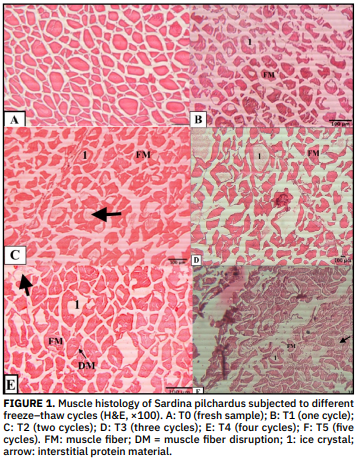
A total of thirty freshly caught sardines were subjected to one to five freeze–thaw cycles, while unfrozen samples served as controls. Muscle structure was assessed by histological and histomorphometric analyses, including measurements of vacuole area, vacuolated fiber area, vacuolated-to-fiber area ratio, and ice crystal size. Microbiological analyses included aerobic mesophilic bacteria, total coliforms, coagulase-positive Staphylococcus aureus, and Salmonella spp. Histological observations revealed a progressive deterioration of muscle architecture with increasing numbers of freeze–thaw cycles, characterized by fiber disorganization, extensive vacuolation, and widening of inter-fiber spaces. Histomorphometric analysis showed significant increases (P < 0.05) in ice crystal area, from 1050 ± 300 µm² at one freeze–thaw cycles to 2300 ± 150 µm² at five freeze–thaw cycles, as well as in the vacuolated area ratio, which increased from 25 ± 7 % to 65 ± 6 %. Microbial counts showed a slight but consistent decrease during the first three freeze–thaw cycles and remained well below the spoilage threshold of 7 log CFU/g. A significant negative correlation (r = −0.78; P < 0.05) was observed between vacuole area and total aerobic mesophilic counts, indicating that structural muscle damage did not promote microbial proliferation under controlled cold storage conditions. In conclusion, repeated freeze–thaw cycles notably impair sardine muscle microstructure and may slightly reduce microbial counts, without favoring bacterial growth when the cold chain is properly maintained. These findings highlight the importance of strict temperature control to preserve both the quality and safety of sardine products.
Downloads
References
Rippen TE, Skonberg D. Chapter 19: Handling of fresh fish. In: Granata LA, Flick Jr GJ, Martin RE, editors. The Seafood Industry: Species, Products, Processing, and Safety. 2nd ed. West Sussex, UK: Wiley-Blackwell; 2012. p. 249–260. DOI: https://doi.org/10.1002/9781118229491.ch19
Leygonie C, Britz TJ, Hoffman LC. Impact of freezing and thawing on the quality of meat: Review. Meat Sci. 2012;91(2):93-98. doi: https://doi.org/fzh375 DOI: https://doi.org/10.1016/j.meatsci.2012.01.013
Hu C, Xie J. The effect of multiple freeze-thaw cycles on the microstructure and quality of Trachurus murphyi. Foods. 2021;10(6):1350. doi: https://doi.org/gkkh6r DOI: https://doi.org/10.3390/foods10061350
Lv Y, Xie J. Effects of freeze–thaw cycles on water migration, microstructure and protein oxidation in cuttlefish. Foods. [Internet]. 2021; 10(11):2576. doi: https://doi.org/qqvc DOI: https://doi.org/10.3390/foods10112576
Strateva M, Penchev G, Stratev D. Influence of Freezing on Muscles of Rainbow Trout (Oncorhynchus mykiss): A Histological and Microbiological Study. J. Food Qual. Hazards Control. [Internet]. 2021; 8(1):2-12. doi: https://doi.org/qqwb DOI: https://doi.org/10.18502/jfqhc.8.1.5457
Ersoy B, Yilmaz AB. Frozen storage of African catfish (Clarias gariepinus Burchell, 1822) mince balls. Turk. J. Vet. Anim. Sci. 2003 [cited 22 Sept 2025]; 27(4):827-832. Available in: https://goo.su/lKFhAwY
Popelka P, Luptáková O, Marcincák S, Nagy J, Mesarcová L, Nagyová A. The effect of glaze and storage temperature on the quality of frozen hoki (Macruronus magellanicus). Czech J. Food Sci. [Internet]. 2012; 30(6):529–536. doi: https://doi.org/qqwc
International Commission of Microbiological Specification for Food (ICMSF). Microorganisms in Food 2. Sampling for Microbiological Analysis: Principles and Specific Applications. Toronto: University of Toronto Press, 2nd edition. 278 pp. [Internet]. 1986 [cited 22 Sept 2025]. Available in: https://goo.su/8cBXLoD
Di Salvo E, Panebianco F, Panebianco A, Ziino G. Quantitative Detection of Viable but Nonculturable Vibrio parahaemolyticus in Frozen Bivalve Molluscs. Foods. [Internet].2023; 12(12):2373. doi: https://doi.org/qqw7 DOI: https://doi.org/10.3390/foods12122373
Megaache M, Bennoune O. Effect of freeze–thaw cycles on the physicochemical, water–holding properties, and histology of Sardinella aurita. Rev. Cientif. FCV. [Internet]. 2024; 34(3):e34356. doi: https://doi.org/qqvg DOI: https://doi.org/10.52973/rcfcv-e34356
Du N, Sun Y, Chen Z, Huang X, Li C, Gao L, Bai S, Wang P, Hao Q. Effects of multiple freeze-thaw cycles on protein and lipid oxidation, microstructure and quality characteristics of rainbow trout (Oncorhynchus mykiss). Fishes. 2023; 8(2):108. doi: https://doi.org/qqvh DOI: https://doi.org/10.3390/fishes8020108
Tinacci L, Armani A, Guidi A, Nucera D, Shvartzman D, Miragliotta V, Coli A, Giannessi E, Stornelli MR, Fronte B, Di Iacovo F, Abramo F. Histological discrimination of fresh and frozen/thawed fish meat: European hake (Merluccius merluccius) as a possible model for white meat fish species. Food Control. 2018; 92:154-161. doi: https://doi.org/gkq8xd DOI: https://doi.org/10.1016/j.foodcont.2018.04.056
Li D, Zhu Z, Sun DW. Effects of freezing on cell structure of fresh cellular food materials: A review. Trends. Food Sci. Technol. [Internet].. 2018; 75:46–55. doi: https://doi.org/gdhwj8 DOI: https://doi.org/10.1016/j.tifs.2018.02.019
Wang H, Wenzheng S, Wang X. Effects of different thawing methods on microstructure and the biochemical properties of tilapia (Oreochromis niloticus) fillets during frozen storage. Int. J. Food Sci. Technol. [Internet]. 2022; 57(1):224–234. doi: https://doi.org/qqw8 DOI: https://doi.org/10.1111/ijfs.15226
Huss HH, Reilly A, Ben Embarek PK. Prevention and control of hazards in seafood. Food Control. [Internet]. 2000 [cited 12 Aug 2025]; 11(2):149–156. Available in: https://goo.su/1dibcVH DOI: https://doi.org/10.1016/S0956-7135(99)00087-0
International Organization for Standardization (ISO) 48331. Microbiology of food chain -Horizontal method for enumeration of microorganisms. Part 1: Colony count at 30 °C by the pour plate technique. 1st edition. Geneva Switzerland: ISO. [Internet]. 2013 [cited 18 Oct 2025]. Available in: https://goo.su/Hz6Uy26
International Organization for Standardization (ISO) 4832. Microbiology of food and animal feeding stuffs — Horizontal method for the enumeration of coliforms — Colony-count technique. 3rd edition. Geneva Switzerland: ISO. [Internet]. 2006 [cited 19 Oct 2025]. Available in: https://goo.su/wWttNa
International Organization for Standardization (ISO) 6888-2. Microbiology of food chain- Horizontal method for the enumeration of coagulase-positive staphylococci (Staphylococcus aureus and other species). Part 2: Technique using rabbit plasma fibrinogen agar medium. 2nd edition. Geneva Switzerland: ISO. [Internet]. 2021 [cited 9 Oct 2025]. Available in: https://goo.su/eBfR4c
International Organization for Standardization (ISO) 65791. Microbiology of the Food Chain — Horizontal Method for the Detection, Enumeration and Serotyping of Salmonella. Part 1: Detection of Salmonella spp. 1st edition. Geneva Switzerland: ISO. [Internet]. 2017 [cited 9 Oct 2025]. Available in: https://goo.su/rBHAFTJ
Commission Regulation (EC) No 2073/2005 of 15 November 2005 on microbiological criteria for foodstuffs. OJ L 338. [Internet]. 2005 [cited 9 Oct 2025]; p. 1-26. Available in: https://goo.su/eEAqF7N
Chatzikyriakidou K, Dimakopoulou-Papazoglou D, Katsanidis E. Safety and quality attributes of fresh sardines (Sardina pilchardus) in storage scenarios imitating harvest-to-refrigerator conditions. Int J Food Sci Technol. 2023; 58(12):6642-6651. doi: https://doi.org/qqvk DOI: https://doi.org/10.1111/ijfs.16780