Social Attitudes and Solutions Towards Stray Animals: Evaluation of Ereğli District of Konya Province
Abstract
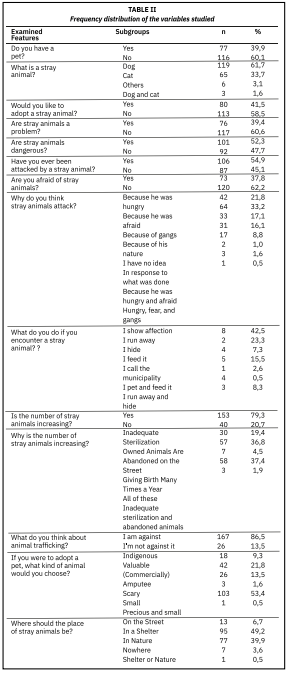
Archaeological and genetic evidence reveals that dogs were domesticated around 12,000 Before Christ, followed by the inclusion of species such as goats, sheep, cattle, and cats in human life. With the Industrial Revolution, the need for animal labor decreased, but domesticated species like cats and dogs retained their importance. Today, factors such as inadequate sterilization practices, animal abandonment, and migration from rural areas to urban centers are leading to an increase in the stray animal population. This study examined public attitudes toward stray animals and proposed solutions, comparing the findings with international practices. According to the survey results, respondents consider adoption (48.2 %) and sterilization (31.1 %) as the primary solutions. This trend aligns with integrated dog population management strategies adopted by organizations such as the World Animal Protection Organization and the Global Alliance for Rabies Control . Successfully implemented worldwide, seize-neuter-vaccine-return programs, rabies vaccination, public awareness campaigns, and adoption campaigns offer both ethical and sustainable solutions. Examples from India, Morocco, Nepal, and various European countries demonstrate that sterilization- vaccination-based approaches yield more lasting results than mass culling. Consequently, the adoption of a One Health approach in managing stray animal populations in Türkiye, the expansion of sterilization and vaccination programs, responsible ownership practices supported by legal regulations, and increased community- local government collaboration are recommended. The findings reveal the necessity of developing local policies in line with global welfare standards.
Downloads
References
Baskici M. Evcillestirme tarihine kisa bir bakis. Ankara Üniv. SBF Derg. [Internet]. 1998; 01(53):73-94. doi: https://doi.org/qbvv DOI: https://doi.org/10.1501/SBFder_0000001944
Tandogan O. A Qualitative Study: Issue (s) of Stray Animal (s) in Türkiye from the Point of View of Volunteers. J. Environ. Nat. Stud. [Internet]. 2024; 6(1):72-84. doi: https://doi.org/qp2d DOI: https://doi.org/10.53472/jenas.1424672
Atkins PJ. Animal cities: Beastly urban histories. 1st ed. Abingdon, Oxon, UK: Ashgate; 2012 [cited 12 Jul 2025]. Available in: https://goo.su/N1nLk
Zeybek SO. Istanbul’un yuttuklari ve kustuklari: Köpekler ve nesneler üzerinden Istanbul tahlili. In: Candan AB, Özbay C, editors. Yeni Istanbul Çalismalari: Sinirlar, Mücadeleler, Açilimlar. 1st ed. Istanbul: Metis Yayinlari; 2014. p. 263-282.
World Organisation for Animal Health (OIE). Report on the OIE’s International Standard on Stray Dog Population Control. Paris: OIE. 2015 [cited 11 Aug 2025]. Available in: https://goo.su/TTkZX
Jackman J, Rowan AN. Free-roaming dogs in developing countries: The benefits of capture, neuter, and return programs. In: Salem DJ, Rowan AN, (Eds.). The state of the animals 2007. Washington, DC: Humane Society Press. 2007 [cited 11 Aug 2025]. p. 55-58. Available in: https://goo.su/jvaPN7G
Selvi MH. The use of statistics in Veterinary Sciences and the test methods used. Res. Pract. Vet. Anim. Sci. [Internet]. 2024; 1(1):43-50. doi: https://doi.org/n4v9
Ecel H, Göncü S. Stray Dogs Problem and Right Approach to Prevent Attack. J. Environ. Sci. Eng. [Internet]. 2023; 12:106-115. doi: https://doi.org/qp3k DOI: https://doi.org/10.17265/2162-5298/2023.03.005
Ramanujan, A. Violent Encounters: ‘Stray’ Dogs in Indian Cities. In: Nagai, K., Jones K, Landry D, Mattfeld M, Rooney C, Sleigh C. (eds). Cosmopolitan Animals. London: Palgrave Macmillan; 2015. p. 216-232. doi: https://doi.org/qp3m DOI: https://doi.org/10.1057/9781137376282_15
Smith LM, Hartmann S, Munteanu AM, Dalla Villa P, Quinnell RJ, Collins LM. The effectiveness of dog population management: A systematic review. Animals. [Internet]. 2019; 9(12):1020. doi: https://doi.org/qp3p DOI: https://doi.org/10.3390/ani9121020
Smith LM, Quinnell RJ, Goold C, Munteanu AM, Hartmann S, Collins LM. Assessing the impact of free-roaming dog population management through systems modelling. Sci. Rep. [Internet]. 2022; 12(1):11452. doi: https://doi.org/qp3q DOI: https://doi.org/10.1038/s41598-022-15049-1
Azevedo A, Peste F, Linck P, Carvalho J, Crawshaw D, Ferreira E, Tinoco-Torres R, Bandeira V. Social Perceptions and Attitudes Towards Free-Roaming Cats and Dogs in Portugal: An Exploratory Study. Animals. [Internet]. 2025; 15(6):771. doi: https://doi.org/qp3r DOI: https://doi.org/10.3390/ani15060771
Butler D, Gumrukcu T. Türkiye signs maritime boundaries deal with Libya amid exploration row. Reuters. [Internet]. London, UK: Reuters. 2019 Nov 18 [cited 11 Aug 2025]. Available in: https://goo.su/J0nImb2
Kosarhan BG. Negotiating the Borders of Humanity: Street Animals in Türkiye and the Biopolitics of Community and Immunity. [Doctoral Thesis on the Internet] Viena, Asutria: Central European University. 2024; 60p. Available in: https://goo.su/R3qm
Chaudhari A, Bril, G, Chakravarti I, Drees T, Verma S, Avinash N, Kumar-Jha A, Langain S, Bhatt N, Kumar S, Choudhary S, Singh P, Chandra S, Murali A, Polak K. Technology for improving street dog welfare and capturing data in digital format during street dog sterilisation programmes. Animals. [Internet]. 2022; 12(15):2000. doi: https://doi.org/qp3w DOI: https://doi.org/10.3390/ani12152000
Sönmez ÖF. Stray dogs in Türkiye: a health needs assessment proposal for rabies elimination. J. Biotechnol. Strateg. Health Res. [Internet]. 2024; 8(1):16-22. doi: https://doi.org/qp3x DOI: https://doi.org/10.34084/bshr.1427893