Preferencias de los consumidores por productos favorables al bienestar animal en Türkiye: un enfoque basado en la Teoría del Comportamiento Planificado ampliada
Resumen
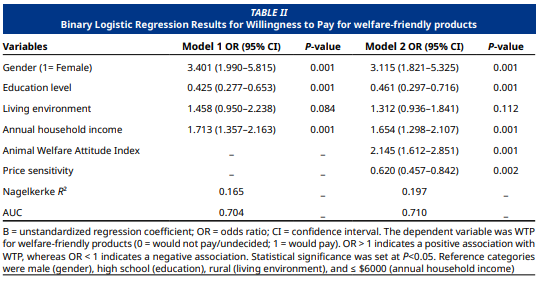
El objetivo de este estudio fue examinar los determinantes actitudinales, sociodemográficos y económicos de la disposición de los consumidores a pagar por productos favorables al bienestar animal en Türkiye, utilizando un marco ampliado de la Teoría del Comportamiento Planificado. Se realizó una encuesta transversal en línea en 2022 con 245 consumidores residentes en la provincia de Samsun. Se empleó un análisis de regresión logística binaria para evaluar la influencia de variables actitudinales, sociodemográficas y económicas sobre la disposición de los consumidores a pagar declarada. Los resultados indicaron que las actitudes favorables al bienestar animal aumentaron significativamente la probabilidad de pagar un sobreprecio (razón de probabilidad = 2,145; intervalo de confianza del 95%: 1,612–2,851; P<0.001), constituyendo el predictor más fuerte del modelo ampliado. El ingreso anual del hogar se asoció positivamente con la disposición de los consumidores a pagar (razón de probabilidad = 1,713; P = 0,001), mientras que la sensibilidad al precio redujo significativamente la intención de pagar un sobreprecio (razón de probabilidad = 0,620; P = 0,002), lo que evidencia la persistencia de la brecha actitud-comportamiento. Las mujeres mostraron una probabilidad significativamente mayor de expresar disposición de los consumidores a pagar en comparación con los hombres (razón de probabilidad = 3,401; P = 0,001), mientras que un mayor nivel educativo se asoció con una menor disposición a pagar un sobreprecio (razón de probabilidad= 0,425; P = 0,001). Entre los consumidores de ingresos medios y altos, una mayor preocupación por las mejoras en las condiciones de alojamiento, alimentación, transporte, sacrificio y ambiente de las explotaciones se asoció con un aumento de la disposición de los consumidores a pagar (rango de razón de probabilidad = 1,298–2,342). El modelo Teoría del Comportamiento Planificado ampliado mostró un mejor desempeño explicativo (Nagelkerke R² = 0,197; área bajo la curva = 0,710), indicando el valor explicativo adicional de las variables actitudinales y económicas. Los hallazgos demuestran que el consumo orientado al bienestar animal en Türkiye está determinado por la interacción entre el compromiso ético y la viabilidad económica. El estudio proporciona implicaciones relevantes para la certificación de bienestar animal, la segmentación de mercado y las estrategias de fijación de precios basadas en evidencia para productos favorables al bienestar animal.
Descargas
Citas
Broom DM. A history of animal welfare science. Acta Biotheor. [Internet]. 2011; 59(2):121–137. doi: https://doi.org/bgqmv4 DOI: https://doi.org/10.1007/s10441-011-9123-3
Fraser D. Understanding animal welfare. Acta Vet. Scand. [Internet]. 2008; 50(Suppl 1):S1. doi: https://doi.org/cj2bb2 DOI: https://doi.org/10.1186/1751-0147-50-S1-S1
Fraser D, Weary DM, Pajor EA, Milligan BN. A scientific conception of animal welfare that reflects ethical concerns. Anim. Welf. [Internet]. 1997; 6(3):187–205. doi: https://doi.org/rbhm DOI: https://doi.org/10.1017/S0962728600019795
Verbeke WAJ, Viaene J. Ethical challenges for livestock production: Meeting consumer concerns about meat safety and animal welfare. J. Agric. Environ. Ethics [Internet]. 2000; 12(2):141–151. doi: https://doi.org/cmc2v3 DOI: https://doi.org/10.1023/A:1009538613588
Blokhuis HJ, Keeling LJ, Gavinelli A, Serratosa J. Animal welfare’s impact on the food chain. Trends Food Sci. Technol. [Internet]. 2008; 19(1):S79–S87. doi: https://doi.org/c9hskn DOI: https://doi.org/10.1016/j.tifs.2008.09.007
Jiang R, Sharma C, Bryant RH, Mohan MS, Al-Marashdeh O, Harrison R, Torrico DD. Animal welfare information affects consumers’ hedonic and emotional responses towards milk. Food Res. Int. [Internet]. 2021; 141:110006. doi: https://doi.org/rbhn DOI: https://doi.org/10.1016/j.foodres.2020.110006
Ammann J, Mack G, El Benni N, Jin S, Newell-Price P, Tindale S, Hunter E, Vicario-Modroño V, Gallardo-Cobos R, Sánchez-Zamora P, Miškolci S, Frewer LJ. Consumers across five European countries prioritise animal welfare above environmental sustainability when buying meat and dairy products. Food Qual. Prefer. [Internet]. 2024; 117:105179. doi: https://doi.org/gtwth7 DOI: https://doi.org/10.1016/j.foodqual.2024.105179
Gemma P, Nannoni E, Padalino B, Peli A, Alexander FL, Buonaiuto G, Sardi L, Martelli G. Perception and awareness of animal welfare among residents of Malta. Animals [Internet]. 2025; 15(11):1634. doi: https://doi.org/rbhp DOI: https://doi.org/10.3390/ani15111634
María GA. Public perception of farm animal welfare in Spain. Livest. Sci. [Internet]. 2006; 103(3):250–256. doi: https://doi.org/ct2z9x DOI: https://doi.org/10.1016/j.livsci.2006.05.011
European Commission. Special Eurobarometer 442: Attitudes of Europeans towards animal welfare. [Internet]. Brussels (Belgium): European Commission; 2016 [cited 1 Jan 2026]. Available from: https://goo.su/uUlCbC
Grunert KG, Sonntag WI, Glanz-Chanos V, Forum S. Consumer interest in environmental impact, safety, health and animal welfare aspects of modern pig production: Results of a cross-national choice experiment. Meat Sci. [Internet]. 2018; 137:123–129. doi: https://doi.org/gc46pc DOI: https://doi.org/10.1016/j.meatsci.2017.11.022
Harper G. Consumer concerns about animal welfare and the impact on food choice. [Internet]. Proceedings of the dissemination seminar. Reading, United Kingdom: Centre for Food Economics Research, University of Reading. 2001 [cited 1 Jan 2026]. Available in: https://goo.su/ACLi1
Bennett RM, Blaney RJ. Estimating the benefits of farm animal welfare legislation using the contingent valuation method. Agric. Econ. [Internet]. 2003; 29(1):85–98. doi: https://doi.org/dvnqms DOI: https://doi.org/10.1111/j.1574-0862.2003.tb00149.x
McKendree MGS, Croney CC, Widmar NO. Effects of demographic factors and information sources on United States consumer perceptions of animal welfare. J. Anim. Sci. [Internet]. 2014; 92(7):3161–3173. doi: https://doi.org/f588hg DOI: https://doi.org/10.2527/jas.2014-6874
Gorton M, Yeh CH, Chatzopoulou E, White J, Tocco B, Hubbard C, Hallam F. Consumers’ willingness to pay for an animal welfare food label. Ecol. Econ. [Internet]. 2023; 209:107852. doi: https://doi.org/gr8gfv DOI: https://doi.org/10.1016/j.ecolecon.2023.107852
Cao YJ, Cranfield J, Chen C, Widowski T. Heterogeneous informational and attitudinal impacts on consumer preferences for eggs from welfare enhanced cage systems. Food Policy [Internet]. 2021; 99:101979. doi: https://doi.org/g36mm3 DOI: https://doi.org/10.1016/j.foodpol.2020.101979
Denver S, Christensen T, Nordström J, Lund TB, Sandøe P. Is there a potential international market for Danish welfare pork? A consumer survey from Denmark, Sweden, and Germany. Meat Sci. [Internet]. 2022; 183:108616. doi: https://doi.org/gmvfnx DOI: https://doi.org/10.1016/j.meatsci.2021.108616
Alonso ME, González-Montaña JR, Lomillos JM. Consumers’ concerns and perceptions of farm animal welfare. Animals [Internet]. 2020; 10(3):385. doi: https://doi.org/gh5936 DOI: https://doi.org/10.3390/ani10030385
Lagerkvist CJ, Hess S. A meta-analysis of consumer willingness to pay for farm animal welfare. Eur. Rev. Agric. Econ. [Internet]. 2011; 38(1):55–78. doi: https://doi.org/bdsccq DOI: https://doi.org/10.1093/erae/jbq043
Yang W, Renwick A. Consumer willingness to pay price premiums for credence attributes of livestock products: A meta-analysis. J. Agric. Econ. [Internet]. 2019; 70(3):618–639. doi: https://doi.org/rbmq DOI: https://doi.org/10.1111/1477-9552.12323
Clark B, Stewart GB, Panzone LA, Kyriazakis I, Frewer LJ. Citizens, consumers and farm animal welfare: A meta-analysis of willingness-to-pay studies. Food Policy [Internet]. 2017; 68:112–127. doi: https://doi.org/gf9zt3 DOI: https://doi.org/10.1016/j.foodpol.2017.01.006
Miele M, Evans A. When foods become animals: Ruminations on ethics and responsibility in care-full practices of consumption. Ethics Place Environ. [Internet]. 2010; 13(2):171–190. doi: https://doi.org/d6xwwh DOI: https://doi.org/10.1080/13668791003778842
de Jonge J, van Trijp HC. The impact of broiler production system practices on consumer perceptions of animal welfare. Poult. Sci. [Internet]. 2013; 92(12):3080–3095. doi: https://doi.org/rbmr DOI: https://doi.org/10.3382/ps.2013-03334
Olesen I, Alfnes F, Røra MB, Kolstad K. Eliciting consumers’ willingness to pay for organic and welfare-labelled salmon in a non-hypothetical choice experiment. Livest. Sci. [Internet]. 2010; 127(2–3):218–226. doi: https://doi.org/bz6b8b DOI: https://doi.org/10.1016/j.livsci.2009.10.001
Ajzen I. The theory of planned behavior. Organ Behav. Hum. Decis. Process. [Internet]. 1991; 50(2):179–211. doi: https://doi.org/cc3 DOI: https://doi.org/10.1016/0749-5978(91)90020-T
Armitage CJ, Conner M. Efficacy of the theory of planned behaviour: A meta-analytic review. Br. J. Soc. Psychol. [Internet]. 2001; 40(4):471–499. doi: https://doi.org/gbn DOI: https://doi.org/10.1348/014466601164939
Miranda-de la Lama GC, Estévez-Moreno LX, Sepulveda WS, Estrada-Chavero MC, Rayas-Amor AA, Villarroel M, María GA. Mexican consumers’ perceptions and attitudes towards farm animal welfare and willingness to pay for welfare friendly meat products. Meat Sci. [Internet]. 2017; 125:106–113. doi: https://doi.org/gmhgpd DOI: https://doi.org/10.1016/j.meatsci.2016.12.001
Carrington MJ, Neville BA, Whitwell GJ. Why ethical consumers don’t walk their talk: Towards a framework for understanding the gap between the ethical purchase intentions and actual buying behaviour of ethically minded consumers. J. Bus. Ethics. [Internet]. 2010; 97(1):139–158. doi: https://doi.org/b4npn7 DOI: https://doi.org/10.1007/s10551-010-0501-6
Vanhonacker F, Verbeke W, Van Poucke E, Tuyttens FAM. Do citizens and farmers interpret the concept of farm animal welfare differently? Livest. Sci. [Internet]. 2008; 116(1–3):126–136. doi: https://doi.org/dc24sv DOI: https://doi.org/10.1016/j.livsci.2007.09.017
Tüfenk ÖG, Bozkurt Z. Consumer attitudes towards animal welfare and its relation to demographic and socio-economic factors. J. Bahri Dağdaş Anim. Res. [Internet]. 2022 [cited 12 Jan 2026]; 11(2):74–87. doi: Available in: https://goo.su/AElwbu
Sweeney S, Regan Á, McKernan C, Benson T, Hanlon A, Dean M. Current consumer perceptions of animal welfare across different farming sectors on the island of Ireland. Animals [Internet]. 2022; 12(2):185. doi: https://doi.org/rbms DOI: https://doi.org/10.3390/ani12020185
Napolitano F, Girolami A, Braghieri A. Consumer liking and willingness to pay for high welfare animal-based products. Trends Food Sci. Technol. [Internet]. 2010; 21(11):537–543. doi: https://doi.org/djg6qm DOI: https://doi.org/10.1016/j.tifs.2010.07.012
Henchion MM, De Backer CJ, Hudders L, O’Reilly S. Ethical and sustainable aspects of meat production; consumer perceptions and system credibility. In: Toldrá F, editor. New aspects of meat quality [Internet]. Cambridge (UK): Woodhead Publishing. 2022. p. 829–851. doi: https://doi.org/rbmt DOI: https://doi.org/10.1016/B978-0-323-85879-3.00001-5
Çavuş–Alan S, Alan S. Consumers and future veterinarians: Attitudes of veterinary students toward welfare-friendly meat products and labelling in Türkiye. Rev. Cient. FCV-LUZ. [Internet]. 2025; 36(1):e361775. doi: https://doi.org/rbv DOI: https://doi.org/10.52973/rcfcv-e361775