Comparación de los efectos clínicos de cuatro protocolos de anestesia diferentes en conejos
Resumen
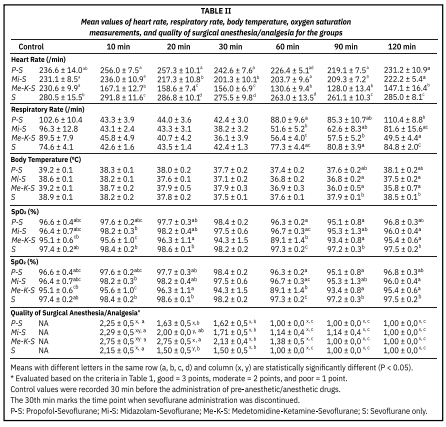
El objetivo de este estudio es comparar los efectos clínicos de cuatro protocolos de anestesia diferentes en conejos y sugerir una alternativa segura y controlada de anestesia inhalatoria con intubación endotraqueal para aplicaciones clínicas y estudios experimentales en conejos. Un total de 40 conejos de Nueva Zelanda se dividieron aleatoriamente en cuatro grupos (n = 10): propofol-sevoflurano, midazolam-sevoflurano, medetomidina- ketamina-sevoflurano y sevoflurano solo. Todos los protocolos de anestesia se completaron sin causar la muerte. Aunque el medetomidina-ketamina-sevoflurano proporcionó la mejor anestesia quirúrgica (2.75 ± 0.5) y calidad de inducción (2.90± 0.5), causó disminuciones significativas en la frecuencia cardíaca y la frecuencia respiratoria desde el inicio (230.6 ±9.9 y 89,5 ± 7,9, respectivamente) hasta el décimo minuto de anestesia (167.1 ± 12.7 y 45.8 ± 4.9, respectivamente) (P < 0.05). La inducción de anestesia más rápida se observó en el propofol-sevoflurano (2.5 ± 0.5), mientras que el medetomidina-ketamina-sevoflurano tuvo el tiempo de recuperación más largo (84.0 ± 8.1). En el grupo midazolam- sevoflurano, la intubación fue significativamente más difícil (P< 0.05). No se encontraron diferencias significativas entre losgrupos en términos de efectos hematológicos postanestésicos. Basándose en la mayor profundidad analgésica observada en este estudio y respaldada por la literatura previa, la combinación medetomidina-ketamina-sevoflurano puede considerarse una opción adecuada para conejos sometidos a procedimientos complejos. Sin embargo, la monitorización continua de los parámetros fisiológicos durante y después de la anestesia hasta la recuperación completa es esencial para prevenir posibles complicaciones. Además, la combinación propofol-sevoflurano parece ser una opción segura y adecuada para conejos que requieren imágenes o inmovilización, ya que permite una rápida recuperación y despertar.
Descargas
Citas
Andersen ML, Winter LMF. Animal models in biological and biomedical research - experimental and ethical concerns. An. Acad. Bras. Ciênc. [Internet]. 2019; 91(suppl 1):e20170238. doi: https://doi.org/gbvmn9 DOI: https://doi.org/10.1590/0001-3765201720170238
Mukherjee P, Roy S, Ghosh D, Nandi SK. Role of animal models in biomedical research: a review. Lab. Anim. Res. [Internet]. 2022; 38(1):18. doi: https://doi.org/mdkp DOI: https://doi.org/10.1186/s42826-022-00128-1
Henke J, Astner S, Brill T, Eissner B, Busch R, Erhardt W. Comparative study of three intramuscular anaesthetic combinations (medetomidine / ketamine, medetomidine / fentanyl / midazolam and xylazine/ketamine) in rabbits. Vet. Anaesth. Analg. [Internet]. 2005; 32(5):261–270. doi: https://doi.org/c72pzh DOI: https://doi.org/10.1111/j.1467-2995.2005.00242.x
Pieper EG, Carter JE, Firestone SM, Baron HR. A review of perioperative mortality in pet rabbits in Australia. Aust. Vet. J. [Internet]. 2025; 103(1–2):3–12. doi: https://doi.org/qksx DOI: https://doi.org/10.1111/avj.13391
Allweiler S, Leach MC, Flecknell PA. The use of propofol and sevoflurane for surgical anaesthesia in New Zealand White rabbits. Lab. Anim. [Internet]. 2010; 44(2):113–117. doi: https://doi.org/b4s4xv DOI: https://doi.org/10.1258/la.2009.009036
Tearney CC, Barter LS, Pypendop BH. Cardiovascular effects of equipotent doses of isoflurane alone and isoflurane plus fentanyl in New Zealand White rabbits (Oryctolagus cuniculus). AJVR. [Internet]. 2015; 76(7):591–598. doi: https://doi.org/f7jt45 DOI: https://doi.org/10.2460/ajvr.76.7.591
Cruz FSF, Carregaro AB, Raiser AG, Zimmerman M, Lukarsewski R, Steffen RPB. Total intravenous anesthesia with propofol and S(+)-ketamine in rabbits. Vet. Anaesth. Analg. [Internet]. 2010; 37(2):116–122. doi: https://doi.org/fsvfvb DOI: https://doi.org/10.1111/j.1467-2995.2009.00513.x
Mutoh T, Kojima K, Takao K, Nishimura R, Sasaki N. Comparison of Sevoflurane with Isoflurane for Rapid Mask Induction in Midazolam and Butorphanol-sedated Dogs. J. Vet. Med. Ser. A. [Internet]. 2001; 48(4):223–230. doi: https://doi.org/c8vpwv DOI: https://doi.org/10.1046/j.1439-0442.2001.00350.x
Kati I, Demirel CB, Huseyinoglu UA, Silay E, Yagmur C, Coskuner I. Comparison of Propofol and Sevoflurane for Laryngeal Mask Airway Insertion. Tohoku J. Exp. Med. [Internet]. 2003; 200(3):111–118. doi: https://doi.org/b8k8n6 DOI: https://doi.org/10.1620/tjem.200.111
Hedenqvist P, Orr HE, Roughan JV, Antunes LM, Flecknell PA. Anaesthesia with ketamine/medetomidine in the rabbit: influence of route of administration and the effect of combination with butorphanol. Vet. Anaesth. Analg.. [Internet]. 2002; 29(1):14–19. doi: https://doi.org/dm6n68 DOI: https://doi.org/10.1046/j.1467-2987.2001.00058.x
Orr HE, Roughan JV, Flecknell PA. Assessment of ketamine and medetomidine anaesthesia in the domestic rabbit. Vet. Anaesth. Analg. [Internet]. 2005; 32(5):271–279. doi: https://doi.org/fdrcch DOI: https://doi.org/10.1111/j.1467-2995.2005.00211.x
Amarpal X, Kinjavdekar, Aithal HP, Pawde AM, Singh J, Udehiya R. Evaluation of Xylazine, Acepromazine and Medetomidine with Ketamine for General Anaesthesia in Rabbits. Scand. J. Lab. Anim. Sci. [Internet]. 2010; Vol 37(3):223–229. doi: https://doi.org/qks2
Campos S, Monteiro J, Valenzuela B, Gonçalinho H, De Pinho PG, Fresco P, Félix L, Antunes L. Evidence of Different Propofol Pharmacokinetics under Short and Prolonged Infusion Times in Rabbits. Basic. Clin. Pharma Tox. [Internet]. 2016; 118(6):421–431. doi: https://doi.org/f8tc5m DOI: https://doi.org/10.1111/bcpt.12521
Erol M, Erol H, Atalan G, Dogan Z, Yönez MK, Melek S. Effects of Systemically Used Midazolam, Ketamine and Isoflurane Anesthetic Agents on Intraocular Pressure and Tear Production in Rabbits. Harran Univ. Vet. Fak. Derg. [Internet]. 2018; 7(1):21–25. doi: https://doi.org/qks3 DOI: https://doi.org/10.31196/huvfd.458783
Yanmaz LE, Okur S, Turgut F, Golgeli A. Effects of intramuscular and intranasal administration of midazolam–dexmedetomidine on sedation and some cardiopulmonary variables in New Zealand White rabbits. Vet. Anaesth. Analg.. [Internet]. 2022; 49(1):113–117. doi: https://doi.org/qks4 DOI: https://doi.org/10.1016/j.vaa.2021.10.003
Fick TE, Schalm SW. A simple technique for endotracheal intubation in rabbits. Lab. Anim. [Internet]. 1987; 21(3):265–266. doi: https://doi.org/fj3f97 DOI: https://doi.org/10.1258/002367787781268837
Fujita M, Morimoto Y, Ishihara M, Shimizu M, Takase B, Maehara T, Kikuchi M. A new rabbit model of myocardial infarction without endotracheal intubation. J. Surg. Res. [Internet]. 2004; 116(1):124–128. doi: https://doi.org/brtbkm DOI: https://doi.org/10.1016/S0022-4804(03)00304-4
Thompson KL, Meier TR, Scholz JA. Endotracheal Intubation of Rabbits Using a Polypropylene Guide Catheter. JoVE. [Internet]. 2017; (129):e56369. doi: https://doi.org/qks5 DOI: https://doi.org/10.3791/56369-v
Tran HS, Puc MM, Tran J-LV, Del Rossi AJ, Hewitt CW. A method of endoscopic endotracheal intubation in rabbits. Lab. Anim. [Internet]. 2001; 35(3):249–252. doi: https://doi.org/cwssx7 DOI: https://doi.org/10.1258/0023677011911705
Flecknell PA, Roughan JV, Hedenqvist P. Induction of anaesthesia with sevoflurane and isoflurane in the rabbit. Lab. Anim. [Internet]. 1999; 33(1):41–46. doi: https://doi.org/ch977b DOI: https://doi.org/10.1258/002367799780578516
Bassan T, Pastor J, Martinez-Caro J, Agulla B, Martorell J. Effects of sedation on haematological, biochemical, coagulation profile, and kaolin-activated thromboelastography in rabbits. Vet. J. [Internet]. 2025; 310:106298. doi: https://doi.org/qks6 DOI: https://doi.org/10.1016/j.tvjl.2025.106298
Khalaf FH, Al-Zuhairi AH, Almutheffer EA. Clinical and hematological effect of acepromazine, midazolam, ketamine as general anesthetic protocol in rabbits. Int. J. Sci. Nat. [Internet]. 2014 [cited 14 Aug 2025]; 5(2):328–331. Avaliable in: https://goo.su/ZzSOOl
Karasu A, Altug N, Aslan L, Bakir B, Yuksek N. Evaluation of the anesthetic effects of xylazine-ketamine, xylazinetiletamine-zolazepam and tiletamine-zolazepam using clinical and laboratory parameters in rabbits. Med. Weterynaryjna. [Internet]. 2018; 74(10):646–652. doi: https://doi.org/qks7 DOI: https://doi.org/10.21521/mw.6119