El extracto de Rosa damascena es tan eficaz como la Centella asiatica en la cicatrización de heridas
Resumen
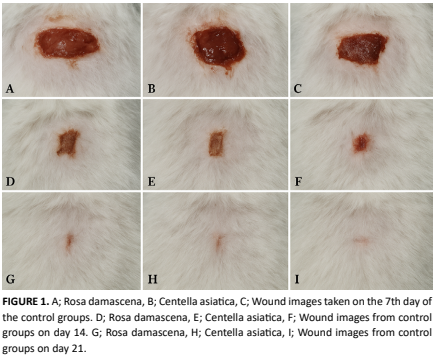
Dado que la cicatrización prolongada de heridas no solo compromete la comodidad del paciente, sino que también incrementa los costos de atención médica, los extractos obtenidos de diversas plantas son los preferidos en estudios clínicos y experimentales para acelerar la cicatrización de heridas y contribuir a su curación. El objetivo fue comparar la eficacia de Centella asiatica, cuya eficacia en la cicatrización de heridas ha sido demostrada en estudios previos, con la de Rosa damascena, cuya investigación aún está en curso. Se utilizaron veintiún ratas albinas Wistar de 8 a 10 semanas de edad. Se afeitó la región dorsal de las ratas con una máquina de afeitar, se limpió con suero fisiológico y se realizó una incisión de 2 x 2 cm para crear una herida escisional de espesor completo en la zona interescapular. Grupo I: Grupo control. Grupo II: Grupo Rosa damascena. El extracto de Rosa damascena se aplicó una vez al día y se cubrió con una gasa. Grupo III: Grupo Centella asiatica recibió una aplicación similar. Las dimensiones de la superficie de la herida se midieron los días 0, 7, 14 y 21 dibujando en papel acetato para calcular el área superficial. Los días 7, 14 y 21 se tomaron biopsias por punción de diferentes áreas para su examen histopatológico. El día 14, no se observó diferencia significativa entre Rosa damascena y Centella asiatica en cuanto al área superficial de la herida (P = 0,415). De nuevo, no se observó diferencia estadísticamente significativa entre los grupos en cuanto a la actividad de fibroblastos los días 7 y 21, y la neovascularización también fue insignificante los días 14 y 21. La regularidad y la densidad del colágeno aumentaron tanto en el grupo de Rosa damascena como en el de Centella asiatica. La retención de VEGF no mostró una diferencia significativa entre los dos grupos el día 21 (P = 0,762). Se concluyó que el extracto de Rosa damascena puede contribuir a la cicatrización de heridas con mayor eficacia que el ungüento de Centella asiatica.
Descargas
Citas
Armstrong DG, Boulton AJM, Bus SA. Diabetic foot ulcers and their recurrence. N. Engl. J. Med. [Internet]. 2017; 376(24):2367-2375. doi: https://doi.org/ghxjdv DOI: https://doi.org/10.1056/NEJMra1615439
Armstrong DG, Tan TW, Boulton AJM, Bus SA. Diabetic foot ulcers: a review. JAMA. [Internet]. 2023; 330(1):62-75. doi: https://doi.org/gs8nrj DOI: https://doi.org/10.1001/jama.2023.10578
Armstrong DG, Gurtner GC. A histologically hostile environment made more hospitable?. Nat. Rev. Endocrinol. [Internet]. 2018; 14(9):511-512. doi: https://doi.org/gqvtfw DOI: https://doi.org/10.1038/s41574-018-0073-6
Gál P, Toporcer T, Grendel T, Vidová Z, Smetana Jr K, Dvoránková B, Gál T, Mozes S, Lenhardt L, Longauer F, Sabol M, Sabo J, Backor M. Effect of Atropa belladonna L. on skin wound healing: biomechanical and histological study in rats and in vitro study in keratinocytes, 3T3 fibroblasts, and human umbilical vein endothelial cells. Wound Repair Regen. [Internet]. 2009; 17(3):378-386. doi: https://doi.org/bhj6sh DOI: https://doi.org/10.1111/j.1524-475X.2009.00475.x
Bahramsoltani R, Farzaei MH, Rahimi R. Medicinal plants and their natural components as future drugs for the treatment of burn wounds: an integrative review. Arch. Dermatol. Res. [Internet]. 2014; 306(7):601-617. doi: https://doi.org/f6r7fm DOI: https://doi.org/10.1007/s00403-014-1474-6
Vitale S, Colanero S, Placidi M, Di Emidio G, Tatone C, Amicarelli F, D’Alessandro AM. Phytochemistry and biological activity of medicinal plants in wound healing: an overview of current research. Molecules. [Internet]. 2022; 27(11):3566. doi: https://doi.org/qgr6 DOI: https://doi.org/10.3390/molecules27113566
Sh Ahmed A, Taher M, Mandal UK, Jaffri JM, Susanti D, Mahmood S, Zakaria ZA. Pharmacological properties of Centella asiatica hydrogel in accelerating wound healing in rabbits. BMC Complement. Altern. Med. [Internet]. 2019; 19(1):213. doi: https://doi.org/qgr7 DOI: https://doi.org/10.1186/s12906-019-2625-2
Gohil KJ, Patel JA, Gajjar AK. Pharmacological review on Centella asiatica: a potential herbal cure-all. Indian J. Pharm. Sci. [Internet]. 2010; 72(5):546-556. doi: https://doi.org/b7xwws DOI: https://doi.org/10.4103/0250-474X.78519
Changsan N, Srichana T, Atipairin A, Sawatdee S. Wound healing efficacy of a polymeric spray film solution containing Centella asiatica leaf extract on acute wounds. J. Wound Care. [Internet]. 2023; 32(12):S22-S32. doi: https://doi.org/g82mvr DOI: https://doi.org/10.12968/jowc.2023.32.Sup12.S22
Arribas-López E, Zand N, Ojo O, Snowden MJ, Kochhar T. A systematic review of the effect of Centella asiatica on wound healing. Int. J. Environ. Res. Public. Health. [Internet]. 2022; 19(6):3266. doi: https://doi.org/gptbvv
Mohebitabar S, Shirazi M, Bioos S, Rahimi R, Malekshahi F, Nejatbakhsh F. Therapeutic efficacy of rose oil: a comprehensive review of clinical evidence. Avicenna J. Phytomed. 2017; 7(3):206-213. doi: https://doi.org/qgth
Singh MK, Savita K, Singh S, Mishra D, Rani P, Chanda D, Verma RS. Vasorelaxant property of 2-phenyl ethyl alcohol isolated from the spent floral distillate of damask rose (Rosa damascena Mill.) and its possible mechanism. J. Ethnopharmacol. [Internet]. 2023; 313:116603. doi: https://doi.org/qgtj DOI: https://doi.org/10.1016/j.jep.2023.116603
Wang H. Beneficial medicinal effects and material applications of rose. Heliyon. [Internet]. 2023; 10(1):e23530. doi: https://doi.org/qgtk DOI: https://doi.org/10.1016/j.heliyon.2023.e23530
Jo S, Jung YS, Cho YR, Seo JW, Lim WC, Nam TG, Lim TG, Byun S. Oral administration of Rosa gallica prevents UVB- induced skin aging through targeting the c-Raf signaling axis. Antioxidants. [Internet]. 2021; 10(11):1663. doi: https://doi.org/qgtm DOI: https://doi.org/10.3390/antiox10111663
Galiano RD, Michaels J, Dobryansky M, Levine JP, Gurtner GC. Quantitative and reproducible model of excisional wound healing in mice. Wound Repair Regen. [Internet]. 2004; 12(4):485-492. doi: https://doi.org/dx8xqf DOI: https://doi.org/10.1111/j.1067-1927.2004.12404.x
Yildizhan E, Ulger BV, Akkus M, Akinci D, Basol O. Comparison of topical sucralfate with dexpanthenol in rat wound model. Int. J. Exp. Path. [Internet]. 2022; 103(4):164-170. doi: https://doi.org/qgtn DOI: https://doi.org/10.1111/iep.12441
Erdogan MA, Yalcin A. Protective effects of benfotiamine on irisin activity in methotrexate-induced liver injury in rats. Arch. Med. Sci. [Internet]. 2018; 16(1):205-211. doi: https://doi.org/qgtp DOI: https://doi.org/10.5114/aoms.2018.80002
Bardaa S, Makni K, Boudaouara O, Bardaa T, Ktari N, Hachicha S, Salah RB, Kallel R,Sahnoun S, Boufi S. Development and evaluation of the wound healing effect of a novel topical cream formula based on Ginkgo biloba extract on wounds in diabetic rats. Biomed. Res. Int. [Internet]. 2021; 2021:6474706. doi: https://doi.org/qgtq DOI: https://doi.org/10.1155/2021/6474706
Kim YW, Baek SR, Lee ES, Lee SH, Moh SH, Kim SY, Moh JH, Kondo C, Cheon YW. Wound healing effects of rose placenta in a mouse model of full-thickness wounds. Arch. Plast. Surg. [Internet]. 2015; 42(6):686-694. doi: https://doi.org/gcbpg8 DOI: https://doi.org/10.5999/aps.2015.42.6.686
Nie X, Zhang H, Shi X, Zhao J, Chen Y, Wu F, Yang J, Li X. Asiaticoside nitric oxide gel accelerates diabetic cutaneous ulcers healing by activating Wnt/β-catenin signaling pathway. Int. Immunopharmacol. [Internet]. 2020; 79:106109. doi: https://doi.org/qgtr DOI: https://doi.org/10.1016/j.intimp.2019.106109
Cialdai F, Risaliti C, Monici M. Role of fibroblasts in wound healing and tissue remodeling on Earth and in space. Front. Bioeng. Biotechnol. [Internet]. 2022; 10:958381. doi: https://doi.org/g9rbrx DOI: https://doi.org/10.3389/fbioe.2022.958381
Madden JW, Peacock EE Jr. Studies on the biology of collagen during wound healing. 3. Dynamic metabolism of scar collagen and remodeling of dermal wounds. Ann. Surg. [Internet]. 1971; 174(3):511-520. doi: https://doi.org/df46fn DOI: https://doi.org/10.1097/00000658-197109000-00017
Yuliati L, mardliyati E, Bramono K, Freisleben HJ. Asiaticoside induces cell proliferation and collagen synthesis in human dermal fibroblasts. Universa Medicina. [Internet]. 2015; 34(2):96-103. doi: https://doi.org/qgts DOI: https://doi.org/10.18051/UnivMed.2015.v34.96-103
Arribas-López E, Zand N, Ojo O, Snowden MJ, Kochhar T. A systematic review of the effect of Centella asiatica on wound healing. Int. J. Environ. Res. Public. Health. [Internet]. 2022; 19(6):3266. doi: https://doi.org/gptbvv DOI: https://doi.org/10.3390/ijerph19063266
Rezaie-Tavirani M, Fayazfar S, Heydari-Keshel S, Rezaee MB, Zamanian-Azodi M, Rezaei-Tavirani M, Khodarahmi R. Effect of essential oil of Rosa damascena on human colon cancer cell line SW742. Gastroenterol. Hepatol. Bed Bench. [Internet]. 2013; 6(1):25-31. doi: https://doi.org/qgtt
Adetutu A, Morgan WA, Corcoran O.Ethnopharmacological survey and in vitro evaluation of wound-healing plants used in South-western Nigeria. J. Ethnopharmacol. [Internet]. 2011; 137(1):50-56. doi: https://doi.org/d4x42m DOI: https://doi.org/10.1016/j.jep.2011.03.073
Coger V, Million N, Rehbock C, Sures B, Nachev M, Barcikowski S, Wistuba N, Strauß S, Vogt PM. Tissue concentrations of zinc, iron, copper, and magnesium during the phases of full thickness wound healing in a rodent model. Biol. Trace Elem. Res. [Internet]. 2019; 191(1):167-176. doi: https://doi.org/qgtv DOI: https://doi.org/10.1007/s12011-018-1600-y
Bonte F, Dumas M, Chaudagne C, Meybeck A. Influence of asiatic acid, madecassic acid, and asiaticoside on human collagen I synthesis. Planta Med. [Internet]. 1994; 60(2):133-135. doi: https://doi.org/c7b7fk DOI: https://doi.org/10.1055/s-2006-959434
Maquart FX, Chastang F, Simeon A, Birembaut P, Gillery P, Wegrowski Y. Triterpenes from Centella asiatica stimulate extracellular matrix accumulation in rat experimental wounds. Eur. J. Dermatol. [Internet]. 1999 [Cited 25 Jun 2025]; 9(4):289-296. Available in: https://goo.su/Ln1ytv
Sunilkumar, Parameshwaraiah S, Shivakumar HG. Evaluation of topical formulations of aqueous extract of Centella asiatica on open wounds in rats. Indian. J. Exp. Biol. [Internet]. 1998 [Cited 25 Jun 2025]; 36(6):569-572. Available in: https://goo.su/xoLqg
Park B, Hwang E, Seo SA, Zhang M, Park SY, Yi TH. Dietary Rosa damascena protects against UVB-induced skin aging by improving collagen synthesis via MMPs reduction through alterations of c-Jun and c-Fos and TGF-β1 stimulation mediated smad2/3 and smad7. J. Funct. Foods. [Internet]. 2017; 36:480-489. doi: https://doi.org/gbv7gf DOI: https://doi.org/10.1016/j.jff.2017.07.028
Cesarone MR, Belcaro G, De Sanctis MT, Incandela L, Cacchio M, Bavera P, Ippolito E, Bucci M, Griffin M, Geroulakuos G, Dugall M, Buccella S, Kleyweght S, Cacchio M. Effects of the total triterpenic fraction of Centella asiatica in venous hypertensive microangiopathy: a prospective, placebo-controlled, randomized trial. Angiology. [Internet]. 2001 [Cited 25 Jun 2025]; 52(S2):S15-S18. Available in: https://goo.su/H6cUL DOI: https://doi.org/10.1177/000331970105202S04
Liu M, Dai Y, Li Y, Luo Y, Huang F, Gong Z, Meng Q. Madecassoside isolated from Centella asiatica herbs facilitates burn wound healing in mice. Planta Med. [Internet]. 2008; 74(8):809-815. doi: https://doi.org/fjfk7g DOI: https://doi.org/10.1055/s-2008-1074533
Batur S, Ayla S, Sakul AA, Okur ME, Karadag AE, Daylan B, Özdemir EM, Kepil N, Günal MY. An alternative approach wound healing field with Polypodium vulgare. Medeni. Med. J. [Internet]. 2020; 35(4):315-323. doi: https://doi.org/qgt3 DOI: https://doi.org/10.5222/MMJ.2020.89983
Zhang F, Lineaweaver W. Acute and sustained effects of vascular endothelial growth factor on survival of flaps and skin grafts. Ann. Plast. Surg. [Internet]. 2011; 66(5):581-582. doi: https://doi.org/cbx3mf DOI: https://doi.org/10.1097/SAP.0b013e3182057376
Feng X, Huang D, Lin D, Zhu L, Zhang M, Chen Y, Wu F. Effects of asiaticoside treatment on the survival of random skin flaps in rats. J. Invest. Surg. [Internet]. 2021; 34(1):107-117. doi: https://doi.org/g62z5v DOI: https://doi.org/10.1080/08941939.2019.1584255