Efecto protector del tetraborato de sodio sobre los perfiles de ácidos grasos en el corazon de ratas, expuestas a toxicidad por plomo
Resumen
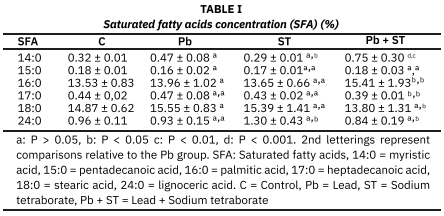
Este estudio fue diseñado para observar los efectos del tetraborato de sodio en la prevención del daño causado por la toxicidad del metal plomo a los ácidos grasos en el tejido cardíaco de ratas. Tras homogeneizar el tejido cardíaco con tampón Tris-HCl, el sedimento separado se preparó para el análisis de ácidos grasos. Los ácidos grasos del extracto lipídico obtenido se transformaron en éster metílico y se analizaron mediante cromatografía de gases SHIMADZU GC 2010 PLUS. Al comparar el grupo plomo con el grupo plomo + tetraborato de sodio, se observaron aumentos parciales en los niveles de ácidos grasos saturados como ácido mirístico (14:0), ácido pentadecanoico (15:0) y ácido palmítico (16:0), mientras que se observaron aumentos variables en algunos niveles de ácidos grasos monoinsaturados como ácido palmitoleico (16:1, n-7) y ácido oleico (18:1, n-9). Además, se observaron aumentos variables en todos los ácidos grasos poliinsaturados, excluyendo los ácidos grasos ácido araquidónico (20:4, n-6) y ácido adrenérgico (22:4, n-6). El cambio más notable en los ácidos grasos en nuestro estudio, el aumento del ácido graso ácido araquidónico (20:4, n-6) en el grupo tratado con plomo, mientras que disminuyó en el grupo tratado con tetraborato de sodio, demuestra que tetraborato de sodio disminuyó los efectos negativos del estrés oxidativo sobre los ácidos grasos. Los resultados de este estudio proporcionan evidencia que respalda el uso potencial de tetraborato de sodio en el diseño de fármacos para prevenir los efectos tóxicos del plomo.
Descargas
Citas
Khaliq H, Juming Z, Ke-Mei P. The Physiological Role of Boron on Health. Biol. Trace. Elem. Res. [Internet]. 2018; 186:31-51. doi: https://doi.org/gfhcgt DOI: https://doi.org/10.1007/s12011-018-1284-3
Sun P, Luo Y, Wu XT, Ansari AR, Wang J Yang K, Xiao K, Peng K. Effects of Supplemental Boron on Intestinal Proliferation and Apoptosis in African Ostrich Chicks. Int. J. Morphol. [Internet]. 2016; 34(3):830-835. doi: https://doi.org/q7cd DOI: https://doi.org/10.4067/S0717-95022016000300002
Keklik E, Keklik M, Bakkaloğlu U, Yürük M, Çoksevim B. The Effect of Borax on Hematological Parameters and Immunoglobulin Values in Rats. West Indian Med. J. [Internet]. 2016; 65:1-14. doi: https://doi.org/q7cf DOI: https://doi.org/10.7727/wimj.2016.359
Hadrup N, Frederiksen M, Sharma AK. Toxicity of boric acid, borax and other boron containing compounds: A review. Regul. Toxicol. Pharmacol. [Internet]. 2021; 121:104873. doi: https://doi.org/q7cg DOI: https://doi.org/10.1016/j.yrtph.2021.104873
Sandhir R, Gill KD. Effect of lead on lipid peroxidation in liver of rats. Biol Trace Elem Res. [Internet]. 1995; 48(1):91-97. doi: https://doi.org/fs5xj3 DOI: https://doi.org/10.1007/BF02789081
El-Sokkary GH, Kamel ES, Reiter RJ. Prophylactic effect of melatonin in reducing lead-induced neurotoxicity in the rat. Cell. Mol. Biol. Lett. [Internet]. 2003; 8(2):461-470. [cited 19 Apr 2026]. Available in: https://goo.su/T5Bk1t
Solliway BM, Schaffer A, Pratt H, Yannai S. Effects of exposure to lead on selected biochemical and haematological variables. Pharmacol. Toxicol. [Internet]. 1996; 78(1):18-22. doi: https://doi.org/bk79m8 DOI: https://doi.org/10.1111/j.1600-0773.1996.tb00174.x
Knowles SO, Donaldson WE. Dietary modification of lead toxicity: Effects on fatty acid and eicosanoid metabolism in chicks. Comp. Biochem. Physiol. C. Comp. Pharmacol. [Internet]. 1990; 95(1):99-104. doi: https://doi.org/fd3v DOI: https://doi.org/10.1016/0742-8413(90)90088-Q
Lawton LJ, Donaldson WE. Lead-induced tissue fatty acid alterations and lipid peroxidation. Biol. Trace Elem. Res. [Internet]. 1991; 28(2):83-97. doi: https://doi.org/b3jbkd DOI: https://doi.org/10.1007/BF02863075
Ribarov SR, Benov LC. Relationship between the hemolytic action of heavy metals and lipid peroxidation. Biochim. Biophys. Acta. [Internet]. 1981; 640(3):721-726. doi: https://doi.org/bj6h25 DOI: https://doi.org/10.1016/0005-2736(81)90102-4
Aoki Y, Brody DJ, Flegal KM, Fakhouri THI, Parker JD, Axelrad DA. Blood Lead and Other Metal Biomarkers as Risk Factors for Cardiovascular Disease Mortality. Medicine. [Internet]. 2016; 95(1):e2223. doi: https://doi.org/q7cm DOI: https://doi.org/10.1097/MD.0000000000002223
Menke A, Muntner P, Batuman V, Silbergeld EK, Guallar, E. Blood lead below 0.48 micromol/L (10 microg/dL) and mortality among US adults. Circulation. [Internet]. 2006; 114(13):1388-1394. doi: https://doi.org/csgott DOI: https://doi.org/10.1161/CIRCULATIONAHA.106.628321
Javorac D, Tatovi'c S, Anđelkovic M, Repi'c A, Barali'c K, Djordjevic AB, Mihajlovic M, Stevuljevic JK, Đuki'c-'Cosi'c D, 'Cur ci M, Antonijevi 'c B, Bula, Z. Low-lead doses induce oxidative damage in cardiac tissue: Subacute toxicity study in Wistar rats and Benchmark dose modelling. Food Chem. Toxicol. [Internet]. 2022; 161:112825. doi: https://doi.org/q7cq DOI: https://doi.org/10.1016/j.fct.2022.112825
Fan Y, Zhao X, Yu J, Xie J, Li C, Liu D, Tang C, Wang C. Lead-induced oxidative damage in rats/mice: a meta-analysis. J. Trace Elem. Med. Biol. [Internet]. 2020; 58:126443. doi: https://doi.org/gp35nt DOI: https://doi.org/10.1016/j.jtemb.2019.126443
Basaran N, Duydu Y, Bacanlı M, Gül-Anlar H, Dilsiz SA, Üstündağ A, Yalçın CÖ, Schwerdtle T, Bolt HM. Evaluation of oxidative stress and immune parameters of boron exposed males and females. Food Chem. Toxicol. [Internet]. 2020; 142:111488. doi: https://doi.org/q7cr DOI: https://doi.org/10.1016/j.fct.2020.111488
Poreba R, Gac P, Poreba M, Andrzejak R. Environmental and occupational exposure to lead as a potential risk factor for cardiovascular diseases. Environ. Toxicol. Pharmcol. [Internet]. 2011; 31(2):267-277. doi: https://doi.org/dvgtks DOI: https://doi.org/10.1016/j.etap.2010.12.002
Jan AT, Azam M, Siddiqui K, Ali A, Choi I, Rizwanul-Haq QM. Heavy Metals and Human Health: Mechanistic Insight into Toxicity and Counter Defense System of Antioxidants. Int. J. Mol. Sci. [Internet]. 2015; 16(12):29592-29630. doi: https://doi.org/f756m8 DOI: https://doi.org/10.3390/ijms161226183
Abdelnour SA, Abd El-Hack M, Swelum AA, Perillo A, Losacco C. The vital roles of boron in animal health and production: a comprehensive review. J. Trace Elem. Med. Biol. [Internet]. 2018; 50:296-304.doi: https://doi.org/gfm5s4 DOI: https://doi.org/10.1016/j.jtemb.2018.07.018
Kar I, Patra AK. Tissue bioaccumulation and toxicopathological effects of cadmium and its dietary amelioration in poultry-a review. Biol. Trace Elem. Res. [Internet]. 2021; 199(10):3846-3868. doi: https://doi.org/g37jv3 DOI: https://doi.org/10.1007/s12011-020-02503-2
Donaldson WE, Knowles SO. Is lead toxicosis a reflection of altered fatty acid composition of membranes? Comp. Biochem. Physiol. C Comp. Pharmacol. [Internet].1993; 104(3):377-379. doi: https://doi.org/c7n28b DOI: https://doi.org/10.1016/0742-8413(93)90003-4
Hsu P.C, Guo YL. Antioxidant nutrients and lead toxicity. Toxicology. [Internet]. 2002; 180(1):33-44. doi: https://doi.org/bvs5zk
Jomova K, Valko M. Advances in metal-induced oxidative stress and human disease. Toxicology. [Internet]. 2011; 283(2-3):65-87. doi: https://doi.org/fc7bv8 DOI: https://doi.org/10.1016/j.tox.2011.03.001
Guide for the Care and Use of Laboratory Animals. National Research Council. 8th edition. Committee for the Update of the Guide for the Care and Use of Laboratory Animals. Washington, DC, USA: National Academies Press; 2011 [cited 20 Jan 2026]. Available in: https://goo.su/X95u9t
Salcan I, Dilber M, Bayram R, Suleyman E, Erhan E, Karahan Yilmaz S, Yazici GN, Coban, A, Suleyman H. Effect of Taxifolin on Cobalt-induced Ototoxicity in Rats: A Biochemical and Histopathological Study. Int. J. Pharmacol. [Internet]. 2000 [cited Sep 15 2025]; 16(8):522-528. doi: https://doi.org/q7c3 DOI: https://doi.org/10.3923/ijp.2020.522.528
Beydilli H, Yilmaz N, Cetin ES, Topal Y, Celik OI, Sahin C, Topal H, Cigerci IH, Sozen H. Evaluation of the protective effect of silibinin against diazinon induced hepatotoxicity and free-radical damage in rat liver. Iran Red. Crescent. Med. J. [Internet]. 2015; 17(4):e25310. doi: https://doi.org/q7c4 DOI: https://doi.org/10.5812/ircmj.17(4)2015.25310
Demir E, Yılmaz Ö. The effects of bitter almond oil on some biochemical parameters in serum and erythrocytes of streptozotocin-induced Type-1 diabetic rats. Van Vet. J. [Internet]. 2015 [cited 01 Sep 2025]; 26(1):17-23. Available in: https://goo.su/njb2B
Hara A, Radin NS. Lipid extraction of tissues with a low-toxicity solven. Anal. Biochem. [Internet]. 1978; 90(1):420-426. doi: https://doi.org/b3c4h8 DOI: https://doi.org/10.1016/0003-2697(78)90046-5
Christie WW. Gas chromatography and lipids. Glaskow: The Oil Pres; [Internet]. 1989. [cited 07 Sep 2025]. Available in: https://goo.su/7C872
Ichihara K, Fukubayashi Y. Preparation of fatty acid methyl esters for gas-liquid chromatography. J. Lipid Res. [Internet], 2010; 51(3):635-640. doi: https://doi.org/b5g5sk DOI: https://doi.org/10.1194/jlr.D001065
Tvrzicka E, Vecka M, Stankova Zak A. Analysis of fatty acids inplasma lipoproteins by gas chromatography flame ionisation detection Quantative aspects. Anal. Chim. Acta. [Internet]. 2002; 465(1-2):337-350. doi: https://doi.org/d624gw DOI: https://doi.org/10.1016/S0003-2670(02)00396-3
Cikler-Dulger E, Sogut I. Investigation of the protective effects of boric acid on ethanol induced kidney injury. Biotech. Histochem. [Internet]. 2020; 95(3):186-193. doi: https://doi.org/gjvtcj DOI: https://doi.org/10.1080/10520295.2019.1662086
Jung JM, Lee J, Kim KH, Jang IG, Song JG, Kang K, Tack FMG, Oh JI, Kwon EE, Kim HW. The effect of lead exposure on fatty acid composition in mouse brain analyzed using pseudo-catalytic derivatization. Environ. Pollut. [Internet]. 2017; 222:182-190. doi: https://doi.org/f9zp3g DOI: https://doi.org/10.1016/j.envpol.2016.12.058
Hsu PC, Guo YL. Antioxidant nutrients and lead toxicity. Toxicology. [Internet]. 2002; 180(1):33-44. doi: https://doi.org/bvs5zk DOI: https://doi.org/10.1016/S0300-483X(02)00380-3
Hoffman DJ, Heinz GH, Sileo L, Audet DJ, Campbell JK, Le Captain LJ. Developmental toxicity of lead-contaminated sediment to mallard ducklings. Arch. Environ. Contam. Toxicol. [Internet]. 2000;39(2):221-232. doi: https://doi.org/bsfjq7 DOI: https://doi.org/10.1007/s002440010099
Hoffman DJ, Heinz GH, Sileo L, Audet DJ, Campbell JK, LeCaptain LJ, Obrecht HH. Developmental toxicity of lead-contaminated sediment in Canada geese (Branta canadensis). J. Toxicol. Environ. Health A. [Internet]. 2000; 59(4):235-252. doi: https://doi.org/bj953v DOI: https://doi.org/10.1080/009841000156916
Dewanjee S, Sahu R, Karmakar S, Gangopadhyay M. Toxic Effects Of Lead Exposure In Wistar Rats: Involvement Of Oxidative Stress And The Beneficial Role Of Edible Jute (Corchorus olitorius) Leaves. [Internet]. Food Chem. Toxicol. 2013; 55: 78-91. doi: https://doi.org/f4tq7x DOI: https://doi.org/10.1016/j.fct.2012.12.040
Reckziegel P, Dias VT, Benvegnú DM, Boufleur N, Barcelos RCS, Segat HJ, Pase CS, dos Santos CMM, Flores EMM, Bürger ME. Antioxidant Protection Of Gallic Acid Against Toxicity Induced By Pb In Blood, Liver And Kidney Of Rats. Toxicol. Rep. [Internet]. 2016; 3:351-356. doi: https://doi.org/g5jxpx DOI: https://doi.org/10.1016/j.toxrep.2016.02.005
Markiewicz-Gorka I, Januszewska L, Michalak A, Prokopowicz A, Januszewska E, Pawlas N, Pawlas K. Effects of chronic exposure to lead, cadmium, and manganese mixtures on oxidative stress in rat liver and heart. Arh. Hig. Rada. Toksikol. [Internet]. 2015; 66(1):51-61. doi: https://doi.org/gm75q6 DOI: https://doi.org/10.1515/aiht-2015-66-2515
Knowles SO, Donaldson WE, Andrews JE. Changes in fatty acid composition of lipids from birds, rodents, and preschool children exposed to lead. Biol. Trace Elem.Res. [Internet]. 1998; 61:113-125. doi: https://doi.org/dw8zdh DOI: https://doi.org/10.1007/BF02784024
Osterode W, Ulberth F. Increased concentration of arachidonic acid in erythrocyte membranes in chronically lead-exposed men. J. Toxicol. Environ. Health A. [Internet]. 2000; 59(2):87-95. doi: https://doi.org/cgv3mn DOI: https://doi.org/10.1080/009841000156998
Reglero MM, Taggart MA, Monsalve-Gonzalez L, Mateo R. Heavy metal exposure in large game from a lead mining area:Effects on oxidative stress and fatty acid composition in liver. Environ. Pollut. [Internet]. 2009; 157(4):1388-1395. doi: https://doi.org/fshngd DOI: https://doi.org/10.1016/j.envpol.2008.11.036
Lim SY, Doherty JD, McBride K, Miller-Ihli NJ, Carmona GN, Stark KD, Salem NJr. Lead exposure and (n-3) fatty acid deficiency during rat neonatal development affect subsequent spatial task performance and olfactory discrimination. J. Nutr. [Internet]. 2005: 135(5):1019-1026. doi: https://doi.org/q7c9 DOI: https://doi.org/10.1093/jn/135.5.1019
Lim SY, Loewke J, Doherty JD, Norman SJr. Preferential effect of lead exposure during lactation on non-essential fatty acids in maternal organs. Lipids. [Internet]. 2005b; 40(7):685-693. doi: https://doi.org/fm2cgj DOI: https://doi.org/10.1007/s11745-005-1431-z
Donaldson, WE, Leeming TK. Dietary Lead: Effects on Hepatic Fatty Acid Composition in Chicks. Toxicol. Appl. Pharmacol. [Internet]. 1984; 73(1):119-123. doi: https://doi.org/c3s6df DOI: https://doi.org/10.1016/0041-008X(84)90060-7