Efectos del sexo y la suplementación con laurel (Laurus nobilis L.) sobre el rendimiento de crecimiento, características de la canal, órganos digestivos y parámetros bioquímicos en codornices japonesas (Coturnix coturnix japonica Temminck & Schlegel)
Resumen
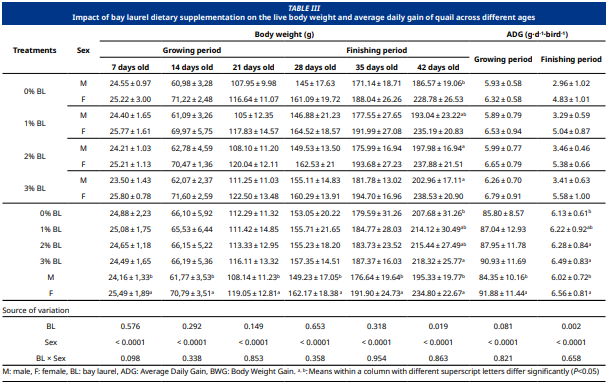
Este estudio explora la incorporación de laurel de bahía en la dieta de codornices japonesas como una alternativa natural a los aditivos sintéticos. El objetivo es promover el crecimiento de las codornices mientras se evalúan los efectos de la suplementación con laurel de bahía sobre las características de la canal, los órganos digestivos y los resultados de la bioquímica sanguínea. Inicialmente, 208 pollitos sin sexar fueron alimentados con una dieta estándar sin laurel de bahía durante siete días. Luego se dividieron en cuatro grupos: 0 %, 1 %, 2 % y 3 % de laurel de bahía, con cada grupo teniendo cuatro réplicas de 13 codornices. El estudio encontró que la suplementación con 3 % de laurel de bahía aumentó el peso corporal a los 42 días (P = 0,019) y la ganancia diaria promedio durante la fase de finalización (P = 0,002). Los grupos alimentados con 2 % y 3 % de laurel de bahía mostraron una disminución en el consumo de alimento (P = 0,022) y en el índice de conversión alimenticia durante la fase de crecimiento (P = 0,01) y un rendimiento de cana mayor (P = 0,013). Además, el 3 % de laurel de bahía aumentó el peso del intestino (P = 0,006) y la longitud cecal (P<0,0001). Todos los niveles de suplementación con laurel de bahía (1 %, 2 % y 3 %) produjeron reducciones en la glucosa sanguínea, los triglicéridos y el colesterol total (P<0,0001). La adición de laurel de bahía no tuvo un efecto sobre otros parámetros bioquímicos (P>0,05). Los efectos del sexo fueron durante todo el período experimental, con las hembras demostrando un peso corporal y ganancia diaria promedio superiores (P<0,0001). Los machos exhibieron un mayor rendimiento de canal (P<0,0001) y proporción de corazón (P<0,0001), mientras que las hembras mostraron mayores niveles de triglicéridos (P<0,0001), proteína total (P = 0,007) y calcio (P<0,0001). Las interacciones laurel de bahía × sexo revelaron diferencias en el colesterol total (P = 0,004), la proporción de corazón (P = 0,013) y el peso del intestino (P = 0,010). La adición de 3 % de laurel de bahía al alimento de las codornices resulta en un mejor rendimiento de crecimiento, rendimiento de canal, desarrollo intestinal y parámetros bioquímicos.
Descargas
Citas
El-Hack MEA, Majrashi KA, Fakiha KG, Roshdy M, Kamal M, Saleh RM, Khafaga AF, Othman SI, Rudayni HA, Allam AA, Moustafa M, Tellez-Isaias G, Alagawany M. Effects of varying dietary microalgae levels on performance, egg quality, fertility, and blood biochemical parameters of laying Japanese quails (Coturnix coturnix japonica). Poult. Sci. [Internet]. 2024; 103(4):103454. doi: https://doi.org/q24q DOI: https://doi.org/10.1016/j.psj.2024.103454
Batool F, Bilal RM, Hassan FU, Nasir TA, Rafeeque M, Elnesr SS, Farag MR, Mahgoub HAM, Naiel MAE, Alagawany M. An updated review on behavior of domestic quail with reference to the negative effect of heat stress. Anim. Biotechnol. [Internet]. 2023; 34(2):424-437. doi: https://doi.org/q24r DOI: https://doi.org/10.1080/10495398.2021.1951281
Quaresma MAG, Antunes IC, Ferreira BG, Parada A, Elias A, Barros M, Santos C, Partidário A, Mourato M, Roseiro LC. The composition of the lipid, protein and mineral fractions of quail breast meat obtained from wild and farmed specimens of common quail (Coturnix coturnix) and farmed Japanese quail (Coturnix japonica domestica). Poult. Sci. [Internet]. 2022; 101(1):101505. doi: https://doi.org/g79x9s DOI: https://doi.org/10.1016/j.psj.2021.101505
Sabow AB. Carcass characteristics, physicochemical attributes, and fatty acid and amino acid compositions of meat obtained from different Japanese quail strains. Trop. Anim. Health Prod. [Internet]. 2020; 52(1):131-140. doi: https://doi.org/q24t DOI: https://doi.org/10.1007/s11250-019-01991-2
Abdulkadir A, Reddy D. A scoping review of the impact of heat stress on the organs of the Japanese quail (Coturnix japonica). J. Basic Appl. Zool. [Internet]. 2023; 84(1):8. doi: https://doi.org/q24s DOI: https://doi.org/10.1186/s41936-023-00331-z
Avcılar ÖV, Yılmaz E. The effects of different slaughter ages and gender on some meat quality characteristics, texture and sensory evaluation values in Japanese quails. Kocatepe Vet. J. [Internet]. 2023; 16(3):287-292. doi: https://doi.org/q24v
Ishige T, Hara H, Hirano T, Kono T, Hanzawa K. Genetic diversity of Japanese quail cathelicidins. Poult. Sci. [Internet]. 2021; 100(5):101046. doi: https://doi.org/q24w DOI: https://doi.org/10.1016/j.psj.2021.101046
Naimati S, Doğan SC, Asghar MU, Wilk M, Korczyński M. The effect of quinoa seed (Chenopodium quinoa Willd.) extract on the performance, carcass characteristics, and meat quality in Japanese quails (Coturnix coturnix japonica). Animals [Internet]. 2022; 12(14):1851. doi: https://doi.org/g7hhb7 DOI: https://doi.org/10.3390/ani12141851
Bolacali M, Irak K, Tufan T, Küçük M. Effects of gender and dietary date palm extract on performance, carcass traits, and antioxidant status of Japanese quail. S. Afr. J. Anim. Sci. [Internet]. 2021; 51(3):387-398. doi: https://doi.org/q24x DOI: https://doi.org/10.4314/sajas.v51i3.13
Ayalew H, Zhang H, Wang J, Wu S, Qiu K, Qi G, Tekeste A, Wassie T, Chanie D. Potential feed additives as antibiotic alternatives in broiler production. Front. Vet. Sci. [Internet]. 2022; 9:916473. doi: https://doi.org/q24z DOI: https://doi.org/10.3389/fvets.2022.916473
El-Rayes TK, El Basuini MFM, Fouad W, Farag SA, Ahmed AI, Ahmad EAM, Dawood MAO. Comparison of different papaya forms on the growth performance, immune response, antioxidative capacity, and caecal microbiota of Japanese quails. Sci. Afr. [Internet]. 2024; 23:e02033. doi: https://doi.org/g8xcf9 DOI: https://doi.org/10.1016/j.sciaf.2023.e02033
El-Hack MEA, El-Saadony MT, Salem HM, El-Tahan AM, Soliman MM, Youssef GBA, Taha AE, Soliman SM, Ahmed AE, El-Kott AF, Al Syaad KM, Swelum AA. Alternatives to antibiotics for organic poultry production: types, modes of action and impacts on bird's health and production. Poult. Sci. [Internet]. 2022; 101(4):101696. doi: https://doi.org/q242 DOI: https://doi.org/10.1016/j.psj.2022.101696
Singletary K. Bay leaf: Potential health benefits. Nutr. Today. [Internet]. 2021; 56(4):202-208. doi: https://doi.org/q243 DOI: https://doi.org/10.1097/NT.0000000000000493
Anzano A, De Falco B, Grauso L, Motti R, Lanzotti V. Laurel, Laurus nobilis L.: a review of its botany, traditional uses, phytochemistry and pharmacology. Phytochem. Rev. [Internet]. 2022; 21(2):565-615. doi: https://doi.org/q244 DOI: https://doi.org/10.1007/s11101-021-09791-z
Khalil NA, ALFaris NA, ALTamimi JZ, Mohamed-Ahmed IA. Anti-inflammatory effects of bay laurel (Laurus nobilis L.) towards the gut microbiome in dextran sodium sulfate induced colitis animal models. Food Sci. Nutr. [Internet]. 2024; 12(4):2650-2660. doi: https://doi.org/q246 DOI: https://doi.org/10.1002/fsn3.3946
Berendika M, Domjanić Drozdek S, Odeh D, Oršolić N, Dragičević P, Sokolović M, Elez Garofulić I, Đikić D, Landeka-Jurčević I. Beneficial effects of laurel (Laurus nobilis L.) and myrtle (Myrtus communis L.) extract on rat health. Molecules [Internet]. 2022; 27(2):581. doi: https://doi.org/gqw89p DOI: https://doi.org/10.3390/molecules27020581
NRC. Nutrient requirements of poultry. 9th ed. Washington (DC): National Academy Press; 1994. p. 44-45 [cited 7 Feb 2026]. Available in: https://goo.su/odH4H
Brake J, Havenstein GB, Scheideler SE, Ferket PR, Rives DV. Relationship of sex, age, and body weight to broiler carcass yield and offal production. Poult. Sci. [Internet]. 1993; 72(6):1137-1145. doi: https://doi.org/g8xcgh DOI: https://doi.org/10.3382/ps.0721137
Duncan DB. Multiple range and multiple F tests. Biometrics [Internet]. 1955; 11(1):1-42. doi: https://doi.org/fhcz8h DOI: https://doi.org/10.2307/3001478
Mustafa M, Abdullah S. Effect of bay leaf (Laurus nobilis L.) powder and oil additives on reproductive performance and some hormone indicators of quails. Tikrit J. Agric. Sci. [Internet]. 2020; 20(1):49-57. doi: https://doi.org/q249 DOI: https://doi.org/10.25130/tjas.20.1.5
Al Rubaee MAM. Effect of bay laurel (Laurus nobilis L.) leaf powder dietary supplementation on dressing percent, carcass traits, carcass cuts and some internal organs of quail. Indian J. Sci. Technol. [Internet]. 2018; 11(37):1-6. doi: https://doi.org/pgmc DOI: https://doi.org/10.17485/ijst/2018/v11i37/130988
Ali NAL, Al-Shuhaib MBS. Highly effective dietary inclusion of laurel (Laurus nobilis) leaves on productive traits of broiler chickens. Acta Sci. Anim. Sci. [Internet]. 2021; 43:e52198. doi: https://doi.org/q25g DOI: https://doi.org/10.4025/actascianimsci.v43i1.52198
Gölcü AO, Duru AA. The effects of laurel (Laurus nobilis L.) leaf powder supplementation on performance, carcass characteristics, meat lipid oxidation and some blood parameters of broiler chicks. J. Hell. Vet. Med. Soc. [Internet]. 2023; 74(2):5677-5686. doi: https://doi.org/q25h DOI: https://doi.org/10.12681/jhvms.29936
Chimezie VO, Akintunde AO, Ademola AA, Aina FA. Principal component analysis of bodyweight and morphometric traits in Japanese quail (Coturnix coturnix japonica). Aceh J. Anim. Sci. [Internet]. 2022; 7(2):47-52. doi: https://doi.org/g8xcgs DOI: https://doi.org/10.13170/ajas.7.2.24533
Ibrahim NS, El-Sayed MA, Assi HAM, Enab A, Abdel-Moneim AME. Genetic and physiological variation in two strains of Japanese quail. J. Genet. Eng. Biotechnol. [Internet]. 2021; 19(1):15. doi: https://doi.org/q25j DOI: https://doi.org/10.1186/s43141-020-00100-3
Narinç D, Genç BA. Genetic parameter estimates of fear, growth, and carcass characteristics in Japanese quail. Turk. J. Vet. Anim. Sci. [Internet]. 2021; 45(2):272-280. doi: https://doi.org/g8xcgt
Vargas-Sánchez RD, Ibarra-Arias FJ, Torres-Martínez BM, Sánchez-Escalante A, Torrescano-Urrutia GR. Use of natural ingredients in Japanese quail diet and their effect on carcass and meat quality-A review. Asian-Australas J. Anim. Sci. [Internet]. 2019; 32(11):1641-1656. doi: https://doi.org/q25k DOI: https://doi.org/10.5713/ajas.18.0800
Torki HM, Al-Tikriti SSA, Al-Kaisi HRM. The effect of breeding system and sex on some carcass characteristics of Japanese quail. In: IOP Conf. Ser. Earth Environ. Sci. [Internet]. 2024; 1371:072010. doi: https://doi.org/q25n DOI: https://doi.org/10.1088/1755-1315/1371/7/072010
Aravind SM, Wichienchot S, Tsao R, Ramakrishnan S, Chakkaravarthi S. Role of dietary polyphenols on gut microbiota, their metabolites and health benefits. Food Res. Int. [Internet]. 2021; 142:110189. doi: https://doi.org/gqhwfw DOI: https://doi.org/10.1016/j.foodres.2021.110189
Nafea HH, Hamid BI, Mousa BH. Effect of dietary Melissa officinalis and Laurus nobilis on some microbial traits of broiler. Eurasia Proc. Sci. Technol. Eng. Math. [Internet]. 2018 [cited 22 Dec 2025]; 3:121-125. Available in: https://goo.su/oY5tv1u
Shini S, Bryden WL. Probiotics and gut health: linking gut homeostasis and poultry productivity. Anim. Prod. Sci. [Internet]. 2022; 62(12):1090-1112. doi: https://doi.org/q25p DOI: https://doi.org/10.1071/AN20701
Alamuoye OF, Ojo JO. Comparison of carcass characteristics of sexed Japanese quails (Coturnix coturnix japonica). Scholar J. Agric. Vet. Sci. [Internet]. 2015 [cited 20 Nov 2025]; 2(5):342-344. Available in: https://goo.su/1Lc1z3X
Wegner M, Kokoszyński D, Żochowska-Kujawska J, Kotowicz M, Włodarczyk K, Banaszewska D, Batkowska J. The influence of genotype and sex on carcass composition, meat quality, digestive system morphometry and leg bone dimensions in Japanese quails (C. coturnix japonica). Sci. Rep. [Internet]. 2024; 14(1):19501. doi: https://doi.org/q25q DOI: https://doi.org/10.1038/s41598-024-70496-2
Ali NAL. Effect of adding different levels of crushed laurel leaves (Laurus nobilis) to the diet of broiler chickens on some physiological blood traits. EurAsian J. BioSci. [Internet]. 2020 [cited 23 Oct 2025); 14(1):449-452. Available in: https://goo.su/c5h0
Hamody SJ, Bandr LK, Qassim AA. Effect of adding different levels of bay laurel (Laurus nobilis L.) powder to diet on productive performance and some physiological traits for female quail. IOP Conf. Ser. Earth. Environ. Sci. [Internet]. 2021; 761(1):012104. doi: https://doi.org/gj8xm9 DOI: https://doi.org/10.1088/1755-1315/761/1/012104
Bulbul T, Ozdemir V, Bulbul A. Use of sage (Salvia triloba L.) and laurel (Laurus nobilis L.) oils in quail diets. Eurasian J. Vet. Sci. [Internet]. 2015; 31(2):95-101. doi: https://doi.org/pghs DOI: https://doi.org/10.15312/EurasianJVetSci.2015210080
Dall'Asta M, Bayle M, Neasta J, Scazzina F, Bruni R, Cros G, Del Rio D, Oiry C. Protection of pancreatic ẞ-cell function by dietary polyphenols. Phytochem. Rev. [Internet]. 2015; 14(6):933-959. doi: https://doi.org/f7z34q DOI: https://doi.org/10.1007/s11101-015-9429-x
AL-Samarrai OR, Naji NA, Hameed RR. Effect of bay leaf (Laurus nobilis L.) and its isolated (flavonoids and glycosides) on the lipids profile in the local Iraqi female rabbits. Tikrit J. Pure Sci. [Internet]. 2017 [cited 19 Oct 2025]; 22(6):72-75. doi: https://doi.org/q25r DOI: https://doi.org/10.25130/tjps.v22i6.793
Falowo AB. Potential of medicinal plants as hypocholesterolemic agents in chicken meat production. Sci. Lett. [Internet]. 2022; 10(1):24-31. doi: https://doi.org/g6twtx DOI: https://doi.org/10.47262/SL/10.1.132021028
Udoh UH, Udoh JE, Adeoye AA. Evaluation of sex effects on serum biochemical and genetic parameters of Japanese quails. Asian Res. J. Agric. [Internet]. 2021 [cited 23 Nov 2025]; 14(4):113-122. Available in: https://goo.su/bifzA DOI: https://doi.org/10.9734/arja/2021/v14i430144