Evaluación de la tasa de crecimiento en potros de raza Pura Sangre Árabe y Barbo
Resumen
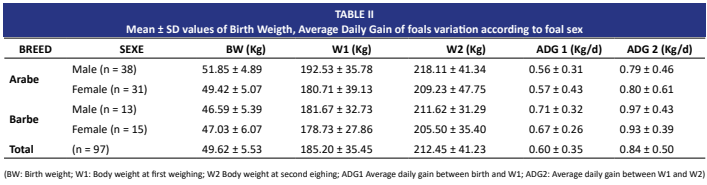
El objetivo principal de este estudio fue evaluar la influencia del sexo, la raza, el mes de nacimiento y el año de nacimiento sobre el peso al nacer y el rendimiento de crecimiento posnatal de potros criados en condiciones estandarizadas en el Haras Nacional Chaouchaoua de Tiaret, Argelia. En total se incluyeron 97 potros (69 Árabes y 28 Barbos) en el estudio. Solo se consideraron los potros nacidos vivos que sobrevivieron más allá de los seis meses de edad. Todos los animales fueron criados bajo las mismas condiciones de alojamiento, alimentación y manejo durante el estudio. Los datos se recopilaron retrospectivamente a partir de los registros oficiales de nacimientos del Haras Nacional correspondientes a los años 2017 a 2021. Se analizaron las siguientes variables : peso al nacer (kg), peso corporal en la primera y segunda pesada, ganancia media diaria entre el nacimiento y peso corporal en la primera pesada, y entre peso corporal entre la primera y segunda pesada. También se registraron las fechas de destete y de pesada. En promedio, las dos pesadas se realizaron con un intervalo de aproximadamente seis meses, lo que permitió estimar las tasas de crecimiento en fases distintas. El análisis de los datos según la raza de los potros reveló una diferencia altamente significativa (P < 0,005) en el peso al nacer entre los dos grupos. Los potros Árabes presentaron un peso medio al nacer significativamente mayor (50,76 ± 5,08 kg) en comparación con los potros Barbos (46,82 ± 5,66 kg). Este estudio aporta información valiosa sobre los patrones de crecimiento posnatal de potros nacidos en el Haras Nacional Chaouchaoua. Nuestros hallazgos confirman que la raza influye significativamente en el peso al nacer y en la tasa de crecimiento, con los potros Barbos superando a los potros Árabes en las ganancias medias diarias.
Descargas
Citas
Gherissi DE, Aumassip-Kadri G, Benhamadi MEA, Meutchieye F, Jamali YH, Gaouar SBS. African horse genetic resources and breeding strategies for African input systems. In: Ibeagha-Awemu EM, Peters SO, Djikeng A, Rege JEO, editors. African Livestock Genetic Resources and Sustainable Breeding Strategies. Sustainable Development Goals Series. Cham, Suiza: Springer; 2025. 497-592. doi: https://doi.org/qm9t DOI: https://doi.org/10.1007/978-3-031-92076-9_11
Chemineau P, Guillaume D, Migaud M, Thiéry JC, Pellicer- Rubio MT, Malpaux B. Seasonality of reproduction in mammals: intimate regulatory mechanisms and practical implications. Reprod. Domest. Anim. [Internet]. 2008; 43(S2):4047. doi: https://doi.org/fmpms8 DOI: https://doi.org/10.1111/j.1439-0531.2008.01141.x
Meliani S, Benallou B, Abdelhadi SA, Halbouche M, Naceri Environmental factors affecting gestation duration and time of foaling of pure bred Arabian mares in Algeria. Asian J. Anim. Vet. Adv. [Internet]. 2011; 6(6):599–608. doi: https://doi.org/cpw6vw DOI: https://doi.org/10.3923/ajava.2011.599.608
MartinRosset W, Younge B. Energy and protein requirements and feeding of the suckling foal. In: MartinRosset W, Miraglia N, editors. Nutrition and feeding of the broodmare. EAAP Scientific Series, Vol 120. Leiden, Netherlands: Wageningen Academic Publishers; 2006. p. 221–243. doi: https://doi.org/qm9v DOI: https://doi.org/10.3920/9789086865840_025
Arfuso F, Assenza A, Tosto F, Giannetto C, Interlandi C, Piccione G, Liotta L. Serum bone metabolism biomarkers in healthy fillies and colts from weaning until one year of age. Res. Vet. Sci. [Internet]. 2022; 150:156–163. doi: https://doi.org/qm9w DOI: https://doi.org/10.1016/j.rvsc.2022.06.018
Dias de Castro LL, Abrahão CLH, Antunes J, Pritsch I, Molento MB. Body development from birth to 18 months of age of Thoroughbred foals in Brazil. Int. J. Plant. Anim. Environ. Sci. [Internet]. 2021; 11:352–362. doi: https://doi.org/qm9x DOI: https://doi.org/10.26502/ijpaes.202110
Pagan JD, Phethean E, Caddel S, McFaull M, Bonner P, Nowara D, Perriam W, Huntington PJ. 117 Factors affecting birth weights in Thoroughbred foals born in Kentucky, United Kingdom, and Australia. [Internet]. 2023; 124:104419. doi: https://doi.org/qm9z DOI: https://doi.org/10.1016/j.jevs.2023.104419
Chatha MA, Ahmad N, Abbas MA, Saadullah M, Khan JA. Effect of the intrinsic and extrinsic factors on the growth and development of young foals under subtropical conditions of Pakistan. PLoS One. [Internet]. 2025; 20(1):e0310784. doi: https://doi.org/qm92 DOI: https://doi.org/10.1371/journal.pone.0310784
Beythien E, Aurich C, Wulf M, Aurich J. Effects of season on placental, foetal and neonatal development in horses. Theriogenology. [Internet]. 2017; 97:98–103. doi: https://doi.org/gbj353 DOI: https://doi.org/10.1016/j.theriogenology.2017.04.027
Robles M, CouturierTarrade A, Derisoud E, Geeverding A, Dubois C, Dahirel M, Aioun J, Prezelin A, Calvez J, Richard C, Wimel L, ChavattePalmer P. Effects of dietary arginine supplementation in pregnant mares on maternal metabolism, placental structure and function and foal growth. Sci. Rep. [Internet]. 2019; 9(1):6461. doi: https://doi.org/qm93 DOI: https://doi.org/10.1038/s41598-019-42941-0
Robles M, Dubois C, Gautier C, Dahirel M, Guenon I, Bouraima-Lelong H, Viguié C, Wimel L, Couturier-Tarrade A, Chavatte-Palmer P. Maternal parity affects placental development, growth and metabolism of foals until 1 year and a half. Theriogenology. [Internet]. 2018; 108:321–330. doi: https://doi.org/gc29kz DOI: https://doi.org/10.1016/j.theriogenology.2017.12.019
Hacan Ö, Tekerli M, Çinkaya S, Demirtaş M. Genetic trends in body measurements at birth for Arabian horse in Türkiye. Arch. Anim. Breed. [Internet]. 2024; 67(4):561–570. doi: https://doi.org/qm96 DOI: https://doi.org/10.5194/aab-67-561-2024
Rogers CW, Gee EK, Dittmer KE. Growth and Bone Development in the Horse: When Is a Horse Skeletally Mature? Animals. [Internet]. 2021; 11(12):3402. doi: https://doi.org/qm97 DOI: https://doi.org/10.3390/ani11123402
Gücüyener H, Çinkaya S, Erdoğan M, Paksoy Y, Demirtaş M, Çelikeloğlu K, Koçak S, Bozkurt Z, Tekerli M. Gestation length and neonatal viability indicators in Thoroughbred horses in Türkiye. Ankara Univ. Vet. Fak. Derg. [Internet]. 2026; 73(1):41-47. doi: https://doi.org/qm99 DOI: https://doi.org/10.33988/auvfd.1726040
Kentucky Equine Research Staff. Nature versus nurture: Factors that affect growth of horses. Equinews Nutr. Health Daily. [Internet]. Versailles, KY, USA: Kentucky Equine Research. [cited 2 Sep 2025]; 2011. Available in: https://goo.su/51Z9vw
Hamrouni A, Gharbi B, Mezir H, Naouer DM. Comparison of morphological traits between Barb and ArabBarb Tunisian horses and proposal of an initial standard for the ArabBarb. J. Vet. Sci. Anim. Husb. [Internet]. 2024 [cited 12 Aug 2025]; 12(1):104. Available from: https://goo.su/sWqKT3T
Rogers CW, Bolwell CF, Gee EK, Rosanowski SM. Equine musculoskeletal development and performance: Impact of the production system and early training. Anim. Prod. Sci. [Internet]. 2020; 60(18):2069–2079. doi: https://doi.org/qnbf DOI: https://doi.org/10.1071/AN17685
Łuszczyński J, Pieszka M, Kosiniak-Kamysz K. Effect of horse breed and sex on growth rate and radiographic closure time of distal radial metaphyseal growth plate. Livest. Sci. [Internet]. 2011; 141(2–3):252–258. doi: https://doi.org/dpqhf2 DOI: https://doi.org/10.1016/j.livsci.2011.06.009
Fradinho MJ, Mateus L, Bernardes N, Bessa RJB, Caldeira RM, FerreiraDias G. Growth patterns, metabolic indicators and osteoarticular status in the Lusitano horse: A longitudinal study. PLoS One. [Internet]. 2019; 14(7):e0219900. doi: https://doi.org/qnbg DOI: https://doi.org/10.1371/journal.pone.0219900
Silva GC, Nogueira CEW, Scalco R, Pizzi GLBL, Leite TA, Bastos R, Curcio BR. Gestational length of Thoroughbred mares kept in tropical and subtropical climates. Theriogenology. [Internet]. 2025; 234:192–197. doi: https://doi.org/qnbh DOI: https://doi.org/10.1016/j.theriogenology.2024.12.017
Robles M, Hammer C, Staniar B, Chavatte-Palmer P. Nutrition of broodmares. Vet. Clin. North. Am. Equine Pract. [Internet]. 2021; 37(1):177205. https://doi.org/qncb DOI: https://doi.org/10.1016/j.cveq.2021.01.001
Veronesi MC, Cotticelli A, Pividori I, Giombolini M, Corazzin M, Ellero L, Peric T. From prefoaling to late pregnancy: cortisol, DHEA(S), progesterone, 17βestradiol, and allopregnanolone hair concentration profiles in Standardbred mares. Animals. [Internet]. 2025; 15(3):324. doi: https://doi.org/qnbk DOI: https://doi.org/10.3390/ani15030324
Köninger M, Von Velsen-Zerweck A, Eiberger C, Löffler C, Töpper A, Visscher C, Reckels B, Vervuert I. Nutrient composition and feed hygiene of alfalfa: Comparison of feed intake and selected metabolic parameters in horses fed alfalfa haylage, alfalfa hay or meadow hay. Animals. [Internet]. 2024; 14(6):889. doi: https://doi.org/qnbm DOI: https://doi.org/10.3390/ani14060889
Silva GC, Mazzo HC, Dallmann PBJ, Silva RB, Curcio BR, Nogueira CEW. Factors affecting gestation length in mares – literature review. Res. Soc. Dev. [Internet]. 2021; 10(5):e12410514564. doi: https://doi.org/qnbn DOI: https://doi.org/10.33448/rsd-v10i5.14564