Evaluación comparativa de los efectos bioprotectores de cepas vivas y muertas (inactivadas por calor) de Lactiplantibacillus plantarum frente a la toxicidad inducida por Cadmio en ratas Wistar
Resumen
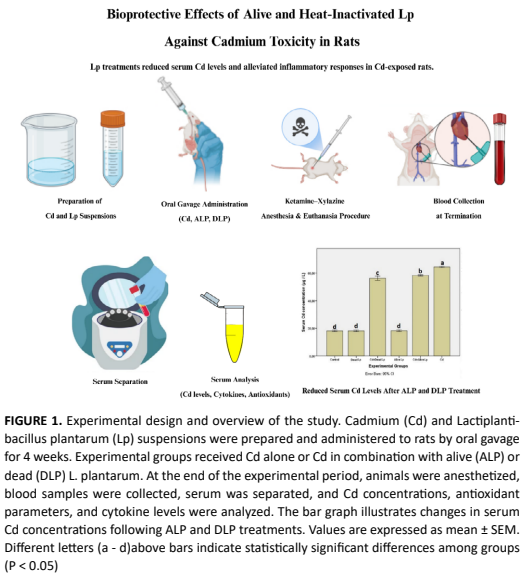
Este estudio se llevó a cabo para evaluar el potencial bioprotector de cepas vivas y muertas (inactivadas por calor) de Lactiplantibacillus plantarum frente a la toxicidad por cadmio en ratas Wistar. Elobjetivo fue determinar si las cepas vivas y termoinactivadas de Lactiplantibacillus plantarum podían atenuar las respuestas inflamatorias y de estrés oxidativo inducidas por cadmio y reducir los niveles séricos de cadmio en las ratas. Cuarenta y ocho ratas macho albinas Wistar se dividieron en seis grupos iguales : control (n = 8), cadmio (n = 8), Lactiplantibacillus plantarum viva (n = 8), Lactiplantibacillus plantarum muerta (n = 8), cadmio + Lactiplantibacillus plantarum viva y cadmio + Lactiplantibacillus plantarum muerta. Las ratas de los grupos cadmio, cadmio + Lactiplantibacillus plantarum viva y cadmio + Lactiplantibacillus plantarum muerta recibieron cloruro de cadmio (2 mg / kg) por vía oral mediante gavage gástrico, tres veces por semana durante 4 semanas. Las suspensiones de Lactiplantibacillus plantarum viva y muerta (109 – 1010 UFC / mL) se administraron a los grupos Lactiplantibacillus plantarum viva, Lactiplantibacillus plantarum muerta, cadmio + Lactiplantibacillus plantarum viva y cadmio + Lactiplantibacillus plantarum muerta con la misma frecuencia y duración. El grupo control recibió solución salina fisiológica. Posteriormente, los animales fueron decapitados y se recolectaron muestras de suero para la determinación de las concentraciones séricas de cadmio, citocinas (TNF - α, IL - 6, IL - 10, IL - 1β) y niveles de antioxidantes (malondialdehído, superóxido dismutasa, glutation peroxidasa, catalasa). La administración de cadmio provocó un aumento significativo de los niveles séricos de TNF - α e IL - 6, pero una disminución de los niveles de IL - 1β (P< 0,05). Los niveles de superóxido dismutasa y glutation peroxidasa se redujeron, mientras que las concentraciones de malondialdehído se elevaron únicamente en el grupo expuesto a cadmio (P < 0,05). Las administraciones de Lactiplantibacillus plantarum atenuaron la respuesta inflamatoria al provocar una disminución significativa de los niveles de IL - 6, especialmente en su forma inactivada por calor (cadmio + Lactiplantibacillus plantarum muerta) (P < 0,05). Tanto las formas vivas como las muertas mostraron tendencias de recuperación parcial en los niveles de superóxido dismutasa, glutation peroxidasa y catalasa. Lactiplantibacillus plantarum presentó propiedades parcialmente antiinflamatorias, antioxidantes y de unión a metales frente a la toxicidad por cadmio en ambas formas, y mostró un modelo bioprotector utilizable en términos de seguridad alimentaria y toxicología veterinaria cuando se aplicó junto con una matriz láctea.
Descargas
Citas
Arroyo VS, Flores KM, Ortiz LB, Gómez-Quiroz LE, Gutiérrez-Ruiz MC. Liver and cadmium toxicity. J. Drug Metab. Toxicol. [Internet]. 2012; S5:001. doi: https://doi.org/qt7c
Prozialeck WC, Edwards JR, Woods JM. The vascular endothelium as a target of cadmium toxicity. Life Sci. [Internet]. 2006; 79(16):1493–1506. doi: https://doi.org/dsj2nn DOI: https://doi.org/10.1016/j.lfs.2006.05.007
El-Sharaky AS, Newairy AA, Badreldeen MM, Eweda SM, Sheweita SA. Protective role of selenium against renal toxicity induced by cadmium in rats. Toxicol. [Internet]. 2007; 235(3):185–193. doi: https://doi.org/cvq9c8 DOI: https://doi.org/10.1016/j.tox.2007.03.014
Nemmiche S, Chabane-Sari D, Kadri M, Guiraud P. Cadmium chloride-induced oxidative stress and DNA damage in the human Jurkat T cell line is not linked to intracellular trace elements depletion. Toxicol. In Vitro. [Internet]. 2011; 25(1):191–198. doi: https://doi.org/b8ckj8 DOI: https://doi.org/10.1016/j.tiv.2010.10.018
Chen X, Bi M, Yang J, Cai J, Zhang H, Zhu Y, Zheng Y, Liu Q, Shi G, Zhang Z. Cadmium exposure triggers oxidative stress, necroptosis, Th1/Th2 imbalance and promotes inflammation through the TNF-α/NF-κB pathway in swine small intestine. J. Hazard. Mater. [Internet]. 2022; 421:126704. doi: https://doi.org/gzq3tf DOI: https://doi.org/10.1016/j.jhazmat.2021.126704
Zhang Y, Li Y, Zhang J, Qi X, Cui Y, Yin K, Lin H. Cadmium induced inflammation and apoptosis of porcine epididymis via activating RAF1/MEK/ERK and NF-κB pathways. Toxicol. Appl. Pharmacol. [Internet]. 2021; 415:115449. doi: https://doi.org/gjr3xk DOI: https://doi.org/10.1016/j.taap.2021.115449
Gök-Metin Z, Yavuz CI. Çevresel ve mesleksel kadmiyum etkilenimi ve sağlık etkileri. Sagl. Toplum [Internet]. 2022 [cited 12 Nov 2025]; 32(2):26–37. Available in: https://goo.su/7qTx0
Kisadere I, Guner B, Tavsanli H, Aydin MF, Usta M. Influence of Lactobacillus plantarum administration on some serum/tissue (uterus) antioxidant and cytokine levels in female rats exposed to cadmium (Cd). Turk. J. Vet. Anim. Sci. [Internet]. 2023; 47(3):270–280. doi: https://doi.org/qpgp DOI: https://doi.org/10.55730/1300-0128.4294
Zhai Q, Wang G, Zhao J, Liu X, Narbad A, Chen YQ, Zhang H, Tian F, Chen W. Protective effects of Lactobacillus plantarum CCFM8610 against chronic cadmium toxicity in mice indicate routes of protection besides intestinal sequestration. Appl. Environ. Microbiol. [Internet]. 2014; 80(13):4063–4071. doi: https://doi.org/f56mzh DOI: https://doi.org/10.1128/AEM.00762-14
Teemu H, Seppo S, Jussi M, Raija T, Kalle L. Reversible surface binding of cadmium and lead by lactic acid and bifidobacteria. Int. J. Food Microbiol. [Internet]. 2008; 125(2):170–175. doi: https://doi.org/fp86tp DOI: https://doi.org/10.1016/j.ijfoodmicro.2008.03.041
Zhai Q, Tian F, Wang G, Zhao J, Liu X, Cross K, Zhang H, Narbad A, Chen W. The cadmium binding characteristics of a lactic acid bacterium in aqueous solutions and its application for removal of cadmium from fruit and vegetable juices. RSC Adv. [Internet]. 2016; 6(8):5990–5998. doi: https://doi.org/gfzgx3 DOI: https://doi.org/10.1039/C5RA24843D
Karczewski J, Troost FJ, Konings I, Dekker J, Kleerebezem M, Brummer RJM, Wells JM. Regulation of human epithelial tight junction proteins by Lactobacillus plantarum in vivo and protective effects on the epithelial barrier. Am. J. Physiol. Gastrointest. Liver Physiol. [Internet]. 2010; 298(6):G851–G859. doi: https://doi.org/cgb7ss DOI: https://doi.org/10.1152/ajpgi.00327.2009
Wang W, Xu C, Zhou X, Zhang L, Gu L, Liu Z, Ma J, Hou J, Jiang Z. Lactobacillus plantarum combined with galactooligosaccharides supplement: a neuroprotective regimen against neurodegeneration and memory impairment by regulating short-chain fatty acids and the c-Jun N-terminal kinase signaling pathway in mice. J. Agric. Food Chem. [Internet]. 2022; 70(28):8619–8630. doi: https://doi.org/qt7d DOI: https://doi.org/10.1021/acs.jafc.2c01950
Guner TE, Akyol BA, Tavsanli H, Gokbulut C. Effects of different inactivation and activation treatments applied to lactic acid bacteria on AFM1 detoxification in milk. Food Biosci. [Internet]. 2025; 69:106974. doi: https://doi.org/qt7f DOI: https://doi.org/10.1016/j.fbio.2025.106974
Ma X. Heavy metals remediation through lactic acid bacteria: Current status and future prospects. Sci. Total Environ. [Internet]. 2024; 946:174455. doi: https://doi.org/g94znd DOI: https://doi.org/10.1016/j.scitotenv.2024.174455
Zhai Q, Wang G, Zhao J, Liu X, Tian F, Zhang H, Chen W. Protective effects of Lactobacillus plantarum CCFM8610 against acute cadmium toxicity in mice. Appl. Environ. Microbiol. [Internet]. 2013; 79(5):1508–1515. doi: https://doi.org/f4k39c DOI: https://doi.org/10.1128/AEM.03417-12
Kisadere I, Aydin MF, Usta M, Donmez N. Protective effects of oral melatonin against cadmium induced neurotoxicity in Wistar rats. Arh. Hig. Rada Toksikol. [Internet]. 2021 [cited 12 Nov 2025]; 72(2):157–163. Available in: https://goo.su/FYWr
Banwo K, Alonge Z, Sanni AI. Binding capacities and antioxidant activities of Lactobacillus plantarum and Pichia kudriavzevii against cadmium and lead toxicities. Biol. Trace Elem. Res. [Internet]. 2021; 199(2):779–791. doi: https://doi.org/ghfmp8 DOI: https://doi.org/10.1007/s12011-020-02164-1
Zhai Q, Xiao Y, Zhao J, Tian F, Zhang H, Narbad A, Chen W. Identification of key proteins and pathways in cadmium tolerance of Lactobacillus plantarum strains by proteomic analysis. Sci. Rep. [Internet]. 2017; 7:1182. doi: https://doi.org/f97ch5 DOI: https://doi.org/10.1038/s41598-017-01180-x
Hashemi SMB, Amiri MJ. Detoxification of aflatoxin M1 in sarshir by viable and nonviable Limosilactobacillus reuteri and Limosilactobacillus rhamnosus: Kinetic, equilibrium and desorption studies. Int. Dairy J. [Internet]. 2022; 127:105223. doi: https://doi.org/grkrwm DOI: https://doi.org/10.1016/j.idairyj.2021.105223
Saglam HS, Altundag H, Atik YT, Dundar MS, Adsan O. Trace elements levels in the serum, urine, and semen of patients with infertility. Turkish. J. Med. Sci. [Internet]. 2015; 45(2): 443–448. doi: https://doi.org/qt7g DOI: https://doi.org/10.3906/sag-1402-140
Andjelkovic M, Buha-Djordjevic A, Antonijevic E, Antonijevic B, Stanic M, Kotur-Stevuljevic J, Spasojevic- Kalimanovska V, Jovanovic M, Boricic N, Wallace D, Bulat Z. Toxic effect of acute cadmium and lead exposure in rat blood, liver, and kidney. Int. J. Environ. Res. Public Health. [Internet]. 2019; 16(2):274. doi: https://doi.org/qpgs DOI: https://doi.org/10.3390/ijerph16020274
Nasiadek M, Danilewicz M, Klimczak M, Stragierowicz J, Kilanowicz A. Subchronic exposure to cadmium causes persistent changes in the reproductive system in female Wistar rats. Oxid. Med. Cell. Longev. [Internet]. 2019; 2019:6490820. doi: https://doi.org/g8sh2q DOI: https://doi.org/10.1155/2019/6490820
Zhai Q, Tian F, Zhao J, Zhang H, Narbad A, Chen W. Oral administration of probiotics inhibits absorption of the heavy metal cadmium by protecting the intestinal barrier. Appl. Environ. Microbiol. [Internet]. 2016; 82(14):4429–4440. doi: https://doi.org/qt7h DOI: https://doi.org/10.1128/AEM.00695-16
Zhai Q, Liu Y, Wang C, Zhao J, Zhang H, Tian F, Lee YK, Chen W. Increased cadmium excretion due to oral administration of Lactobacillus plantarum strains by regulating enterohepatic circulation in mice. J. Agric. Food Chem. [Internet]. 2019; 67(14):3956–3965. doi: https://doi.org/qt7j DOI: https://doi.org/10.1021/acs.jafc.9b01004
Zhu J, Yu L, Shen X, Tian F, Zhao J, Zhang H, Chen W, Zhai Q. Protective effects of Lactobacillus plantarum CCFM8610 against acute toxicity caused by different food-derived forms of cadmium in mice. Int. J. Mol. Sci. [Internet]. 2021; 22(20):11045. doi: https://doi.org/gpn654 DOI: https://doi.org/10.3390/ijms222011045
Abd-Allah MM, Ramadan AA, Said NM, Ibrahim IH, Abdel- karim EA. Effects of cadmium chloride and glyphosate on antioxidants as biochemical biomarkers in Nile tilapia. J. Aquac. Res. Dev. [Internet]. 2019; 10(1):1000561. doi: https://doi.org/qt7k DOI: https://doi.org/10.4172/2155-9546.1000561
Kara H, Karatas F, Canatan H. Effect of single dose cadmium chloride administration on oxidative stress in male and female rats. Turk. J. Vet. Anim. Sci. [Internet]. 2005 [cited 13 Aug 2025]; 29(1):37–42. Available in: https://goo.su/GY2Rw
Zhang Y, Li Z, Kholodkevich S, Sharov A, Feng Y, Ren N, Sun K. Cadmium-induced oxidative stress, histopathology, and transcriptome changes in the hepatopancreas of freshwater crayfish (Procambarus clarkii). Sci. Total Environ. [Internet]. 2019; 666:944–955. doi: https://doi.org/gv5gg6 DOI: https://doi.org/10.1016/j.scitotenv.2019.02.159
Jafarpour D, Shekarforoush SS, Ghaisari HR, Nazifi S, Sajedianfard J, Eskandari MH. Protective effects of synbiotic diets of Bacillus coagulans, Lactobacillus plantarum and inulin against acute cadmium toxicity in rats. BMC Complement. Altern. Med. [Internet]. 2017; 17(1):291. doi: https://doi.org/gbg8bm DOI: https://doi.org/10.1186/s12906-017-1803-3
Cuypers A, Plusquin M, Remans T, Jozefczak M, Keunen E, Gielen H, Opdenakker K, Nair AR, Munters E, Artois TJ, Nawrot T, Vangronsveld J, Smeets K. Cadmium stress: an oxidative challenge. Biometals. [Internet]. 2010; 23(5):927–940. doi: https://doi.org/ddcb5p DOI: https://doi.org/10.1007/s10534-010-9329-x
Genchi G, Sinicropi MS, Lauria G, Carocci A, Catalano A. The effects of cadmium toxicity. Int. J. Environ. Res. Public Health [Internet]. 2020; 17(11):3782. doi: https://doi.org/gpwrpb DOI: https://doi.org/10.3390/ijerph17113782
Xue Y, Huang F, Tang R, Fan Q, Zhang B, Xu Z, Sun X, Ruan Z. Chlorogenic acid attenuates cadmium-induced intestinal injury in Sprague–Dawley rats. Food Chem. Toxicol. [Internet]. 2019; 133:110751. doi: https://doi.org/qt7p DOI: https://doi.org/10.1016/j.fct.2019.110751
Majlesi M, Gheisari HR, Shekarforoush SS, Abhari K, Dahesh S, Pashangeh S. Protection of probiotic Bacillus coagulans and Lactobacillus plantarum against cadmium toxicity in rats. Comp. Clin. Pathol. [Internet]. 2023; 32:789–797. doi: https://doi.org/qt7q DOI: https://doi.org/10.1007/s00580-023-03489-8
Choudhury C, Mazumder R, Biswas R, Sengupta M. Cadmium exposure induces inflammation through the canonical NF-κB pathway in monocytes/macrophages of Channa punctatus Bloch. Fish Shellfish Immunol. [Internet]. 2021; 110:116–126. doi: https://doi.org/gjr3xs DOI: https://doi.org/10.1016/j.fsi.2021.01.002
Kisadere I. The effects of melatonin treatment on some serum immunoregulatory cytokine levels in rats exposed to chronic cadmium toxicity. Kocatepe Vet. J. [Internet]. 2020 [cited 12 Aug 2025]; 13(3):262–266. Available in: https://goo.su/Aioqw
Han P, Tian X, Wang H, Ju Y, Sheng M, Wang Y, Cheng D. Purslane (Portulaca oleracea L.) polysaccharide relieves cadmium-induced colonic impairments by restricting Cd accumulation and inhibiting inflammatory responses. Int. J. Biol. Macromol. [Internet]. 2024; 257(1):128500. doi: https://doi.org/g5dx3p DOI: https://doi.org/10.1016/j.ijbiomac.2023.128500
Napolitano J, Liu M, Bao S, Knoell D. Cadmium suppresses IL-1β production and release in monocytes (P3010). J. Immunol. [Internet]. 2013; 190(1):114.6. doi: https://doi.org/qt7s DOI: https://doi.org/10.4049/jimmunol.190.Supp.114.6
Kizir D, Toraman E, Karaman M. Molecular changes associated with inflammation and reproduction in cadmium-induced testicular toxicity: Mitigating effect of Lactobacillus plantarum. Biol. Trace Elem. Res. [Internet]. 2025; 203:5768–5775. doi: https://doi.org/qt7t DOI: https://doi.org/10.1007/s12011-025-04601-5
Zhang Q, Shang X, Geng L, Che X, Wei H, Tang S, Xu W. Dietary selenium-rich Lactobacillus plantarum alleviates cadmium-induced oxidative stress and inflammation in bulatmai barbel Luciobarbus capito. Fishes. [Internet]. 2023; 8(3):136. doi: https://doi.org/qt7v DOI: https://doi.org/10.3390/fishes8030136