Factors associated with neoplasms in treated dogs at a Veterinary clinic in the city of Guayaquil - Ecuador (2022–2024)
Abstract
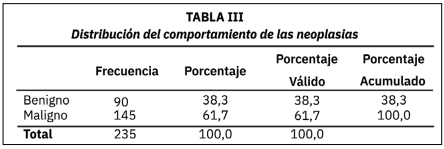
Neoplasms in dogs represent a growing concern in veterinary clinical practice, prompting studies aimed at identifying associated risk factors. This study aimed to determine the demographic and clinical variables linked to the occurrence of tumors in dogs treated at a veterinary clinic in the city of Guayaquil - Ecuador between 2022 and 2024. An observational, retrospective, and analytical design was applied, based on the analysis of 235 clinical records with histopathological confirmation. Results showed that the highest frequency of neoplasms occurred in dogs aged 7 to 10 years (48.5 %), with a higher incidence in males (52.8 %) and in neutered animals (51.5 %). Malignant neoplasms accounted for 61.7 % of the total cases, with the integumentary system being the most commonly affected (26.8 %). The most frequently affected breeds were Poodles and mixed breeds. Statistically significant associations (P < 0.05) were found between tumor type and neoplastic behavior, sterilization status, and anatomical location. These findings underscore the importance of epidemiological studies in veterinary oncology to establish preventive strategies, promote early diagnosis, and optimize therapeutic protocols in small animal practice.
Downloads
References
Pineda-Cruz J, Romero-Núñez C, Mendoza-Martínez G, García-Contreras C, Plata-Pérez F, Martínez-Jiménez A. Tumor venéreo transmisible en caninos del área metropolitana de la ciudad de México. Rev. Cient. FCV LUZ. [Internet] 2010 [citada 22 May 2025]; 20(4):362–366. Disponible en: https://goo.su/uyzEtV2
Cardona-Mendoza J. Prevalencia y factores de riesgo de neoplasia mamaria en caninos atendidos en la protectora de animales de Pereira entre 2017 y 2018. [Tesis de grado en internet]. Pereira, Colombia: Universidad Tecnológica de Pereira. 2019 [citada 4 Abr 2025]. 22 p. Disponible en: https://goo.su/kgL5Uqi
Dhein ES, Heikkilä U, Oevermann A, Blatter S, Meier D, Hartnack S, Guscetti F. Incidence rates of the most common canine tumors based on data from the Swiss Canine Cancer Registry (2008 to 2020). PLoS One. [Internet]. 2024; 19(4):e0302231. doi: https://doi.org/g9qpqh DOI: https://doi.org/10.1371/journal.pone.0302231
Vinueza RL, Cabrera F, Donoso L, Pérez J, Díaz R. Frecuencia de Neoplasias en Caninos en Quito, Ecuador. RIVEP. [Internet]. 2017; 28(1):92-100. doi: https://doi.org/qh5d DOI: https://doi.org/10.15381/rivep.v28i1.12931
Baioni E, Scanziani E, Vincenti MC, Leschiera M, Bozzetta E, Pezzolato M, Desiato R, Bertolini S, Maurella C, Ru G. Estimating canine cancer incidence: findings from a population-based tumour registry in northwestern Italy. BMC Vet. Res. [Internet]. 2017; 13(1):203. doi: https://doi.org/gbnv4n DOI: https://doi.org/10.1186/s12917-017-1126-0
Ayora-Zhagñay N, Martínez-Piedra C. Prevalencia de neoplasias en perros de la ciudad de Cuenca diagnosticados por histopatología en el periodo 2015- 2021. [Tesis de grado en internet]. Ecuador: Universidad de Cuenca. 2022 [citada 10 abril 2025]. 67 p. Disponible en: https://goo.su/7CYur3
Tarquino-Acevedo MC. Frecuencia de enfermedades oncológicas en caninos confirmadas por histopatología en dos centros Veterinarios de referencia en la ciudad de Medellín, Colombia en los años 2020 a 2022. [Tesis de Maestría en internet]. Medellín, Colombia: Univsersidad CES. 2024 [citada 10 Abr 2025]. 58p. Disponible en: https://goo.su/1dvs8n
Avallone G, Rasotto R, Chambers JK, Miller AD, BehlingKelly E, Monti P, Berlato D, Valenti P, Roccabianca P. Review of Histological Grading Systems in Veterinary Medicine. Vet. Pathol. [Internet]. 2021; 58(5):809-828. doi: https://doi.org/gshjqk DOI: https://doi.org/10.1177/0300985821999831
Ortiz OL, Perales CR. Frecuencia y clasificación de neoplasias en tracto reproductor masculino de caninos, diagnosticadas histopatológicamente en el Laboratorio de Patología Animal de la Universidad Nacional Mayor de San Marcos. Periodo 2011-2017. RIVEP. [Internet]. 2020; 31(2):e17832. doi: https://doi.org/qh5g DOI: https://doi.org/10.15381/rivep.v31i2.17832
De La Cruz-Hernández NI, Monreal-García AE, CarvajalDe La Fuente V, Barrón-Vargas CA, Martínez-Burnes J, Zarate-Terán A, Carmona-Aguirre D. Frecuencia y caracterización de las principales neoplasias presentes en el perro doméstico en Tamaulipas (México). Rev. Med. Vet. [Internet]. 2017; 35:53–71. doi: https://doi.org/qh5h DOI: https://doi.org/10.19052/mv.4389
Guillermo NM. Oncología canina y felina. De la teoría a la práctica. 1st. ed. Zaragoza, España: Servet; 2013.
Comazzi S, Marelli S, Cozzi M, Rizzi R, Finotello R, Henriques J, Pastor J, Ponce F, Rohrer C, Ruggen B, Teske E. Breed-associated risks for developing canine lymphoma differ among countries: an European canine lymphoma network study. BMC Vet Res. [Internet]. 2018; 14(1):232. doi: https://doi.org/gd3ftm DOI: https://doi.org/10.1186/s12917-018-1557-2
Vail DM, Thamm DH, Liptak JM. Oncología Clínica de Pequeños Animales. 6th ed. España: Edra; 2022.
Moe L, Gamlem H, Dahl K, Glattre E. Canine neoplasia – population-based incidence of vascular tumours. APMIS. [Internet]. 2008; 116(125):63–67. doi: https://doi.org/dvpz5c DOI: https://doi.org/10.1111/j.1600-0463.2008.125m6.x
Bertrán-Trepat J, Borrego J, Carvalho S, Clemente M, Clemente P, Kitagawa K, García AL, Meléndez A, Naranjo C, Petite A, Vilar-Saavedra P, Schmidt J. Manual Clínico de Oncología en Pequeños Animales. 1st. ed. España: Improve Formación Veterinaria; 2020.
Del Castillo Magán N, Ruano-Barneda R. Manual de oncología para veterinarios clínicos: Cómo enfrentarse al paciente oncológico. 1st. ed. Zaragoza, España: SERVET; 2017.
Fonti N, Parisi F, Lachi A, Dhein ES, Guscetti F, Poli A, Millanta F. Age at Tumor Diagnosis in 14,636 Canine Cases from the Pathology-Based UNIPI Animal Cancer Registry, Italy: One Size Doesn’t Fit All. Vet Sci. [Internet]. 2024; 11(10):485. doi: https://doi.org/qh5j DOI: https://doi.org/10.3390/vetsci11100485
Enrriquez-Tocto SM, Aguilar-Caivinagua AS. Determinación de tumores de piel en perros mediante citología e histopatología. Cód. Cient. Rev. Investig. [Internet]. 2024; 5(2):832–854. doi: https://doi.org/qh5k DOI: https://doi.org/10.55813/gaea/ccri/v5/n2/585
Ruano-Barneda R. Oncología práctica para el clínico de pequeños animales. 1st. ed. España: Multimédica Ediciones Veterinarias; 2013
Rodríguez J, Santana Á, Herráez P, Killick DR, De Los Monteros AE. Epidemiology of canine mammary tumours on the Canary Archipelago in Spain. BMC Vet. Res. [Internet]. 2022; 18(1):268 doi: https://doi.org/qh5m DOI: https://doi.org/10.1186/s12917-022-03363-9
Schwartz SM, Urfer SR, White M, Megquier K, Shrager S, Ruple A. Lifetime prevalence of malignant and benign tumours in companion dogs: Cross-sectional analysis of Dog Aging Project baseline survey. Vet. Comp. Oncol. [Internet]. 2022; 20(4):797–804. doi: https://doi.org/g7tv9v DOI: https://doi.org/10.1111/vco.12839
Merlo DF, Rossi L, Pellegrino C, Ceppi M, Cardellino U, Capurro C, Ratto A, Sambuco P, Sestito V, Tanara G, Bocchini V. Cancer Incidence in Pet Dogs: Findings of the Animal Tumor Registry of Genoa, Italy. J. Vet. Intern. Med. [Internet]. 2008; 22(4): 976–984. doi: https://doi.org/fjf9b5 DOI: https://doi.org/10.1111/j.1939-1676.2008.0133.x
Dobson JM, Samuel S, Milstein H, Rogers K, Wood J. Canine neoplasia in the UK: estimates of incidence rates from a population of insured dogs. J. Small Anim. Pract. [Internet]. 2002; 43(6):240–246. doi: https://doi.org/bk378q DOI: https://doi.org/10.1111/j.1748-5827.2002.tb00066.x
Komazawa S, Sakai H, Itoh Y, Kawabe M, Murakami M, Mori T, Maruo K. Canine tumor development and crude incidence of tumors by breed based on domestic dogs in Gifu prefecture. J. Vet. Med. Sci. [Internet]. 2016; 78(8):1269–1275. doi: https://doi.org/f8zwzn DOI: https://doi.org/10.1292/jvms.15-0584
Schectman S, Khanam A, Walters M, Kirwan E, Sylvester W, Khan F. A retrospective study of canine transmissible venereal tumour in Grenada, West Indies. Vet. Med. Sci. [Internet]. 2022; 8(3):1008–1012. doi: https://doi.org/qh5n DOI: https://doi.org/10.1002/vms3.778
Choi JW, Yoon HY, Jeong SW. Clinical Outcomes of Surgically Managed Spontaneous Tumors in 114 Clientowned Dogs.Inmune Netw. [Internet] 2016; 16(2):116125 doi: https://doi.org/qh5q DOI: https://doi.org/10.4110/in.2016.16.2.116
Beaudu-Lange C, Larrat S, Lange E, Lecoq K, Nguyen F. Prevalence of Reproductive Disorders including Mammary Tumors and Associated Mortality in Female Dogs. Vet. Sci. [Internet]. 2021; 8(9):184 doi: https://doi.org/qh5t DOI: https://doi.org/10.3390/vetsci8090184
Bryan JN, Keeler MR, Henry CJ, Bryan ME, Hahn AW, Caldwell CW. A population study of neutering status as a risk factor for canine prostate cancer. Prostate. [Internet]. 2007; 67(11):1174–1181. doi: https://doi.org/cnkmmx DOI: https://doi.org/10.1002/pros.20590
Benavides-Melo C, Chavez-Velasquez C, Vallejo-Timaran D, Del Hierro J, Perengüez-Narvaez J. Canine oncological casuistry in veterinary patology laboratory of nariño university. REVIP. [Internet]. 2014 [citada 10 May 2025]; 3(1):12–26. Disponible en: https://goo.su/NIzzN2
Martins AL, Canadas-Sousa A, Mesquita JR, Dias-Pereira P, Amorim I, Gärtner F. Retrospective study of canine cutaneous tumors submitted to a diagnostic pathology laboratory in Northern Portugal (2014–2020). Canine Med. Genet. [Internet]. 2022; 9(1):2. doi: https://doi.org/qh5x DOI: https://doi.org/10.1186/s40575-022-00113-w
Aupperle-Lellbach H, Grassinger JM, Floren A, Törner K, Beitzinger C, Loesenbeck G, Müller T. Tumour Incidence in Dogs in Germany: a Retrospective Analysis of 109,616 Histopathological Diagnoses (2014–2019). J. Comp. Pathol. [Internet]. 2022; 198:33–55. doi: https://doi.org/qh5z DOI: https://doi.org/10.1016/j.jcpa.2022.07.009