Reproductive management characteristics in bovine systems located in the Canuto parish of Chone Cantón, Ecuador
Abstract
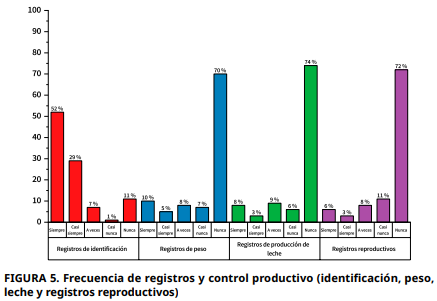
Cattle farming plays a vital role in the economic sector and food security. This study aimed to characterize reproductive management practices in bovine production systems located in the Canuto parish of the Chone cantón, Ecuador, in order to identify current practices, challenges, and opportunities to optimize productivity and sustainability. A questionnaire validated by experts was applied, and data were analyzed using descriptive and bivariate statistics. The results revealed severe structural challenges and low technological adoption. Regarding infrastructure, only 10% of farms have paved road access, and 53% rely on wells for water. In management, reproductive control is minimal, with 72% of farms lacking records, and mineral supplementation is deficient (51% do not use mineral salts). The adoption of reproductive biotechnologies is similarly low (9% use artificial insemination). Bivariate analysis was conclusive: formal education did not influence technological adoption; however, technical training and cost perception showed a highly significant association. It is concluded that low reproductive efficiency is driven by a combination of deficient structural conditions, socioeconomic limitations, and scarce practical training. Therefore, strengthening technical training and implementing record–keeping systems are crucial strategies to improve the productivity and sustainability of the local cattle sector.
Downloads
References
Obregón Perdomo LA, Ortiz Meneses CA, Cuellar Medina Y. La utilización de las herramientas tecnológicas en los sistemas de producción ganaderas doble propósito. I+D Rev. Invest. [Internet]. 2022; 17(1):34-48. doi: https://doi.org/qhhd DOI: https://doi.org/10.33304/revinv.v17n1-2022003
Smith J, Sones K, Grace D, MacMillan S, Tarawali S, Herrero M. Beyond milk, meat, and eggs: Role of livestock in food and nutrition security. Anim. Front. [Internet]. 2013; 3(1):6–13. doi: https://doi.org/ggmkhk DOI: https://doi.org/10.2527/af.2013-0002
Grout L, Baker MG, French N, Hales S. A review of potential public health impacts associated with the global dairy sector. GeoHealth [Internet]. 2020; 4(2):e2019GH000213. doi: https://doi.org/gjp6cd DOI: https://doi.org/10.1029/2019GH000213
Opadoyin Tona G. Impact of beef and milk sourced from cattle production on global food security. In: Abubakar M, editor. Bovine science–challenges and advances. Londres (RU): IntechOpen; [Internet]. 2022; 12:1-16. doi: https://doi.org/qhhf DOI: https://doi.org/10.5772/intechopen.99322
Torres Aburto VF, Severino Lendechy VH, López Reyes LY, Perezgrovas Garza RA, Espinosa Ortiz VE, Peralta Torres JA. Evaluación económica de la eficiencia reproductiva y productiva en sistemas productivos con ganado criollo en Campeche, México. Acta Univ. [Internet]. 2022; 32:e3501. doi: https://doi.org/g8x7px DOI: https://doi.org/10.15174/au.2022.3501
Valdez–Arjona L, Ramírez–Mella M, Díaz Ramírez M, Jiménez Guzmán J, García Garibay M, Miranda de la Lama GC, Cruz Monterrosa RG, Ramírez–Bribiesca E. Problemas productivos y reproductivos por deficiencias minerales en bovinos de algunas regiones tropicales de México. Agro Product. [Internet]. 2019; 12(12):11-18. doi: https://doi.org/qhhk DOI: https://doi.org/10.32854/agrop.vi0.1505
Bustillo–Parrado JC, Melo–Colina JA. Parámetros reproductivos y eficiencia reproductiva en ganado bovino. Villavicencio (Colombia): Universidad Cooperativa de Colombia; [Internet]. 2020 [consultado 11 Oct. 2025]; 21 p. Disponible en: https://goo.su/AkGDH
Centro del Agua y Desarrollo Sustentable (CADS), Escuela Politécnica del Litoral (ESPOL), Programa de las Naciones Unidas para el Desarrollo (PNUD). Análisis de vulnerabilidad del cantón Chone: Perfil Territorial 2013. Guayaquil (Ecuador): Digital Center; [Internet]. 2012 [consultado 6 Jul. 2025]; 63 p. Disponible en: https://goo.su/r1N2Nt
Israel GD. Determining Sample Size. Gainesville (EUA): Institute of Food and Agricultural Sciences (IFAS), Universidad de Florida; [Internet]. 2012; PEOD6 [consultado 12 Jun. 2025]; Disponible en: https://goo.su/UjEBpw
Olorunfemi SO. Rural road infrastructural challenges: An impediment to agricultural development in Idanre local government area of Ondo state, Nigeria. Ghana J. Geogr. [Internet]. 2020; 12(2):108–124. doi: https://doi.org/qhhq DOI: https://doi.org/10.4314/gjg.v12i2.5
Singh AK, Bhakat C, Yadav DK, Kansal G, Rajput MS. Importance of measuring water intake in dairy animals: A review. Int. J. Adv. Agric. Sci. Technol. [Internet]. 2020 [consultado 22 May 2025]; 7(2):23–30. Disponible en: https://goo.su/IBPqF8
Tulu D, Hundessa F, Gadissa S, Temesgen T. Review on the influence of water quality on livestock production in the era of climate change: perspectives from dryland regions. Cogent Food Agric. [Internet]. 2024; 10(1):2306726. doi: https://doi.org/qhh6 DOI: https://doi.org/10.1080/23311932.2024.2306726
Ayers RS, Westcot DW. Water quality for agriculture. [Internet]. FAO Irrigation and Drainage Paper. 1985 [consultado 19 Oct. 2025]. Roma (Italia): Food and Agriculture Organization of the United Nations. Disponible en: https://goo.su/RVLVSYT
Huitu H, Kaustell K, Pastell M. The effect of storms on Finnish dairy farms: electrical outage statistics and the effect on milk production. Nat. Hazards [Internet]. 2020; 104:1695–1704. doi: https://doi.org/qhh7 DOI: https://doi.org/10.1007/s11069-020-04240-0
Rubira–Gutiérrez C, Acosta–Lozano N, Luna–Murillo R, Quevedo– Pinos N, Andrade – Yucailla V. Uso del pasto Saboya, rendimiento y calidad nutricional en diferentes frecuencias de corte en Manglaralto, Santa Elena. DATEH. [Internet]. 2023 [citado 14 Ago. 2025]; 5(2):1–10. Disponible en: https://goo.su/LMXzU
Bolaños–Aguilar ED, Enríquez–Quiroz FJ, Fragoso Islas A, Castañeda Arriola RO, Montero–Lagunes M, Vinay Vadillo JC. Comportamiento productivo de una asociación Mombaza– Kudzú en diferentes épocas del año. Rev. Mex. Cienc. Pecu. [Internet]. 2024; 15(4):913–929. doi: https://doi.org/qhh8 DOI: https://doi.org/10.22319/rmcp.v15i4.6470
Martínez O. Caracterización de las fibras en pastos estrella africana (Cynodon nlemfuensis), brachiaria (Urochloa decumbens) y pasto elefante (Pennisetum purpureum) y su efecto en la ganancia de peso en bovinos destetos [tesis de maestría en Internet]. Bucaramanga (Colombia): Universidad Cooperativa de Colombia; [Internet]. 2022 [consultado 12 Jun. 2025]; 123 p. Disponible en: https://goo.su/LUci
Njarui DMG, Gatheru M, Ghimire SR. Brachiaria grass for climate resilient and sustainable livestock production in Kenya. En: Leal Filho W, Oguge N, Ayal D, Adeleke L, da Silva I, editores. African Handbook of Climate Change Adaptation. Cham (Suiza): Springer International Publishing; [Internet]. 2020; 22 p. doi: https://doi.org/qhjb DOI: https://doi.org/10.1007/978-3-030-42091-8_146-1
Greene LW. 119 Assessing the current mineral supplementation needs for pasture–based beef cattle operations in the southeastern United States. J. Anim. Sci. [Internet]. 2016; 94(suppl 1):58. doi: https://doi.org/qhjc DOI: https://doi.org/10.2527/ssasas2015-119
Olson KC. Management of mineral supplementation programs for cow–calf operations. Vet. Clin. North Am. Food Anim. Pract. [Internet]. 2007; 23(1):69–90. doi: https://doi.org/cmbb85 DOI: https://doi.org/10.1016/j.cvfa.2006.11.005
Mwanga G, Mbega E, Yonah Z, Chagunda MGG. How information communication technology can enhance evidence–based decisions and farm–to–fork animal traceability for livestock farmers. Sci. World J. [Internet]. 2020; 2020:1279569. doi: https://doi.org/qhjd DOI: https://doi.org/10.1155/2020/1279569
Sánchez Z, Galina CS, Vargas B, Romero JJ, Estrada S. The use of computer records: A tool to increase productivity in dairy herds. Animals [Internet]. 2020; 10(1):111. doi: https://doi.org/qhjf DOI: https://doi.org/10.3390/ani10010111
El Moutaouakil K, Falih N. A design of a smart farm system for cattle monitoring. Indones. Eléctr. Eng. Comput. Sci. [Internet]. 2023; 32(2):857–864. doi: https://doi.org/qhjg DOI: https://doi.org/10.11591/ijeecs.v32.i2.pp857-864
Baruselli PS, Reis EL, Marques MO, Nasser LF, Bó GA. The use of hormonal treatments to improve reproductive performance of anestrous beef cattle in tropical climates. Anim. Reprod. Sci. [Internet]. 2004; 82–83:479–486. doi: https://doi.org/bhdv25 DOI: https://doi.org/10.1016/j.anireprosci.2004.04.025
Tucho TT. Review on retention of placenta in dairy cows and it is economic and reproductive impacts. J. Nat. Sci. Res. [Internet]. 2017 [citado 18 May. 2025]; 7(7):28. Disponible en: https://goo.su/s9o05
Galina CS, Geffroy M. Dual–Purpose cattle raised in tropical conditions: ¿What are their shortcomings in sound productive and reproductive function? Animals [Internet]. 2023; 13(13):2224. doi: https://doi.org/qhjh DOI: https://doi.org/10.3390/ani13132224
Hufana–Duran D, Duran PG. Animal reproduction strategies for sustainable livestock production in the tropics. IOP Conf. Ser.: Earth Environ. Sci. [Internet]. 2020; 492:012065. doi: https://doi.org/gq3rxr DOI: https://doi.org/10.1088/1755-1315/492/1/012065
Caldera–Navarrete NA, Vivas–Garay JA, Saldaña–Romero AM, Mora–Hernández CA. Caracterización del manejo reproductivo bovino en fincas ganaderas de la región suroriental del país (Managua, Masaya, Granada, Carazo). Rev. Univ. Cienc. Soc. [Internet]. 2025 [citado 29 Jun. 2025]; 1(2):3–4. Disponible en: https://goo.su/Rdkbc
Setiana L, Saleh DM, Nugroho AP, Lana DL. Factors in the adoption of artificial insemination (AI) technology for beef cattle in Brebes Regency. J. Penyuluhan [Internet]. 2020; 16(1):88–97. doi: https://doi.org/qhjj DOI: https://doi.org/10.25015/16202027574
Suteky T, Dwatmadji. Factors affecting the adoption of artificial insemination (AI) in beef cattle by smallholder farmers in Bengkulu province, Indonesia. Adv. Biol. Sci. Res. [Internet]. 2021; 19:177–181. doi: https://doi.org/qhjk DOI: https://doi.org/10.2991/absr.k.210609.032
Abraha B, Gezahegn M, Yousuf J. Adoption of artificial insemination service for cattle crossbreeding by smallholder farmers in Lelay–Maichew district, Tigray, Ethiopia. J. Dev. Agric. Econ. [Internet]. 2020; 12(2):104–112. doi: https://doi.org/qhjm DOI: https://doi.org/10.5897/JDAE2019.1086