Evaluación clínica y cardiovascular comparativa de la anestesia con Ketamina- Medetomidina-Midazolam y Ketamina-Dexmedetomidina-Midazolam en gerbillos
Resumen
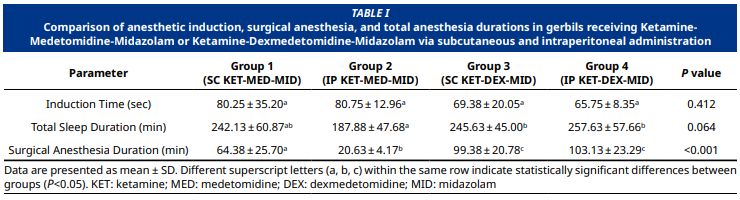
Este estudio investigó el desempeño anestésico y los efectos cardiopulmonares de las combinaciones ketamina-medetomidina- midazolam y ketamina-dexmedetomidina-midazolam administradas por vía subcutánea o intraperitoneal en gerbillos. Treinta y dos gerbillos machos clínicamente sanos fueron distribuidos en cuatro grupos experimentales según el protocolo anestésico y la vía de administración. Todos los protocolos produjeron una sedación adecuada y anestesia quirúrgica sin mortalidad. La inducción anestésica se logró en todos los animales en un período relativamente corto, y las combinaciones que contenían dexmedetomidina tendieron a inducir la anestesia más rápidamente que los protocolos basados en medetomidina. La duración de la anestesia quirúrgica fue significativamente mayor en los animales que recibieron dexmedetomidina, lo que indica un efecto anestésico más prolongado. Durante el período de observación se registraron cambios significativos en la frecuencia cardíaca, la frecuencia respiratoria, la temperatura corporal y la saturación periférica de oxígeno. Se observó depresión cardiopulmonar en todos los grupos, aunque fue más evidente en los animales tratados con dexmedetomidina. La administración intraperitoneal generalmente produjo un inicio anestésico más rápido y efectos fisiológicos más marcados en comparación con la administración subcutánea. Aunque se observaron reducciones en los parámetros cardiovasculares y respiratorios, no se registraron complicaciones potencialmente mortales. Asimismo, aunque los valores de saturación de oxígeno fueron compatibles con una recuperación espontánea, las disminuciones transitorias observadas en los animales tratados con dexmedetomidina sugieren que debería considerarse la administración de oxígeno suplementario durante procedimientos anestésicos prolongados. La recuperación tendió a producirse más tempranamente en los gerbillos tratados con medetomidina, mientras que la dexmedetomidina generó un estado anestésico de mayor duración. Los resultados indican que ambas combinaciones anestésicas pueden utilizarse de forma segura en gerbillos bajo condiciones adecuadas de monitorización. La dexmedetomidina proporcionó un efecto anestésico más profundo y prolongado, mientras que la administración subcutánea ofreció un perfil anestésico más gradual con una depresión fisiológica menos marcada.
Descargas
Citas
Flecknell P. Laboratory Animal Anaesthesia. 3rd ed. London (United Kingdom): Academic Press; 2009. 299 p. DOI: https://doi.org/10.1016/B978-0-12-369376-1.00002-2
Fish RE, Brown MJ, Danneman PJ, Karas AZ. Anesthesia and Analgesia in Laboratory Animals. 2nd ed. San Diego (California, USA): Academic Press; 2008. 656 p.
Wenger S. Anesthesia and analgesia in rabbits and rodents. J. Exot. Pet Med. [Internet]. 2012; 21(1):7–16. doi: https://doi.org/gftwzv DOI: https://doi.org/10.1053/j.jepm.2011.11.010
Hawkins P, Morton DB, Burman O, Dennison N, Honess P, Jennings M, Lane S, Middleton V, Roughan JV, Wells S, Westwood K, UK Joint Working Group on Refinement BVAAWF/FRAME/RSPCA/UFAW. A guide to defining and implementing protocols for the welfare assessment of laboratory animals: eleventh report of the BVAAWF/FRAME/RSPCA/UFAW Joint Working Group on Refinement. Lab. Anim. [Internet]. 2011; 45(1):1–13. doi: https://doi.org/d3gsm2 DOI: https://doi.org/10.1258/la.2010.010031
Turner PV, Brabb T, Pekow C, Vasbinder MA. Administration of substances to laboratory animals: routes of administration and factors to consider. J. Am. Assoc. Lab. Anim. Sci. [Internet]. 2011 [cited 12 Apr 2026]; 50(5):600–613. Available in: https://goo.su/Pn1yc
Henke J, Astner S, Brill T, Eissner B, Busch R, Erhardt W. Comparative study of three intramuscular anesthetic combinations (medetomidine/ketamine, medetomidine/fentanyl/midazolam and xylazine/ketamine) in rabbits. Vet. Anaesth. Analg. [Internet]. 2005; 32(5):261–270. doi: https://doi.org/c72pzh DOI: https://doi.org/10.1111/j.1467-2995.2005.00242.x
Kawai S, Takagi Y, Kaneko S, Kurosawa T. Effect of three types of mixed anesthetic agents alternate to ketamine in mice. Exp. Anim. [Internet]. 2011; 60(5):481–487. doi: https://doi.org/d6qnnj DOI: https://doi.org/10.1538/expanim.60.481
Arras M, Autenried P, Rettich A, Spaeni D, Rülicke T. Optimization of intraperitoneal injection anesthesia in mice: drugs, dosages, adverse effects, and anesthesia depth. Comp. Med. [Internet]. 2001 [cited 23 Jan 2026]; 51(5):443–456. Available in: https://goo.su/zl4QmlD
Mion G, Villevieille T. Ketamine pharmacology: An update (Pharmacodynamics and Molecular Aspects, Recent Findings). CNS Neurosci. Ther. [Internet]. 2013; 19(6):370–380. doi: https://doi.org/f4w3xq DOI: https://doi.org/10.1111/cns.12099
Wixson SK, White WJ, Hughes HC Jr, Lang CM, Marshall WK. The effects of pentobarbital, fentanyl-droperidol, ketamine-xylazine and ketamine-diazepam on arterial blood pH, blood gases, mean arterial blood pressure and heart rate in adult male rats. Lab. Anim. Sci. [Internet]. 1987; 37(6):736–742. PMID: 3125387. Available in: https://goo.su/74MTzV8
Sinclair MD. A review of the physiological effects of alpha–2 agonists related to the clinical use of medetomidine in small animal practice. Can. Vet. J. [Internet]. 2003 [cited 11 Feb 2026]; 44(11):885–897. Available in: https://goo.su/ChBRC
Murrell JC, Hellebrekers LJ. Medetomidine and dexmedetomidine: a review of cardiovascular effects and antinociceptive properties in the dog. Vet. Anaesth. Analg. [Internet]. 2005; 32(3):117–127. doi: https://doi.org/c3445d DOI: https://doi.org/10.1111/j.1467-2995.2005.00233.x
Savola JM. Cardiovascular actions of medetomidine and their reversal by atipamezole. Acta Vet. Scand. Suppl. [Internet]. 1989 [cited 11 Feb 2026]; 85:39–47. PMID: 2571276. Available in: https://goo.su/0AERTU
Davis JA. Mouse and rat anesthesia and analgesia. Curr. Protoc. Neurosci. [Internet]. 2008; 42:A.4B.1–A.4B.21. doi: https://doi.org/fr2pbq DOI: https://doi.org/10.1002/0471142301.nsa04bs42
Charan J, Kantharia ND. How to calculate sample size in animal studies? J. Pharmacol. Pharmacother. [Internet]. 2013; 4(4):303–306. doi: https://doi.org/gf3sst DOI: https://doi.org/10.4103/0976-500X.119726
Field A. Discovering statistics using IBM SPSS Statistics. 4th ed. London (United Kingdom): Sage Publications; 2013. 915 p.
Farag AF, Mandour AS, Hamabe L, Yoshida T, Shimada K, Tanaka R. Novel protocol to establish the myocardial infarction model in rats using a combination of medetomidine-midazolam-butorphanol (MMB) and atipamezole. Front. Vet. Sci. [Internet]. 2022; 9:1064836. doi: https://doi.org/rmcm DOI: https://doi.org/10.3389/fvets.2022.1064836
Akçali B, Yönez MK, Alpman U. Different dexmedetomidine combinations with sevoflurane, ketamine, or propofol lead to varying clinical and laboratory outcomes in rabbits. Am. J. Vet. Res. [Internet]. 2025; 86(10):0135. doi: https://doi.org/rmcn DOI: https://doi.org/10.2460/ajvr.25.04.0135
Kamibayashi T, Maze M, Weiskopf RB, Todd MM. Clinical uses of alpha2 – adrenergic agonists. Anesthesiology [Internet]. 2000; 93(5):1345–1349. doi: https://doi.org/d7px86 DOI: https://doi.org/10.1097/00000542-200011000-00030
Tashiro M, Tohei A. Recommended doses of medetomidine-midazolam-butorphanol with atipamezole for preventing hypothermia in mice. J. Vet. Med. Sci. [Internet]. 2022; 84(3):445–453. doi: https://doi.org/rmcq DOI: https://doi.org/10.1292/jvms.21-0479
Weerink MAS, Struys MMRF, Hannivoort LN, Barends CRM, Absalom AR, Colin P. Clinical pharmacokinetics and pharmacodynamics of dexmedetomidine. Clin. Pharmacokinet. 2017; 56(8):893–913. https://doi.org/ghmfng DOI: https://doi.org/10.1007/s40262-017-0507-7
Di Franco C, Evangelista F, Briganti A. Multiple uses of dexmedetomidine in small animals: a mini review. Front. Vet. Sci. [Internet]. 2023; 10:1135124. doi: https://doi.org/g43bxd DOI: https://doi.org/10.3389/fvets.2023.1135124
Pleyers T, Levionnois O, Siegenthaler J, Spadavecchia C, Raillard M. Investigation of selected respiratory effects of (dex)medetomidine in healthy Beagles. Vet. Anaesth. Analg. [Internet]. 2020; 47(5):667–671. doi: https://doi.org/rmcs DOI: https://doi.org/10.1016/j.vaa.2020.05.001
Hall JE, Uhrich TD, Barney JA, Arain SR, Ebert TJ. Sedative, amnestic, and analgesic properties of small-dose dexmedetomidine infusions. Anesth. Analg. [Internet]. 2000; 90(3):699–705. doi: https://doi.org/fg5cbn DOI: https://doi.org/10.1097/00000539-200003000-00035
Kilic N, Henke J, Erhardt W. Die Ketamine-medetomidine anaesthesia beim hamsters: ein klinischer Vergleich zwischen subkutaner und intraperitonealer applikation [Ketamine/medetomidine-anaesthesia in the hamster: a clinical comparison between the subcutaneous and intraperitoneal way of application]. Tieraerztl Prax. Ausg. K: Kleintiere – Heimtiere. [Internet]. 2004; 32(6):384–388. German. doi: https://doi.org/rmcr DOI: https://doi.org/10.1055/s-0037-1622438