Efectos de la clindamicina sobre el estrés oxidativo sérico y la histopatología hepática
Resumen
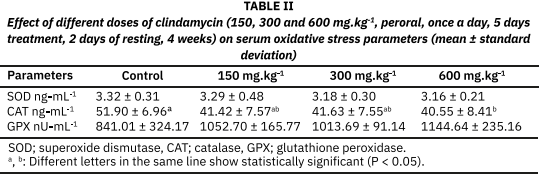
La clindamicina es un antibiótico que se utiliza para tratar infecciones de las vías respiratorias superiores, dentales, cutáneas y anaeróbicas. La clindamicina a largo plazo y en dosis altas también puede utilizarse en afecciones como infecciones óseas. Sin embargo, existe información limitada sobre la seguridad del uso prolongado de clindamicina en dosis altas. El estudio tiene como objetivo determinar los efectos de la administración prolongada de clindamicina en diferentes dosis sobre los parámetros de estrés oxidativo sérico y la histopatología hepática. El estudio incluyó 40 ratas Wistar albinas ratas, divididas equitativamente en cuatro grupos. Mientras que al primer grupo (grupo control) no se le administró ningún tratamiento, a los otros tres grupos se les administró clindamicina por vía oral en dosis de 150, 300 y 600 mg/kg/día, respectivamente (tratamiento 5 días/semana, descanso 2 días/semana) durante 4 semanas. Al final del estudio, se tomaron muestras de sangre y tejido hepático de las ratas para su análisis. Los niveles séricos de superóxido dismutasa, glutatión peroxidasa y catalasa se midieron utilizando un lector ensayo por inmunoabsorción ligado a enzimas. El tejido hepático fue examinado histopatológicamente. A una dosis de 600 mg/kg, los niveles de catalasa fueron menores en comparación con el grupo control (P < 0.05). En la histopatología hepática, la necrosis de interfase, la necrosis confluente, la degeneración hidrópica, la inflamación portal y las puntuaciones de esteatosis fueron mayores en los grupos de 300 y 600 mg/kg en comparación con el grupo control (P < 0.05). Además, solo el grupo de dosis de 600 mg/kg tuvo una puntuación de proliferación de conductos biliares mayor en comparación con el grupo control (P < 0.05). En conclusión, dado que se observó que la clindamicina afecta los parámetros de estrés oxidativo y causa hepatotoxicidad a dosis altas, se puede sugerir que la clindamicina puede ser segura para el hígado en las dosis y duración terapéuticas recomendadas.
Descargas
Citas
Yazar E. Kemoterapotikler. In: Yazar E, editor. Veteriner Ilaç Rehberi ve Terapötik El Kitabi. 6th edition: Ankara, Türkiye: Nobel Medical Bookstores; 2024. p. 83-130.
Lell B, Kremsner PG. Clindamycin as an antimalarial drug: Review of clinical trials. Antimicrob. Agents Chemother. [Internet]. 2002; 46(8):2315–2320. doi: https://doi.org/bpv8vb DOI: https://doi.org/10.1128/AAC.46.8.2315-2320.2002
Luchian I, Goriuc A, Martu MA, Covasa M. Clindamycin as an alternative option in optimizing periodontal therapy. Antibiotics, [Internet]. 2021; 10(7):814. doi: https://doi.org/rj7g DOI: https://doi.org/10.3390/antibiotics10070814
Hayvan Bilgi Sistemi-Tarbil [Animal Information System–Tarbil]. [Internet]. 2026 [cited 26 March 2026]. Turkish: Tarim ve Orman Bakanligi. Available in: https://goo.su/4mMV6qQ
Yilmaz HE, Cagatay IT, Diler O, Naziroglu M, Ozil O, Kan S. Identification of Staphylococcus warneri from rainbow trout (Oncorhynchus mykiss Walbaum, 1792) using proteomics–based MALDI–TOF MS. Rev. Científ. FCV-LUZ. [Internet]. 2025; 35:e35574. doi: https://doi.org/rj7h DOI: https://doi.org/10.52973/rcfcv-e35574
Sanchez–Prado RG, Santo–Endara JP, Sanchez–Prado RE, Guzman–Pucha S, Aguilar–Galvez FL, Chalco–Torres LE, Pimbosa–Ortiz DE, Perez–Rodriguez JE. Bacterial susceptibility profile in Staphylococcus spp. strains isolated from canines with otitis externa. Rev. Científ. FCV-LUZ. [Internet]. 2024; 34:e34364. doi: https://doi.org/rj7j
Alvarez LA, Sijpe GV, Desmet S, Metsemakers WJ, Spriet I, Allegaert K, Rozenski J. Ways to improve insights into clindamycin pharmacology and pharmacokinetics tailored to practice. Antibiotics. [Internet]. 2022; 11(5):701. doi: https://doi.org/rj7k DOI: https://doi.org/10.3390/antibiotics11050701
Tasgin E, Suvarikli-Alan B, Parlak TM, Yazar E. The effects of long acting and different doses of danofloxacin on oxidative stress, biochemical, and hemogram parameters in rats. Rev. Científ. FCV-LUZ. [Internet]. 2026; 36:e362898. doi: https://doi.org/rj7p DOI: https://doi.org/10.52973/rcfcv-e362898
Smieja M. Current indications for the use of clindamycin: A critical review. Can. J. Infect. Dis. Med. Microbiol. [Internet]. 1998; 9(1):538090. doi: https://doi.org/rj7q DOI: https://doi.org/10.1155/1998/538090
Wettasinghe I, Samarasinghe SM, Puthra S, Sugathapala AGH. Possible cholestatic hepatitis with clindamycin therapy: A case report. J. Health. Sci. Innov. Res. [Internet]. 2023; 4(2):31-35. doi: https://doi.org/rj7s DOI: https://doi.org/10.31357/jhsir.v4i2.6814
Del Rosso JQ, Armillei MA, Lomakin IB, Grada A, Bunick CG. Clindamycin: A comprehensive status report with emphasis on use in dermatology. J. Clin. Aesthet. Dermatol. [Internet]. 2024 [cited 12 Feb 2026]; 17(8):2940. Available in: https://goo.su/nCr5cMw
Ibrahim KM, Mantawy EM, Elanany MM, Abdelgawad HS, Khalifa NM, Hussien RH, El-Agroudy NN, El-Demerdash E. Protection from doxorubicin-induced nephrotoxicity by clindamycin: novel antioxidant, anti-inflammatory and anti-apoptotic roles. Naunyn Schmiedebergs Arch. Pharmacol. [Internet]. 2020; 393(4):739-748. doi: https://doi.org/rj7t DOI: https://doi.org/10.1007/s00210-019-01782-4
Sezer K, Keskin M. Role of the free oxygen radicals on the pathogenesis of the diseases. F. U. Sag. Bil. Vet. Derg. [Internet]. 2014 [cited 18 Apr 2026]; 28(1):49-56. Available in: https://goo.su/4o1Xpyl
Tabakoglu E, Durgut R. Oxidative stress in veterinary medicine and effects in some important diseases. AVKAE Derg, [Internet]. 2013 [cited 19 Feb 2026]; 3(1):69-75. Available in: https://goo.su/adiBiI
Senanayake S. Medicinal mishap: Possible acute hepatotoxicity from oral clindamycin. Aust. Prescr. [Internet]. 2009; 32(5):140. doi: https://doi.org/rj7v DOI: https://doi.org/10.18773/austprescr.2009.068
Luna LG. Manual of Histologic Staining Methods of the Armed Forces Institute of Pathology. 3rd edition. New York, USA: McGraw-Hill. 1968.
Ishak K, Baptista A, Bianchi L, Callea F, De Groote J, Gudat F, Denk H, Desmet V, Korb G, MacSween RN, Phillipsk MJ, Portmannl BG, Poulsenm H, Scheuer PJ, Schmidn M, Thaler H. Histological grading and staging of chronic hepatitis. J. Hepatol. [Internet]. 1995; 22(6):696-699. doi: https://doi.org/chd3g4 DOI: https://doi.org/10.1016/0168-8278(95)80226-6
Kleiner DE. The histopathological evaluation of druginduced liver injury. Histopathology. [Internet]. 2017; 70(1):81-93. doi: https://doi.org/g8f7mk DOI: https://doi.org/10.1111/his.13082
Kleiner DE, Brunt EM, Natta MV, Behling C, Contos MJ, Cummings OW, Ferrell LD, Liu YC, Torbenson MS, Arida AU, Yeh M, McCullough AJ, Sanyal AJ. Design and validation of a histological scoring system for nonalcoholic fatty liver disease. Hepatology. [Internet]. 2005; 41(6):1313-1321. doi: https://doi.org/b83sjk DOI: https://doi.org/10.1002/hep.20701
El-Ansary AK, Al-Daihan S, Bacha AB, Shaker GH, Al-Ayadhi LY. Comparative study on the protective effect of carnosine and carnitine against pro-inflammatory/ pro-oxidant effects of clindamycin and propionic acid administrations to hamsters. Afr. J. Microbiol. Res. [Internet]. 2013; 7(2):103-114. doi: https://doi.org/rj7w DOI: https://doi.org/10.5897/AJMR12.1178
Aabed K, Bhat RS, Moubayed N, Al-Mutiri M, Al-Marshoud M, Al-Qahtani A, El-Ansary A. Ameliorative effect of probiotics (Lactobacillus paracaseii and Protexin®) and prebiotics (propolis and bee pollen) on clindamycin and propionic acid-induced oxidative stress and altered gut microbiota in a rodent model of autism. Cell. Mol. Biol. [Internet]. 2019; 65(1):1-7. doi: https://doi.org/rj7x DOI: https://doi.org/10.14715/cmb/2019.65.1.1
Al-Orf N, El-Ansary A, Bjorklund G, Moubayed N, Bhat RS, Bacha AB. Therapeutic effects of probiotics on neurotoxicity induced by clindamycin and propionic acid in juvenile hamsters. Metab. Brain Dis. [Internet]. 2018; 33(6):1811-1820. doi: https://doi.org/rj7z DOI: https://doi.org/10.1007/s11011-018-0284-5
Munz M, Grummich H, Birkmann J, Wilhelm M, Holzgrabe U, Sorgel F. Severe drug-induced liver injury as an adverse drug event of antibiotics: a case report and review of the literature. Chemotherapy. [Internet]. 2017; 62(6):367373. doi: https://doi.org/rj72 DOI: https://doi.org/10.1159/000480399
Elmore M, Rissing JP, Rink L, Brooks GF. Clindamycin-associated hepatotoxicity. Am. J. Med. [Internet]. 1974; 57(4):627-630. doi: https://doi.org/fjsk7s DOI: https://doi.org/10.1016/0002-9343(74)90015-1
Aygun C, Kocaman O, Gurbuz Y, Senturk O, Hulagu S. Clindamycin-induced acute cholestatic hepatitis. World J. Gastroenterol. [Internet]. 2007; 13(40):5408-5410. doi: https://doi.org/rj73 DOI: https://doi.org/10.3748/wjg.v13.i40.5408
Moole H, Ahmed Z, Saxena N, Puli SR, Dhillon S. Oral clindamycin causing acute cholestatic hepatitis without ductopenia: a brief review of idiosyncratic drug-induced liver injury and a case report. J. Community Hosp. Intern. Med. Perspect, [Internet]. 2015; 19; 5(5):28746. doi: https://doi.org/rj74 DOI: https://doi.org/10.3402/jchimp.v5.28746