Análisis comparativo de los perfiles de resistencia a los antimicrobianos de cepas de Campylobacter aisladas de pollos de engorde, ganado vacuno y ovino en Argelia
Resumen
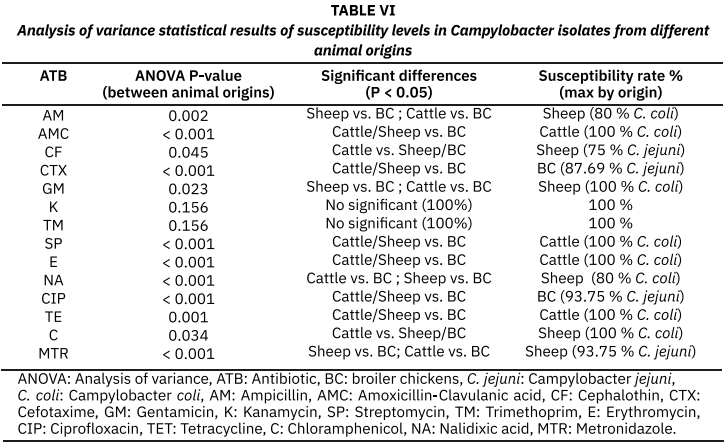
Campylobacter son los principales agentes etiológicos de las infecciones gastrointestinales. El objetivo de este estudio fue analizar la frecuencia de cepas de Campylobacter resistentes a los antibióticos en pollos de engorde, ganado vacuno y ovino de Argelia, mediante un análisis comparativo por origen animal. Se recogieron un total de 138 cepas (96 de Campylobacter jejuni y 42 de Campylobacter coli). Las pruebas de sensibilidad a los antimicrobianos se realizaron mediante métodos de difusión en disco. Los resultados revelaron una mayor resistencia en los pollos de engorde que en los otros orígenes, con una mayor tasa de C. coli que de C. jejuni con respecto a las quinolonas, las fluoroquinolonas, los macrólidos, la tetraciclina (100 %) y los betalactámicos (72-77 %) en las cepas de C. coli, seguidas de un alto nivel de resistencia en C. jejuni frente a las quinolonas, las fluoroquinolonas y el metronidazol (92 %), macrólidos (75 %) y los betalactámicos (69 %). En el ganado vacuno y ovino también se obtuvieron tasas elevadas: las cepas de C. coli bovina mostraron una resistencia total a las quinolonas, un nivel creciente de resistencia a las cefalosporinas y los macrólidos (79 % y 59 %, respectivamente), y la C. coli ovina presentó una tasa elevada de resistencia a los betalactámicos y los nitroimidazoles (70 %). En el análisis de varianza, se observaron perfiles de alta resistencia en los pollos de engorde a la mayoría de los antibióticos, en comparación con las cepas bovinas y ovinas, con diferencias estadísticamente significativas (P < 0,05). Las cepas bovinas y ovinas mostraron tasas elevadas de resistencia a las quinolonas, aunque esta resistencia fue menos extensa que la observada en los pollos de engorde. Con el fin de limitar la propagación de la resistencia a los antimicrobianos, es necesario adoptar un enfoque «Una sola salud».
Descargas
Citas
Velazquez-Meza ME, Galarde-López M, Carrillo-Quiróz B, Alpuche-Aranda CM. Antimicrobial resistance: One Health approach. Vet. World. [Internet]. 2022; 15(3):743-749. doi: https://doi.org/gsx72m DOI: https://doi.org/10.14202/vetworld.2022.743-749
Endale H, Mathewos M, Abdeta D. Potential Causes of Spread of Antimicrobial Resistance and Preventive Measures in One Health Perspective-A Review. Infect. Drug Resist. [Internet]. 2023; 16:7515-7545. doi: https://doi.org/g5wc2k DOI: https://doi.org/10.2147/IDR.S428837
Almansour AM, Alhadlaq MA, Alzahrani KO, Mukhtar LE, Alharbi AL, Alajel SM. The Silent Threat: Antimicrobial-Resistant Pathogens in Food-Producing Animals and Their Impact on Public Health. Microorganisms. [Internet]. 2023; 11(9):2127. doi: https://doi.org/rh99 DOI: https://doi.org/10.3390/microorganisms11092127
Samtiya M, Matthews KR, Dhewa T, Puniya AK. Antimicrobial Resistance in the Food Chain: Trends, Mechanisms, Pathways, and Possible Regulation Strategies. Foods. [Internet]. 2022; 11(19):2966. doi: https://doi.org/qrqk DOI: https://doi.org/10.3390/foods11192966
Bukari Z, Emmanuel T, Woodward J, Ferguson R, Ezughara M, Darga N, Lopes BS. The Global Challenge of Campylobacter: Antimicrobial Resistance and Emerging Intervention Strategies. Trop. Med. Infect. Dis. [Internet]. 2025; 10(1):25. doi: https://doi.org/rjbb
Lopez-Chavarrias V, Ugarte-Ruiz M, Barcena C, Olarra A, Garcia M, Saez JL, de Frutos C, Serrano T, Perez I, Moreno MA, Dominguez L, Alvarez J. Monitoring of Antimicrobial Resistance to Aminoglycosides and Macrolides in Campylobacter coli and Campylobacter jejuni From Healthy Livestock in Spain (2002–2018). Front. Microbiol. [Internet]. 2021; 12:689262. doi: https://doi.org/rjbc DOI: https://doi.org/10.3389/fmicb.2021.689262
Ellis-Iversen J, Ridley A, Morris V, Sowa A, Harris J, Atterbury R, Sparks N, Allen V. Persistent environmental reservoirs on farms as risk factors for Campylobacter in commercial poultry. Epidemiol. Infect. [Internet]. 2012; 140(5):916-924. doi: https://doi.org/bf9ttv DOI: https://doi.org/10.1017/S095026881100118X
Foddai A, Nauta M, Ellis-Iversen J. A model using an inter-sectorial data integration process indicates that reducing Campylobacter cross-contamination at slaughter mitigates the risk of human campylobacteriosis effectively. Microbial. Risk Anal. [Internet]. 2023; 23:100248. doi: https://doi.org/gv3wqqmp. Pathol. [Internet]. 2006; 134(4):267–289. doi: https://doi.org/dwjcjp DOI: https://doi.org/10.1016/j.mran.2023.100248
Rahimi E, Mousavinafchi S, Shakerian A. Isolation, characterization, and antimicrobial resistance profiles of Campylobacter jejuni and Campylobacter coli from raw meat of large livestock in Iran. Arch. Razi. Inst. [Internet]. 2024; 79(1):41-54. doi: https://doi.org/rjbd DOI: https://doi.org/10.32592/ARI.2024.79.1.41
Shchur N, Chechet O, Mazur T, Martyniuk O, Gorbatiuk O, Buchkovska H, Musiets I, Ordynska D, Finkova O, Moskalenko L, Ponomaryova-Gerasimyuk T, Lusta M, Nedosekov V. Prevalence and Antimicrobial Resistance of Campylobacter Isolated from Animals and Poultry in Ukraine. Adv. Anim. Vet. Sci. [Internet]. 2023; 11(5): 852863. doi: https://doi.org/rjbf DOI: https://doi.org/10.17582/journal.aavs/2023/11.5.852.863
Wanja DW, Mbuthia PG, Bebora LC, Aboge GO, Ogoti B. Antimicrobial Usage, Susceptibility Profiles, and Resistance Genes in Campylobacter Isolated from Cattle, Chicken, and Water Samples in Kajiado County, Kenya. Int. J. Microbiol. [Internet]. 2023; 2023:8394605. doi: https://doi.org/rjbg DOI: https://doi.org/10.1155/2023/8394605
Devi A, Mahony TJ, Wilkinson JM, Vanniasinkam T. Antimicrobial susceptibility of clinical isolates of Campylobacter jejuni from New South Wales, Australia. J. Glob. Antimicrob. Resist. [Internet]. 2019; 16:76-80. doi: https://doi.org/rjbh DOI: https://doi.org/10.1016/j.jgar.2018.09.011
Portes AB, Panzenhagen P, Pereira dos Santos AM, Junior CAC. Antibiotic Resistance in Campylobacter: A Systematic Review of South American Isolates. Antibiotics. [Internet]. 2023; 12(3):548. doi: https://doi.org/rjbj DOI: https://doi.org/10.3390/antibiotics12030548
Vasantha VL, Prakash B, Yadav BC, Hiremath BN, Mukherjee S, Swathi P, Ramakrishnan R, Nagella P, Al-Khayri JM. Role of Antibiotics in Animal Feed: Prospects and Future Challenges. In: Gupta A, Prasad R, eds. Antimicrobials in Animal Husbandry. Boca Raton, Florida, USA: CRC Press; 2025.
Wieczorek K, Osek J. Antimicrobial Resistance Mechanisms among Campylobacter. BioMed Res. Int.. [Internet]. 2013; 2013(1):340605. doi: https://doi.org/f9sm7w DOI: https://doi.org/10.1155/2013/340605
Moore JE, Barton MD, Blair IS, Corcoran D, Dooley JSG, Fanning S, Kempf I, Lastovica A, Lowery CJ, Matsuda M, McDowell D, McMahon A, Millar BC, Rao JR, Rooney PJ, Seal BS, Snelling WJ, Tolba O. The epidemiology of antibiotic resistance in Campylobacter. Microbes Infect. [Internet]. 2006; 8(7):1955-1966. doi: https://doi.org/bh5n83 DOI: https://doi.org/10.1016/j.micinf.2005.12.030
Vlieghe ER, Jacobs JA, Van Esbroeck M, Koole O, Van Gompel A. Trends of Norfloxacin and Erythromycin Resistance of Campylobacter jejuni/Campylobacter coli Isolates Recovered From International Travelers, 1994 to 2006. J. Travel Med. [Internet]. 2008; 15(6):419-425. doi: https://doi.org/bkrs3f DOI: https://doi.org/10.1111/j.1708-8305.2008.00236.x
Dai L, Sahin O, Grover M, Zhang Q. New and alternative strategies for the prevention, control, and treatment of antibiotic-resistant Campylobacter.Transl. Res. [Internet]. 2020; 223:76-88. doi: https://doi.org/hbksbn DOI: https://doi.org/10.1016/j.trsl.2020.04.009
Zhang Q, Beyi AF, Yin Y. Zoonotic and antibiotic-resistant Campylobacter: a view through the One Health lens. One Health Adv. [Internet]. 2023; 1(1):4. doi: https://doi.org/g63nrv DOI: https://doi.org/10.1186/s44280-023-00003-1
Hock L, Walczak C, Mosser J, Ragimbeau C, Cauchie H-M. Exploring the Role of the Environment as a Reservoir of Antimicrobial-Resistant Campylobacter: Insights from Wild Birds and Surface Waters. Microorganisms. [Internet]. 2024; 12(8):1621. doi: https://doi.org/rjb8 DOI: https://doi.org/10.3390/microorganisms12081621
Bunduru. IA, Balta I, .tef L, Ahmadi M, Pe. I, McCleery D, Corcionivoschi N. Overview of Virulence and Antibiotic Resistance in Campylobacter spp. Liv. Isolates. Antibiotics. [Internet]. 2023; 12(2):402. doi: https://doi.org/rjb9 DOI: https://doi.org/10.3390/antibiotics12020402
Plishka M, Sargeant JM, Greer AL, Hookey S, Winder C. The Prevalence of Campylobacter in Live Cattle, Turkey, Chicken, and Swine in the United States and Canada: A Systematic Review and Meta-Analysis. Foodborne Pathogens and Disease. [Internet]. 2021; 18(4):230-242. doi: https://doi.org/rjcb DOI: https://doi.org/10.1089/fpd.2020.2834
International Organisation for Standarisation. Microbiology of food chain — Horizontal method for detection and enumeration of Campylobacter spp.- Part 2: Colony-count technique. 1st ed. Geneva, Switzerland: ISO. 2017.
Bukari Z, Emmanuel T, Woodward J, Ferguson R, Ezughara M, Darga N, Lopez BS. The Global Challenge of Campylobacter: Antimicrobial Resistance and Emerging Intervention Strategies. Trop. Med. Infect. Dis. [Internet]. 2025; 10(1):25. doi: https://doi.org/rjbb DOI: https://doi.org/10.3390/tropicalmed10010025
Gharbi M, Tiss R, Hamdi C, Hamrouni S, Maaroufi A. Occurrence of Florfenicol and Linezolid Resistance and Emergence of optrA Gene in Campylobacter coli Isolates from Tunisian Avian Farms. International Journal of Microbiology. [Internet]. 2024; 2024(1):1694745. doi: https://doi.org/rjcc DOI: https://doi.org/10.1155/2024/1694745
Gharbi M, Bejaoui A, Ben-Hamda C, Jouini A, Ghedira K, Zrelli C, Hamrouni S, Aouadhi C, Bessoussa G, Ghram A, Maaroufi A. Prevalence and Antibiotic Resistance Patterns of Campylobacter spp. Isolated from Broiler Chickens in the North of Tunisia. BioMed Res. Int. [Internet]. 2018; 2018: 7943786. doi: https://doi.org/rjcd DOI: https://doi.org/10.1155/2018/7943786
Bai Y, Ma J, Li F, Yang B, Ren X, Wang Y, Hu Y, Dong Y, Wang W, Zhang J, Yan S, Cui S. Antimicrobial Resistance and Genomic Characterization of Campylobacter jejuni and Campylobacter coli Isolated from Retail Chickens in Beijing, China. Microorganisms. [Internet]. 2024; 12(8):1601. doi: https://doi.org/rjcf DOI: https://doi.org/10.3390/microorganisms12081601
Sodagari HR, Agrawal I, Sohail MN, Yudhanto S, Varga C. Monitoring antimicrobial resistance in Campylobacter isolates of chickens and turkeys at the slaughter establishment level across the United States, 2013–2021. Epidemiol. Infect. [Internet]. 2024; 152:e41. doi: https://doi.org/rjcg DOI: https://doi.org/10.1017/S0950268824000359
Wang Y, Dong Y, Deng F, Liu D, Yao H, Zhang Q, Shen J, Liu Z, Gao Y, Wu C, Shen Z. Species shift and multidrug resistance of Campylobacter from chicken and swine, China, 2008–14. J. Antimicrob. Chemother. [Internet]. 2016; 71(3):666–669. doi: https://doi.org/rjcj DOI: https://doi.org/10.1093/jac/dkv382
El-Naenaeey E, Abd El-Aziz N, Sewid A, Hashem A, Hefny A. Antimicrobial Resistance, Virulence-Associated Genes, And Flagellin Typing Of Thermophilic Campylobacter Species Isolated From Diarrheic Humans, Raw Milk, And Broiler Niches. Slov. Vet. Res. [Internet]. 2021; 58(24): 155–164. doi: https://doi.org/rjck DOI: https://doi.org/10.26873/SVR-1436-2021
Asmai R, Karraouan B, Es-Soucrati K, An-Nassiri H, Bouchrif B, Karib H, Triqui R. Prevalence and antibiotic resistance of Campylobacter coli isolated from broiler farms in the Marrakesh Safi region, Morocco. Vet. World. [Internet]. 2020; 13(9):1892–1897.doi: https://doi.org/rjcn DOI: https://doi.org/10.14202/vetworld.2020.1892-1897
Jae-Uk A. Antimicrobial resistance, virulence factor and molecular epidemiology of Campylobacter jejuni and Campylobacter coli from livestock. [Doctoral Dissertation Thesis]. [Internet]. Department of Veterinary Medicine, College of Veterinary Medicine, Seoul National University Graduate School; 2025 [cited 20 Mar 2026]. 248 p. Available in: https://goo.su/ti6nMFH
Ocejo M, Oporto B, Lavín JL, Hurtado A. Whole genomebased characterisation of antimicrobial resistance and genetic diversity in Campylobacter jejuni and Campylobacter coli from ruminants. Sci. Rep. [Internet]. 2021; 11(1):8998. doi: https://doi.org/rjcr DOI: https://doi.org/10.1038/s41598-021-88318-0
Tang Y, Sahin O, Pavlovic N, LeJeune J, Carlson J, Wu Z, Dai L, Zhang Q. Rising fluoroquinolone resistance in Campylobacter isolated from feedlot cattle in the United States. Sci. Rep. [Internet]. 2017; 7(1):494. doi: https://doi.org/gc4rng DOI: https://doi.org/10.1038/s41598-017-00584-z
Institute for Agriculture and trade Policy (IATP). FAO Urges Countries to Discontinue the Use of Chloramphenicol in Animal Production. [Internet]. Minneapolis, USA: IATP. 2022 [cited 20 Mar 2026]. Available in: https://goo.su/ggKNO
Official Journal of the European Union. Commission Implementing Regulation (EU) 2022/1644. [Internet]. European Union: Official Journal of the European Union. 2022 [cited 20 Mar 2026]; 248:3-17. Available in: https://goo.su/vfRHH
An JU, Lee J, Cho S, Song H. Comparative Genomic Analysis of Livestock-Derived Campylobacter jejuni: Antimicrobial Resistance, Virulence, Mobile Genetic Elements, and Genetic Relatedness. J. Microbiol. Biotechnol. 2025; 35:e2411044. doi: https://doi.org/rjcs DOI: https://doi.org/10.4014/jmb.2411.11044
Espunyes J, Cabezón O, Dias-Alves A, Miralles P, Ayats T, Cerdà-Cuéllar M. Assessing the role of livestock and sympatric wild ruminants in spreading antimicrobial resistant Campylobacter and Salmonella in alpine ecosystems. BMC Vet. Res. 2021; 17(1):79. doi: https://doi.org/rjc DOI: https://doi.org/10.1186/s12917-021-02784-2
Mak PHW, Rehman MA, Kiarie EG, Topp E, Diarra MS. Production systems and important antimicrobial resistantpathogenic bacteria in poultry: a review. J. Anim. Sci. Biotechnol. 2022; 13(1):148. doi: https://doi.org/rjcv DOI: https://doi.org/10.1186/s40104-022-00786-0
Moser S, Seth-Smith H, Egli A, Kittl S, Overesch G. Campylobacter jejuni from Canine and Bovine Cases of Campylobacteriosis Express High Antimicrobial Resistance Rates against (Fluoro)quinolones and Tetracyclines. Pathogens. 2020; 9(9):691. doi: https://doi.org/rjcw DOI: https://doi.org/10.3390/pathogens9090691