Asociación de factores nutricionales, raciales y estacionales en bovinos bajo condiciones tropicales
Resumen
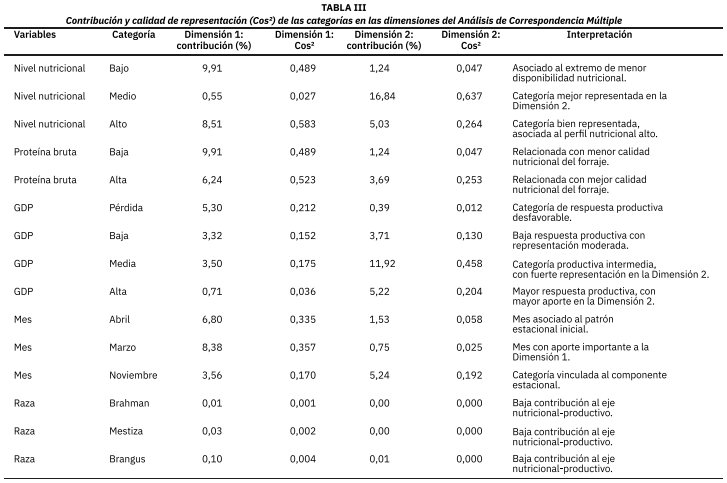
El objetivo del estudio fue evaluar la asociación del nivel nutricional, la raza, la estacionalidad y el sexo con la ganancia diaria de peso en bovinos tropicales. Para ello, se analizaron 669 registros productivos correspondientes a bovinos Brahman, Brangus y mestizos. Se consideraron como variables de análisis el nivel nutricional (bajo, medio y alto), el grupo racial, el sexo, el mes de evaluación como indicador de la estacionalidad, el año de registro (2024 y 2025), la ganancia diaria de peso y el contenido de proteína bruta del forraje. La ganancia diaria de peso y la proteína bruta fueron categorizadas previamente para el análisis multivariante. Se empleó un Análisis de Correspondencia Múltiple para explorar asociaciones entre variables categóricas, complementado con el coeficiente V de Cramér y el procedimiento de Holm-Bonferroni para el ajuste por comparaciones múltiples (α = 0,05). El Análisis de Correspondencia Múltiple explicó el 48.70 % de la varianza total. La Dimensión 1 (20,10 %) separó los niveles nutricionales, mientras que la Dimensión 2 (15,50 %) capturó el efecto estacional. El Análisis de Correspondencia Múltiple mostró una proximidad entre las categorías correspondientes al nivel nutricional alto, la proteína bruta alta y la mayor ganancia diaria de peso. La V de Cramér confirmó una fuerte asociación entre el nivel nutricional, la proteína bruta y la ganancia diaria de peso (V > 0,50). En contraste, no se encontró asociación entre el grupo racial y la ganancia diaria de peso (V = 0,03; P > 0,05), ni entre el grupo racial y el nivel nutricional (V = 0,01; P > 0,05). Noviembre presentó el mayor número de registros con pérdida de peso. Aunque el nivel nutricional y la estacionalidad se asociaron con la ganancia diaria de peso, el diseño del estudio no permitió diferenciar el efecto de cada uno de estos factores. Se recomienda que futuras investigaciones evalúen ambos factores de manera independiente e incorporen la estimación del consumo de forraje y mediciones de la composición corporal.
Descargas
Citas
Morrone S, Dimauro C, Gambella F, Cappai MG. Industry 4.0 and precision livestock farming (PLF): an up–to–date overview across animal productions. Sensors [Internet]. 2022; 22(12):4319. doi: https://doi.org/rf74 DOI: https://doi.org/10.3390/s22124319
Grzesiak W, Zaborski D, Plucinski M, Jedrzejczak–Silicka M, Pilarczyk R, Sablik P. The use of selected machine learning methods in dairy cattle farming: a review. Animals [Internet]. 2025; 15(14):2033. doi: https://doi.org/rf8d DOI: https://doi.org/10.3390/ani15142033
Prieto–Luna JC, Alarcón–Sucasaca A, Fernández–Romero V, Turpo–Galeano YH, Delgado–Berrocal YR, Holgado–Apaza LA. Automated monitoring system for estrus signs in cattle using precision livestock farming with IoT technology in the Peruvian Amazon. Rev. Cient. Sist. Inform. [Internet]. 2025; 5(1):e837. doi: https://doi.org/rf8m DOI: https://doi.org/10.51252/rcsi.v5i1.837
Kraft M, Bernhardt H, Brunsch R, Büscher W, Colangelo E, Graf H, Marquering J, Tapken H, Toppel K, Westerkamp C, Ziron M. Can livestock farming benefit from Industry 4.0 technology? Evidence from recent study. Appl. Sci. [Internet]. 2022; 12(24):12844. doi: https://doi.org/g9qdfp DOI: https://doi.org/10.3390/app122412844
Higaki S, Noronha de Andrade–Freitas E, Negreiro A, Dórea JRR, Cabrera VE. Leveraging unsupervised machine learning techniques for detecting outliers in the daily milk yield data of dairy cows. J. Dairy Sci. [Internet]. 2025; 108(9):9696–9711. doi: https://doi.org/rf8r DOI: https://doi.org/10.3168/jds.2024-25889
Hossain ME, Kabir MA, Zheng L, Swain DL, McGrath S, Medway J. A systematic review of machine learning techniques for cattle identification: datasets, methods and future directions. Artif. Intell. Agric. [Internet]. 2022; 6:138–155. doi: https://doi.org/grg35z DOI: https://doi.org/10.1016/j.aiia.2022.09.002
Chelotti JO, Martinez–Rau L, Ferrero M, Vignolo L, Galli J, Planisich A, Rufiner HL, Giovanini L. Livestock feeding behaviour: A review on automated systems for ruminant monitoring. Biosystems Eng. [Internet]. 2024; 246:150–177. doi: https://doi.org/gt6x7v DOI: https://doi.org/10.1016/j.biosystemseng.2024.08.003
Michelena Á, Díaz–Longueira A, Novais P, Simic D, Fontenla–Romero Ó, Calvo–Rolle J. Comparative analysis of unsupervised anomaly detection techniques for heat detection in dairy cattle. Neurocomputing [Internet]. 2024; 618:129088. doi: https://doi.org/rf8w DOI: https://doi.org/10.1016/j.neucom.2024.129088
Idris M, Uddin J, Sullivan M, McNeill DM, Phillips CJC. Non–invasive physiological indicators of heat stress in cattle. Animals [Internet]. 2021; 11(1):71. doi: https://doi.org/g95qcd DOI: https://doi.org/10.3390/ani11010071
Indarjulianto S, Nururrozi A, Datrianto DS, Fen TY, Priyo Jr TW, Setyawan EMN. Physiology value of breath, pulse and body temperature of cattle. BIO Web Conf. [Internet]. 2022; 49(2):01007. doi: https://doi.org/rf8x DOI: https://doi.org/10.1051/bioconf/20224901007
King MTM, Dancy KM, LeBlanc SJ, Pajor EA, DeVries TJ. Deviations in behavior and productivity data before diagnosis of health disorders in cows milked with an automated system. J. Dairy Sci. [Internet]. 2017; 100(10):8358–8371. doi: https://doi.org/gbz7t9 DOI: https://doi.org/10.3168/jds.2017-12723
Beauchemin KA. Invited review: current perspectives on eating and rumination activity in dairy cows. J. Dairy Sci. [Internet]. 2018; 101(6):4762–4784. doi: https://doi.org/gdmrbs DOI: https://doi.org/10.3168/jds.2017-13706
Codl R, Duchácek J, Stádník L, Gašparík M. Behavioral indicators of mastitis: feeding–to–rumination ratio as a predictive tool in Holstein–Czech Fleckvieh crossbreeds. Cogent Food Agric. [Internet]. 2026; 12(1):2629620. doi: https://doi.org/rgc5 DOI: https://doi.org/10.1080/23311932.2026.2629620
Jiang T, Gradus JL, Rosellini AJ. Supervised machine learning: a brief primer. Behav. Ther. [Internet]. 2020; 51(5):675–687. doi: https://doi.org/gm2xrd DOI: https://doi.org/10.1016/j.beth.2020.05.002
Kuo CT, Xu D, Friesen R. A brief review of unsupervised machine learning algorithms in astronomy: dimensionality reduction and clustering. Universe [Internet]. 2025; 11(12):412. doi: https://doi.org/rgc6 DOI: https://doi.org/10.3390/universe11120412
Breiman L. Random forests. Mach. Learn. [Internet]. 2001; 45(1):5–32. doi: https://doi.org/d8zjwq DOI: https://doi.org/10.1023/A:1010933404324
Viteri–Guzmán G, Molineros–Meza R, Oyarzún–Soares E. Impact on cattle welfare with IoT technology and statistical data analytics. E3S Web of Conferences [Internet]. 2025; 658:03005. doi: https://doi.org/rgc7 DOI: https://doi.org/10.1051/e3sconf/202565803005
Sun D, Webb L, van der Tol PPJ, van Reenen K. A systematic review of automatic health monitoring in calves: glimpsing the future from current practice. Front. Vet. Sci. [Internet]. 2021; 8:761468. doi https://doi.org/rgc8 DOI: https://doi.org/10.3389/fvets.2021.761468
Girdauskaite A, Grige S, Džermeikaite K, Krištolaityte J, Malašauskiene D, Televicius M, Šertvytyte G, Lemboviciute G, Antanaitis R. Supervised machine learning approaches for early detection of metabolic and udder health disorders in dairy cows using sensor–derived data. Front. Vet. Sci. [Internet]. 2025; 12:1726719. doi: https://doi.org/rgc9 DOI: https://doi.org/10.3389/fvets.2025.1726719
Brown W, Cavani L, Peñagaricano F, Weigel K, White HM. Feeding behavior parameters and temporal patterns in mid–lactation Holstein cows across a range of residual feed intake values. J. Dairy Sci. [Internet]. 2022; 105(10):8130–8142. doi: https://doi.org/rgdb DOI: https://doi.org/10.3168/jds.2022-22093