Modelización predictiva de la resistencia antimicrobiana en Salmonella entérica zoonótica: un análisis retrospectivo mediante aprendizaje automático de datos nacionales de vigilancia (2000–2020)
Resumen
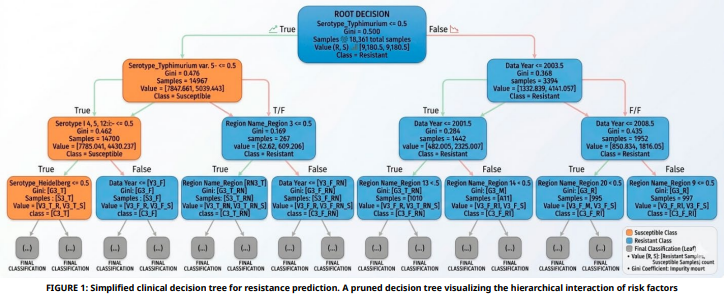
Los patógenos zoonóticos representan un desafío clave para el enfoque One Health (Una Sola Salud), especialmente con respecto a la resistencia a los antimicrobianos. No obstante, los datos de vigilancia disponibles continúan estando infrautilizados, lo que dificulta la mitigación efectiva de los riesgos asociados a la resistencia a los antimicrobianos. La investigación se realizó con el objetivo de evaluar el potencial de técnicas de aprendizaje automático para predecir con precisión la resistencia a la tetraciclina en aislamientos de Salmonella entérica procedentes de fuentes veterinarias. Para ello, se analizaron datos recopilados entre 2000 y 2020 por el Sistema Nacional de Monitoreo de la Resistencia a los Antimicrobianos de la Administración de Alimentos y Medicamentos de los Estados Unidos. El estudio se centró en desarrollar un modelo predictivo de clasificación para la identificación de serovares de Salmonella mediante técnicas de aprendizaje automático. Para evaluar el rendimiento, se utilizó una validación cruzada estratificada de 5 pliegues. Además, se analizó la utilidad clínica a través del valor predictivo negativo, con intervalos de confianza del 95 %. La resistencia a la tetraciclina se estimó en un 12,7 % en general. El modelo XGBoost presentó el mejor rendimiento predictivo con un AUC = 0,817 (IC 95 %: 0,802–0,829), en comparación con la regresión logística (0,790). La estabilidad interna del modelo fue sólida y el valor predictivo negativo alcanzó el 94,9 %, indicando una buena identificación de los aislamientos susceptibles. El análisis de la importancia de las variables reveló que el serotipo fue el factor más relevante, seguido de variables temporales y espaciales. El estudio mostróel potencial de los modelos de gradient boosting para la estratificación del riesgo de resistencia a los antimicrobianos, así como para la gestión responsable de antimicrobianos, sobre todo en la orientación de terapias empíricas en ausencia de resultados de laboratorio.
Descargas
Citas
O’Neill J. Tackling drug–resistant infections globally: final report and recommendations. Rev. Antimicrob. Resist. [Internet]. 2016 [cited 22 Feb 2026]; London (UK): Wellcome Trust and the UK Government. 84 p. Available in: https://goo.su/xFz2B
Tang KL, Caffrey NP, Nóbrega DB, Cork SC, Ronksley PE, Barkema HW, Polachek AJ, Ganshorn H, Sharma N, Kellner JD, Ghali WA. Restricting the use of antibiotics in food–producing animals and its association with antibiotic resistance in food–producing animals and human beings: a systematic review and meta–analysis. Lancet Planet. Health [Internet]. 2017; 1(8):e316–e327. doi: https://doi.org/cfxh DOI: https://doi.org/10.1016/S2542-5196(17)30141-9
Majowicz SE, Musto J, Scallan E, Angulo FJ, Kirk M, O’Brien SJ, Jones TF, Fazil A, Hoekstra RM, International Collaboration on Enteric Disease “Burden of Illness” Studies. The global burden of nontyphoidal Salmonella gastroenteritis. Clin. Infect. Dis. [Internet]. 2010; 50(6):882–889. doi: https://doi.org/b33mj3 DOI: https://doi.org/10.1086/650733
Tanmoy AM, Hooda Y, Sajib MSI, Rahman H, Sarkar A, Das D, Islam N, Kanon N, Rahman MA, Garrett DO, Endtz HP, Luby SP, Shahidullah M, Amin MR, Alam J, Hanif M, Saha SK, Saha S. Trends in antimicrobial resistance amongst Salmonella Typhi in Bangladesh: A 24–year retrospective observational study (1999–2022). PLoS Negl. Trop. Dis. [Internet]. 2024; 18(10):e0012558. doi: https://doi.org/rggf DOI: https://doi.org/10.1371/journal.pntd.0012558
Karp BE, Tate H, Plumblee JR, Dessai U, Whichard JM, Thacker EL, Hale KR, Wilson W, Friedman CR, Griffin PM, McDermott PF. National Antimicrobial Resistance Monitoring System: two decades of advancing public health through integrated surveillance of antimicrobial resistance. Foodborne Pathog. Dis. [Internet]. 2017; 14(10):545–557. doi: https://doi.org/gb4jhm DOI: https://doi.org/10.1089/fpd.2017.2283
EFSA (European Food Safety Authority), ECDC (European Centre for Disease Prevention and Control). The European Union summary report on antimicrobial resistance in zoonotic and indicator bacteria from humans, animals and food in 2017/2018. EFSA J. [Internet]. 2020; 18(3):e06007. doi: https://doi.org/gjtmrh DOI: https://doi.org/10.2903/j.efsa.2020.6007
Magouras I, Carmo LP, Stärk KD, Schüpbach–Regula G. Antimicrobial usage and resistance in livestock: Where should we focus? Front. Vet. Sci. [Internet]. 2017; 4:148. doi: https://doi.org/rggn DOI: https://doi.org/10.3389/fvets.2017.00148
Liu Y, Wang X, Wu L, Shi Z, Zhu M, Ye L, Xu P. Prediction of antimicrobial resistance in Staphylococcus aureus with a machine learning classifier based on WGS data. Microbiol Spectr. [Internet]. 2025; 13(9):e0006525. doi: https://doi.org/rghj . DOI: https://doi.org/10.1128/spectrum.00065-25
Anahtar MN, Yang JH, Kanjilal S. Applications of machine learning to the problem of antimicrobial resistance: an emerging model for translational research. J. Clin. Microbiol. [Internet]. 2021; 59(7):e01260–20. doi: https://doi.org/ghzvz8 DOI: https://doi.org/10.1128/JCM.01260-20
Moradigaravand D, Palm M, Farewell A, Mustonen V, Warringer J, Parts L. Prediction of antibiotic resistance in Escherichia coli from large–scale pan–genome data. PLoS Comput. Biol. [Internet]. 2018; 14(12):e1006258. doi: https://doi.org/ggmjgg DOI: https://doi.org/10.1371/journal.pcbi.1006258
Nguyen M, Long SW, McDermott PF, Olsen RJ, Olson R, Stevens RL, Tyson GH, Zhao S, Davis JJ. Using machine learning to predict antimicrobial MICs and associated genomic features for nontyphoidal Salmonella. J. Clin. Microbiol. [Internet]. 2019; 57(2):e01260–18. doi: https://doi.org/gjtwtp DOI: https://doi.org/10.1128/JCM.01260-18
Food and Drug Administration (FDA). National Antimicrobial Resistance Monitoring System (NARMS). 2018 NARMS Update: Integrated Report Summary. [Internet]. Maryland (Montgomery, USA): Food and Drug Administration; 2020 [cited 22 Feb 2026]. Disponible en: https://www.fda.gov
Alvarez DM, Barrón–Montenegro R, Conejeros J, Rivera D, Undurraga EA, Moreno–Switt AI. A review of the global emergence of multidrug–resistant Salmonella enterica subsp. enterica serovar Infantis. Int. J. Food Microbiol. [Internet]. 2023; 403:110297. doi: https://doi.org/rghb DOI: https://doi.org/10.1016/j.ijfoodmicro.2023.110297
Gaur P, Hada V, Rath RS, Mohanty A, Singh P, Rukadikar A. Interpretation of antimicrobial susceptibility testing using European Committee on Antimicrobial Susceptibility Testing (EUCAST) and Clinical and Laboratory Standards Institute (CLSI) breakpoints: analysis of agreement. Cureus. [Internet]. 2023; 15(3):e36977. doi: https://doi.org/g92b2h DOI: https://doi.org/10.7759/cureus.36977
Dohoo I, Martin W, Stryhn H. Veterinary epidemiologic research. 2nd ed. Charlottetown, Prince Edward Island (Canada): VER Inc; 2009.
Rokach L, Maimon O. Data mining with decision trees: theory and applications. 2nd ed. Singapore: World Scientific Publishing Co. Pte. Ltd. 2008 [cited 22 Feb 2026]. Available in: https://goo.su/dXx27ys
Breiman L. Random forests. Mach. Learn. [Internet]. 2001; 45(1):5–32. https://doi.org/d8zjwq DOI: https://doi.org/10.1023/A:1010933404324
Chen T, Guestrin C. XGBoost: a scalable tree boosting system. In: Proceedings of the 22nd ACM SIGKDD International Conference on Knowledge Discovery and Data Mining. New York, USA: Association for Computing Machinery; 2016. p. 785–794. doi: https://doi.org/gdp84q DOI: https://doi.org/10.1145/2939672.2939785
Mellor KC, Petrovska L, Thomson NR, Harris K, Reid SWJ, Mather AE. Antimicrobial resistance diversity suggestive of distinct Salmonella Typhimurium sources or selective pressures in food–production animals. Front. Microbiol. [Internet]. 2019; 10:708. doi: https://doi.org/fvzc DOI: https://doi.org/10.3389/fmicb.2019.00708
Oh H, Choi Y, Lee J. Antibiotic–resistant Salmonella in animal products jeopardize human health. Food Sci. Anim. Resour. [Internet]. 2025; 45(2):409–428. doi: https://doi.org/qzt3 DOI: https://doi.org/10.5851/kosfa.2025.e4
Tang R, Luo R, Tang S, Song H, Chen X. Machine learning in predicting antimicrobial resistance: a systematic review and meta–analysis. Int. J. Antimicrob. Agents [Internet]. 2022; 60(5–6):106684. doi: https://doi.org/g62n28 DOI: https://doi.org/10.1016/j.ijantimicag.2022.106684
Ferri M, Ranucci E, Romagnoli P, Giaccone V. Antimicrobial resistance: A global emerging threat to public health systems. Crit. Rev. Food Sci. Nutr. [Internet]. 2017; 57(13):2857–2876. doi: https://doi.org/ggh25p DOI: https://doi.org/10.1080/10408398.2015.1077192
Page SW, Gautier P. Use of antimicrobial agents in livestock. Rev. Sci. Tech. [Internet]. 2012; 31(1):145–188. doi: https://doi.org/gmxmqv DOI: https://doi.org/10.20506/rst.31.1.2106
Weese JS, Page SW, Prescott JF. Antimicrobial stewardship in animals. En: Giguère S, Prescott JF, Dowling PM, eds. Antimicrobial therapy in veterinary medicine. 5th ed. Hoboken (NJ, USA): John Wiley & Sons, Inc. 2013. p. 117–132. doi: https://doi.org/rghf DOI: https://doi.org/10.1002/9781118675014.ch7
Guardabassi L, Prescott JF. Antimicrobial stewardship in small animal veterinary practice: from theory to practice. Vet. Clin. North Am. Small Anim. Pract. [Internet]. 2015; 45(2):361–376. doi: https://doi.org/rghg DOI: https://doi.org/10.1016/j.cvsm.2014.11.005
Carroll LM, Gaballa A, Guldimann C, Sullivan G, Henderson LO, Wiedmann M. Identification of novel mobilized colistin resistance gene mcr–9 in a multidrug–resistant, colistin–susceptible Salmonella enterica serotype Typhimurium isolate. mBio [Internet]. 2019; 10(3):e00853–19. doi: https://doi.org/gf7r4q DOI: https://doi.org/10.1128/mBio.00853-19