Efecto del extracto de Pelargonium sidoides sobre algunos parámetros endocrinos y de estrés oxidativo en ratas con síndrome de ovario poliquístico
Resumen
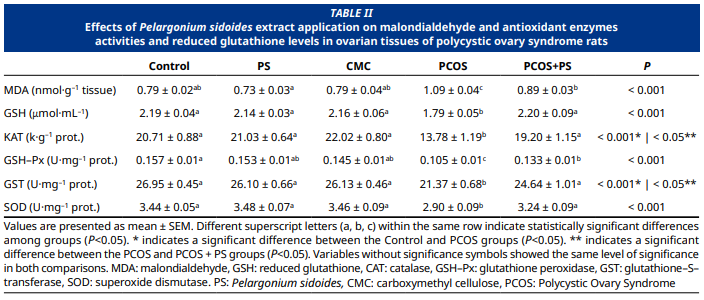
Se evaluó el papel potencial del extracto de Pelargonium sidoides en la reducción del estrés oxidativo en ratas con síndrome de ovario poliquístico (SOP) inducido experimentalmente. Se formaron cinco grupos: grupo control sin tratamiento; un grupo que recibió 1 % de carboximetilcelulosa; otro grupo recibió extracto de P. sidoides (30 mg·kg–1·día–1 durante 3 días -d-); al grupo SOP se le administró letrozol (1 mg·kg–1·día–1 durante 21 d); y en el grupo SOP + P. sidoides, se dosificó el extracto durante los últimos 3 d de la administración de letrozol. Se determinaron los niveles de malondialdehído y glutatión reducido, y las actividades de catalasa, glutatión peroxidasa, superóxido dismutasa y glutatión–S–transferasa en sangre y tejidos ováricos. Además, se determinaron hormonas y biomarcadores como hormona foliculo estimulante (FSH), hormona luteinizante (LH), testosterona, insulina, colesterol y glucosa en suero. Las ratas del grupo SOP mostraron niveles de malondialdehído significativamente elevados tanto en plasma como en tejido ovárico, lo que indica un aumento del estrés oxidativo. Por el contrario, en comparación con los controles, los niveles de glutatión reducido y la actividad de las enzimas antioxidantes fueron significativamente menores. En el grupo SOP + P. sidoides, los niveles de glutatión reducido ováricos aumentaron significativamente, sin embargo, no se observó ninguna alteración en los niveles de glutatión reducido plasmáticos. Los niveles de malondialdehído disminuyeron en ambos tejidos, y las actividades de las enzimas antioxidantes mejoraron significativamente, lo que sugiere una restauración parcial del equilibrio oxidativo. Las evaluaciones endocrinas mostraron que las ratas SOP tenían niveles séricos más altos de LH, testosterona, insulina y colesterol, con niveles disminuidos de FSH, mientras que la glucosa se mantuvo sin cambios. En el grupo SOP + P. sidoides, muchos parámetros se aproximaron a los valores de control, y no se detectaron diferencias significativas en comparación con las ratas sanas, excepto para la testosterona. En comparación con el grupo SOP, el suero redujo significativamente los niveles de LH, testosterona e insulina, e incrementó la FSH, mientras que la glucosa permaneció inalterada. En general, los hallazgos indican que el SOP induce estrés oxidativo en el plasma y los tejidos ováricos, y altera biomarcadores hormonales y metabólicos clave. El extracto de P. sidoides, gracias a sus efectos antioxidantes, podría aliviar las alteraciones oxidativas y hormonales asociadas al SOP, lo que sugiere su potencial papel de apoyo para mitigar las complicaciones relacionadas con esta afección.
Descargas
Citas
Stener–Victorin E, Teede H, Norman RJ, Legro R, Goodarzi MO, Dokras A, Laven J, Hoeger K, Piltonen TT. Polycystic ovary syndrome. Nature [Internet]. 2024; 10(1):27. doi: https://doi.org/gtrjvx DOI: https://doi.org/10.1038/s41572-024-00511-3
Singh S, Pal N, Shubham S, Sarma DK, Verma V, Marotta F, Kumar M. Polycystic ovary syndrome: etiology, current management, and future therapeutics. J. Clin. Med. [Internet]. 2023; 12(4):1454. doi: https://doi.org/j4h4 DOI: https://doi.org/10.3390/jcm12041454
El Hayek S, Bitar L, Hamdar LH, Mirza FG, Daoud G. Poly cystic ovarian syndrome: an updated overview. Front. Physiol. [Internet]. 2016; 7:124. doi: https://doi.org/grrfg2 DOI: https://doi.org/10.3389/fphys.2016.00124
Teede HJ, Tay CT, Laven JJ, Dokras A, Moran LJ, Piltonen TT, Costello MF, Boivin J, Redman LM, Boyle JA, Norman RJ, Mousa A, Joham AE. Recommendations from the 2023 international evidence–based guideline for the assessment and management of polycystic ovary syndrome. Europ. J. Endocrinol. [Internet]. 2023; 189(2):43–64. doi: https://doi.org/gs4rjw
Deswal R, Narwal V, Dang A, Pundir CS. The prevalence of polycystic ovary syndrome: a brief systematic review. J. Hum. Reprod. Sci. [Internet]. 2020; 13(4):261–271. doi: https://doi.org/grqdzh DOI: https://doi.org/10.4103/jhrs.JHRS_95_18
Motlagh–Asghari K, Nejadghaderi SA, Alizadeh M, Sanaie S, Sullman MJM, Kolahi AA, Avery J, Safiri S. Burden of polycystic ovary syndrome in the Middle East and North Africa region, 1990–2019. Sci. Rep. [Internet]. 2022; 12:7039. doi: https://doi.org/g96sdq DOI: https://doi.org/10.1038/s41598-022-11006-0
Bremer AA. Polycystic ovary syndrome in the pediatric population. Metab. Syndr. Relat. Disord. [Internet]. 2010; 8(5):375–394. doi: https://doi.org/bshwdq DOI: https://doi.org/10.1089/met.2010.0039
Çelikdemir N, Mamur MN, Çeribasi AO, Üstün I, Yilmaz S, Kaya E. Effect of Maca root (Lepidium meyenii) on some biochemical and antioxidant parameters in rats with experimental polycystic ovary syndrome. Rev. Cient. FCV–LUZ [Internet]. 2025; 35(2):e35619. doi: https://doi.org/rf3s DOI: https://doi.org/10.52973/rcfcv-e35619
de Andrade–Fauth J, Beserra BST, Garcia ÉC, Amato AA. The effect of herbal extracts and plant bioactive compounds on insulin resistance in women with polycystic ovary syndrome: a systematic review and meta–analysis of randomized controlled trials. Phytomed. Plus [Internet]. 2026; 6(2):100962. doi: https://doi.org/rf3t DOI: https://doi.org/10.1016/j.phyplu.2026.100962
Chavez GN, Jaworsky K, Basu A. The effects of plant–derived phytochemical compounds and phytochemical–rich diets on females with polycystic ovarian syndrome: a scoping review of clinical trials. Int. J. Environ. Res. Public Health. [Internet]. 2023; 20(15):6534. doi: https://doi.org/rf3v DOI: https://doi.org/10.3390/ijerph20156534
Mtimkulu Y, Lewu MN, Mulidzi AR, Lewu F. Cultivation and beneficial uses of Pelargonium sidoides DC.– A review. J. Med. Plants Econ. Dev. [Internet]. 2024; 8(1):246. doi: https://doi.org/rf3w DOI: https://doi.org/10.4102/JOMPED.v8i1.246
Reina BD, Malheiros SS, Vieira SM, de Andrade PF, Dovigo LN. Unlocking the therapeutic potential of Pelargonium sidoides natural extract: A scoping review. Heliyon [Internet]. 2024; 10(23):e40554. doi: https://doi.org/rf3x DOI: https://doi.org/10.1016/j.heliyon.2024.e40554
Theisen LL, Muller CP. EPs® 7630 (Umckaloabo®), an extract from Pelargonium sidoides roots, exerts anti–influenza virus activity in vitro and in vivo. Antivir. Res. [Internet]. 2012; 94(2):147–156. doi: https://doi.org/f3w4xg DOI: https://doi.org/10.1016/j.antiviral.2012.03.006
Kim CE, Griffiths WJ, Taylor PW. Components derived from Pelargonium stimulate macrophage killing of Mycobacterium species. J. Appl. Microbiol. [Internet]. 2009; 106(4):1184–1193. doi: https://doi.org/dsrh3r DOI: https://doi.org/10.1111/j.1365-2672.2008.04085.x
Michaelis M, Doerr HW, Cinatl Jr J. Investigation of the influence of EPs® 7630, a herbal drug preparation from Pelargonium sidoides, on replication of a broad panel of respiratory viruses. Phytomedicine [Internet]. 2011; 18(5):384–386. doi: https://doi.org/fwxm5t
Helfer M, Koppensteiner H, Schneider M, Rebensburg S, Forcisi S, Müller C, Schmitt–Kopplin P, Schindler M, Brack–Werner, R. The root extract of the medicinal plant Pelargonium sidoides is a potent HIV–1 attachment inhibitor. PloS One [Internet]. 2014; 9(1):e87487. doi: https://doi.org/f5vmr4 DOI: https://doi.org/10.1371/journal.pone.0087487
Luna Jr LA, Bachi ALL, Brito RN, Eid RG, Suguri VM, Oliveira PW, Gregorio LC, Vaisberg M. Immune responses induced by Pelargonium sidoides extract in serum and nasal mucosa of athletes after exhaustive exercise: Modulation of secretory IgA, IL–6 and IL–15. Phytomedicine [Internet]. 2011; 18(4):303–308. doi: https://doi.org/bfd6wt DOI: https://doi.org/10.1016/j.phymed.2010.08.003
Wittschier N, Faller G, Hensel A. An extract of Pelargonium sidoides (EPs 7630) inhibits in situ adhesion of Helicobacter pylori to human stomach. Phytomedicine [Internet]. 2007; 14(4):285–288. doi: https://doi.org/b9j8ct DOI: https://doi.org/10.1016/j.phymed.2006.12.008
Unay S, Sirinyildiz F, Keskin A, Kahraman–Cetin N. Protective effects of Pelargonium sidoides against oxidative stress and inflammation in experimental mesenteric ischemia–reperfusion injury. J. Mol. Histol. [Internet]. 2026; 57(2):136. doi: https://doi.org/rf36 DOI: https://doi.org/10.1007/s10735-026-10790-7
Balasubramanian R, Maideen NMP, Muthusamy S, Gobinath M. A review of clinical and preclinical studies on the therapeutic potential of black seeds (Nigella sativa) in the management of polycystic ovarian syndrome (PCOS). J. Pharmacopunct. [Internet]. 2023; 26(1):1–9. doi: https://doi.org/rf37 DOI: https://doi.org/10.3831/KPI.2023.26.1.1
Elmosalamy SH, Elleithy EM, Ahmed ZSO, Rashad MM, Ali GE, Hassan NH. Dysregulation of intraovarian redox status and steroidogenesis pathway in letrozole–induced PCOS rat model: a possible modulatory role of l–Carnitine. Beni–Suef Univ. J. Basic Appl. Sci. [Internet]. 2022; 11(1):146. doi: https://doi.org/rf38 DOI: https://doi.org/10.1186/s43088-022-00329-6
Dogan G, Dogan G, Karaca O, Ayaz E. Effects of Pelargonium sidoides (UMCA®) on pulmonary contusion from blunt thoracic trauma in rats. Ann. Med. Res. [Internet]. 2020; 27(9):2319–2325. doi: https://doi.org/rf39 DOI: https://doi.org/10.5455/annalsmedres.2020.07.757
Placer ZA, Cushman L, Johnson BC. Estimation of products of lipid peroxidation (malonyl dialdehyde) in biological fluids. Anal. Biochem. [Internet]. 1966; 16(2):359–364. doi: https://doi.org/b96rpj DOI: https://doi.org/10.1016/0003-2697(66)90167-9
Ellman GL, Courtney KD, Andres Jr V, Featherstone RM. A new and rapid colorimetric determination of acetylcholinesterase activity. Biochem. Pharmacol. [Internet]. 1961; 7(2):88–95. doi: https://doi.org/fwdkkz DOI: https://doi.org/10.1016/0006-2952(61)90145-9
Aebi H. Catalase. In: Bergmeyer HU, editor. Methods of Enzymatic Analysis. 2nd. ed. Weinheim, Germany: Verlag Chemie/Academic Press Inc. 1974. p. 673–678. DOI: https://doi.org/10.1016/B978-0-12-091302-2.50032-3
Beutler E. Red cell metabolism. A manual of biochemical methods. 3rd ed. Orlando (Florida, USA): Grune & Stratton; 1984.
Habig WH, Pabst MJ, Jakoby WB. Glutathione S–transferases: The first enzymatic step in mercapturic acid formation. J. Biol. Chem. [Internet]. 1974 [cited 20 Mar 2026]; 249(22):7130–7139. Available in: https://goo.su/vQ7i1 DOI: https://doi.org/10.1016/S0021-9258(19)42083-8
Sun YI, Oberley LW, Li Y. A simple method for clinical assay of superoxide dismutase. Clin. Chem. [Internet]. 1988 [cited 20 Mar 2026]; 34(3): 497–500. PMID: 3349599. Available in: https://goo.su/rfHOaLp DOI: https://doi.org/10.1093/clinchem/34.3.497
Frankel S, Reitman S, Sonnen AC. A textbook on laboratory procedure and their interpretation. In: Gradwohl RBH, editor. Gradwohl’s clinical laboratory methods and diagnosis. 7th edition. St. Louis (Misuri, USA): C.V. Mosby Company; 1970 [cited 20 Mar 2026]. p. 403–404. Available in: https://goo.su/kNn2k
Lowry O, Rosebrough N, Farr AL, Randall RJ. Protein measurement with the Folin phenol reagent. J. Biol. Chem. [Internet]. 1951; 193(1):265–275. doi: https://doi.org/ghv6nr DOI: https://doi.org/10.1016/S0021-9258(19)52451-6
Victor VM, Rovira–Llopis S, Bañuls C, Diaz–Morales N, Martinez de Maranon A, Rios–Navarro C, Alvarez A, Gomez M, Rocha M, Hernández–Mijares A. Insulin resistance in PCOS patients enhances oxidative stress and leukocyte adhesion: role of myeloperoxidase. PLoS One. [Internet]. 2016; 11(3):e0151960. doi: https://doi.org/bv7p DOI: https://doi.org/10.1371/journal.pone.0151960
Agarwal A, Gupta S, Sharma RK. Role of oxidative stress in female reproduction. Reprod. Biol. Endocrinol. [Internet]. 2005; 3(1):28. doi: https://doi.org/bn2njr DOI: https://doi.org/10.1186/1477-7827-3-28
Babaeenezhad E, Farzane–Yegane D, Yarahmadi S, Fakouri A, Dezfoulian O. Betaine alleviates letrozole–induced polycystic ovarian syndrome in rats by regulating oxidative stress and inflammation and restoring the proliferation–apoptosis balance. J. Ovarian Res. [Internet]. 2025; 18(1):261. doi: https://doi.org/rf6b DOI: https://doi.org/10.1186/s13048-025-01826-9
Elfiky AM, Ibrahim RS, Khattab AR, Kadry MO, Ammar NM, Shawky E. Exploring the therapeutic potential of marjoram (Origanum majorana L.) in polycystic ovary syndrome: insights from serum metabolomics, network pharmacology and experimental validation. BMC Complement. Med. Ther. [Internet]. 2025; 25(1):67. doi: https://doi.org/rf6d DOI: https://doi.org/10.1186/s12906-025-04774-5
Femi–Olabisi FJ, Oyerinde OR, Faokunla OO, Omar SA, Igene PE, Asaluwala OE, Adeoye BO, Oladoye OO. Alpha–lipoic acid regulates pro–inflammatory cytokines and hormones in letrozole–induced polycystic ovary syndrome in rats. Endocr. Metab. Sci. [Internet]. 2025; 18:100245. doi: https://doi.org/rf6f DOI: https://doi.org/10.1016/j.endmts.2025.100245
Elmosalamy SH, Ahmed ZSO, Elleithy EM, Rashad MM, Ali GE, Hassan NH. Novel therapeutic insights of Alpha lipoic acid: antioxidant, and steroidogenesis regulatory role in letrozole induced PCOS rat model. Vet. Med. J. [Internet]. 2024; 70(1):26–45. doi: https://doi.org/rf6g DOI: https://doi.org/10.21608/vmjg.2024.255839.1029
Rashid S, Khan WY, Hafiz S, Mushtaq Z, Rafiq M, Rasheed S, Ganie SA, Amin S. Ocimum tenuiflorum L. extracts attenuate polycystic ovarian syndrome in letrozole treated female Wistar rats through modulation of iNOS, COX–2, IL–1ß and TNF–a. J. Mol. Histol. [Internet]. 2026; 57(2):126. doi: https://doi.org/rf6h DOI: https://doi.org/10.1007/s10735-026-10774-7
Terlizzi M, Colarusso C, Di Maio U, Bagnulo A, Pinto A, Sorrentino R. Antioxidant and antimicrobial properties of Pelargonium sidoides DC and lactoferrin combination. Biosci. Rep. [Internet]. 2020; 40(11):BSR20203284. doi: https://doi.org/rf6j DOI: https://doi.org/10.1042/BSR20203284
Michaelis M, Doerr HW, Cinatl Jr J. Investigation of the influence of EPs® 7630, a herbal drug preparation from Pelargonium sidoides, on replication of a broad panel of respiratory viruses. Phytomedicine [Internet]. 2011; 18(5):384–386. doi: https://doi.org/fwxm5t DOI: https://doi.org/10.1016/j.phymed.2010.09.008
Xu J, Dun J, Yang J, Zhang J, Lin Q, Huang M, Ji F, Huang L, You X, Lin Y. Letrozole rat model mimics human polycystic ovarian syndrome and changes in insulin signal pathways. Med. Sci. Monit. [Internet]. 2020; 26:e923073. doi: https://doi.org/gsqdx6 DOI: https://doi.org/10.12659/MSM.923073
Houston EJ, Templeman NM. Reappraising the relationship between hyperinsulinemia and insulin resistance in PCOS. J. Endocrinol. [Internet]. 2025; 265(2):e240269. doi: https://doi.org/g953qn DOI: https://doi.org/10.1530/JOE-24-0269
Jahan S, Abid A, Khalid S, Afsar T, Ain QU, Shaheen G, Almajwal A, Razak S. Therapeutic potentials of Quercetin in management of polycystic ovarian syndrome using Letrozole induced rat model: a histological and a biochemical study. J. Ovarian Res. [Internet]. 2018; 11:26. doi: https://doi.org/gqpv5b DOI: https://doi.org/10.1186/s13048-018-0400-5
Ghowsi M, Khazali H, Sisakhtnezhad S. The effect of resveratrol on oxidative stress in the liver and serum of a rat model of polycystic ovary syndrome: An experimental study. Int. J. Reprod. Biomed. [Internet]. 2018 [cited 20 Mar 2026]; 16(3):149–158. PMID: 29766146. Available in: https://goo.su/kqzhQ DOI: https://doi.org/10.29252/ijrm.16.3.149
Reddy PS, Begum N, Mutha S, Bakshi V. Beneficial effect of Curcumin in Letrozole induced polycystic ovary syndrome. Asian Pacif. J. Reprod. [Internet]. 2016; 5(2):116–122. doi: https://doi.org/ghhdzb DOI: https://doi.org/10.1016/j.apjr.2016.01.006
Jindrich–Cinatl Jr J, Wass MN, Michaelis M. Multiple mechanisms enable broad–spectrum activity of the Pelargonium sidoides root extract EPs 7630 against acute respiratory tract infections. Front. Pharmacol. [Internet]. 2024; 15:1455870. doi: https://doi.org/rf6k DOI: https://doi.org/10.3389/fphar.2024.1455870
Aslan A, Seçme M. Effects of Pelargonium sidoides extract on apoptosis and oxidative stress in human neuroblastoma cells. Medicina [Internet]. 2024; 60(12):2110. doi: https://doi.org/rf6m DOI: https://doi.org/10.3390/medicina60122110
Van Wyngaard J, Famuyide IM, Invernizzi L, Ndivhuwo KK, Tordiffe ASW, Maharaj, VJ, McGaw LJ. Optimizing extraction of Pelargonium sidoides roots: Impact of ethanol concentration on biological activity of extracts. S. Afr. J. Bot. [Internet]. 2023; 162:667–679. doi: https://doi.org/rf6n DOI: https://doi.org/10.1016/j.sajb.2023.09.058
Wang MX, Yin Q, Xu X. A rat model of polycystic ovary syndrome with insulin resistance induced by letrozole combined with high fat diet. Med. Sci. Monit. [Internet]. 2020; 26:e922136. doi: https://doi.org/gt9dwh DOI: https://doi.org/10.12659/MSM.922136
Careddu D, Pettenazzo A. Pelargonium sidoides extract EPs 7630: a review of its clinical efficacy and safety for treating acute respiratory tract infections in children. Int. J. Gen. Med. [Internet]. 2018; 11:91–98. doi: https://doi.org/rf6p DOI: https://doi.org/10.2147/IJGM.S154198