Efectos de los agentes anestésıcos butorfanol + ısoflurano y medetomıdına+ısoflurano sobre los parámetros cardıopulmonares, hematológıcos y bıoquímıcos en palomas
Resumen
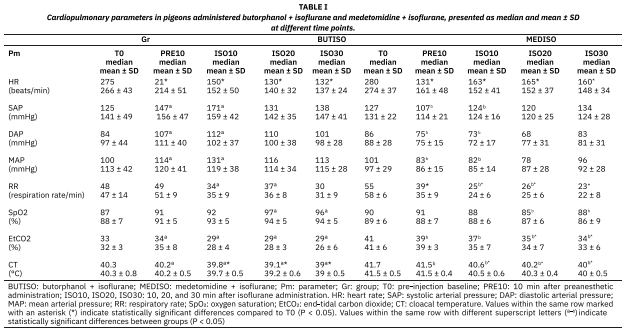
Con el objetivo de desarrollar una combinación anestésica segura y equilibrada en aves y evaluar los efectos de estas combinaciones en diversos sistemas, se llevo a cabo esta investigacion. Para ello se utilizaron Veinte palomas adultas clínicamente sanas (1-2 años de edad, 448,9 ± 41,2 g) las cuales fueron divididas aleatoriamente en dos grupos. El grupo I recibió butorfanol (2 mg/kg, IM), seguido 10 minutos después de isoflurano al 2 % mediante mascarilla facial. El grupo II recibió medetomidina (0,2 mg/kg, IM), seguida del mismo protocolo de isoflurano. Se monitorizaron y analizaron los valores cardiopulmonares, hematológicos, bioquímicos y reflejos. Los resultados obtenidos nos muestran reducciones significativas de la frecuencia cardíaca y la temperatura cloacal en ambos grupos. En el grupo II, la frecuencia respiratoria y los valores de dióxido de carbono al final de la espiración también disminuyeron significativamente en comparación con el valor inicial (P < 0,05). Al comparar los dos grupos, se observaron diferencias significativas en los valores de frecuencia respiratoria, temperatura cloacal, CO₂ al final de la espiración, presión arterial sistólica, presión arterial diastólica, presión arterial media y saturación de oxígeno. Los resultados hematológicos y bioquímicos mostraron que la disminución de glóbulos rojos en el grupo I y el aumento de aspartato aminotransferasa en el grupo II, en comparación con T0, fueron estadísticamente significativos. También se observaron diferencias significativas entre los grupos en glóbulos rojos, hemoglobina y hematocrito. Asimismo, se observó que medetomidina provocó una mayor disminución de los reflejos. Se concluye que el protocolo I demostró efectos depresores más leves en los sistemas cardiopulmonar y hematológico, lo que sugiere que podría ser una opción anestésica más segura en palomas.
Descargas
Citas
Granone TD, Francisco OND, Killos MB, Quandt JE, Mandsager RE, Graham LF. Comparison of three different inhalant anesthetic agents (isoflurane, sevoflurane, desflurane) in red-tailed hawks (Buteo jamaicensis). Vet. Anaesth. Analg. [Internet]. 2012; 39(1):29-37. doi: https://doi.org/cqt4mc DOI: https://doi.org/10.1111/j.1467-2995.2011.00668.x
Kamiloglu A. An Overview to the Avian Anesthesia. J. Erciyes Univ. Vet. Fac. [Internet]. 2017 [cited 20 Feb 2026]; 14(2):137-144. available in: https://goo.su/zPzHB
Straub J, Forbes NA, Thielebein J, Pees M, Krautwald-Junghanns ME. The effects of isoflurane anaesthesia on some Doppler-derived cardiac parameters in the common buzzard (Buteo buteo). Vet. J. [Internet]. 2003; 166(3):273-276. doi: https://doi.org/btt5bk DOI: https://doi.org/10.1016/S1090-0233(03)00074-1
Seamon AB, Hofmeister EH, Diver SJ. Outcome following inhalation anesthesia in birds at a veterinary referral hospital: 352 cases (2004–2014). J. Am. Vet. Med. Assoc. [Internet]. 2017; 251(7):814-817. doi: https://doi.org/gb4m9f DOI: https://doi.org/10.2460/javma.251.7.814
Mercado JA, Larsen RS, Wack RF, Pypendop BH. Minimum anesthetic concentration of isoflurane in captive thickbilled parrots (Rhynchopsitta pachyrhyncha). Am. J .Vet. Res. [Internet]. 2008; 69(2):189-194. doi: https://doi.org/b5zrjm DOI: https://doi.org/10.2460/ajvr.69.2.189
Deori P, Sarma KK, Nath PJ, Singh CK, Nath R. Physiological alteration, quality of anesthesia and economy of isoflurane in domestic chickens (Gallus domesticus). Vet. World. [Internet]. 2017; 10(5):493-497. doi: https://doi.org/gpc758 DOI: https://doi.org/10.14202/vetworld.2017.493-497
Anjana RR, Parikh PV, Mahla JK, Kelawala DN, Patel KP, Ashwath SN. Comparative evaluation of isoflurane and sevoflurane in avian patients. Vet. World. [Internet]. 2021; 14(5):1067-1073. doi: https://doi.org/gkczvf DOI: https://doi.org/10.14202/vetworld.2021.1067-1073
Botman J, Dugdale A, Gabriel F, Vandeweerd JM. Cardiorespiratory parameters in the awake pigeon and during anaesthesia with isoflurane. Vet. Anaesth. Analg. [Internet]. 2016; 43(1):63-71. doi: https://doi.org/f8j49s DOI: https://doi.org/10.1111/vaa.12262
Costa A, Volpato J, Mattoso CR, Lunardeli B, de Moraes AN, Saito ME. Hematologic evaluation in guans (Penelope obscura) under physical restraint and isoflurane anesthesia. J. Zoo Wildl. Med. [Internet]. 2018; 49(1):4853. doi: https://doi.org/rd55 DOI: https://doi.org/10.1638/2016-0125R2.1
Berg KJ, Whittington JK, Watson MK, Wiggen K, Blalock A, Mitchell MA. Effects of isoflurane anesthesia on the hematologic values of rehabilitated wild owls. J. Avian Med. Surg. [Internet]. 2019; 33(4):369-380. doi: https://doi.org/rd56 DOI: https://doi.org/10.1647/2017-333
Doss G, Mans C. Avian sedation. J. Avian Med. Surg. [Internet]. 2021; 35(3):253-268. doi: https://doi.org/rd57 DOI: https://doi.org/10.1647/20-00045
Escobar A, Valadão CAA, Brosnan RJ, Denicol AC, Flôres FN, Thiesen R, Coelho CMM. Effects of butorphanol on the minimum anesthetic concentration for sevoflurane in guineafowl (Numida meleagris). Am. J. Vet. Res. [Internet]. 2012; 73(2):183-188. doi: https://doi.org/fzmx24 DOI: https://doi.org/10.2460/ajvr.73.2.183
Sani IM, Onifade KI. Medetomidine elicit variable effects on sedative indices, hematological and physiological parameters in domestic pigeons (Columba livia). Afr. J. Pharm. Pharmacol. [Internet]. 2012; 6(4):235-240. doi: https://doi.org/rd58 DOI: https://doi.org/10.5897/AJPP11.498
Sanchez D, Guzman M, Beafrere H. Avian pain management and anesthesia. In: Graham JE, Doss GA. Hugues Beaufrè, eds. Exotic Animal Emergency and Critical Care Medicine. 1st ed. [Internet]. 2021: 488-502. doi: https://doi.org/rd59 DOI: https://doi.org/10.1002/9781119149262.ch28
Sandmeier P. Evaluation of medetomidine for shortterm immobilization of domestic pigeons (Columba livia) and Amazon parrots (Amazona species). J. Avian Med. Surg. [Internet]. 2000 [cited 20 Feb 2026]; 14(1):8-14. Available in: https://goo.su/rjyJ7 DOI: https://doi.org/10.1647/1082-6742(2000)014[0008:EOMFST]2.0.CO;2
Lierz M, Korbel R. Anesthesia and analgesia in birds. J. Exot. Pet Med. [Internet]. 2012; 21(1):44-58. doi: https://doi.org/gh37m4 DOI: https://doi.org/10.1053/j.jepm.2011.11.008
Mostachio GQ, De-Oliveira LD, Carciofi AC, Vicente WR. The effects of anesthesia with a combination of intramuscular xylazine–diazepam–ketamine on heart rate, respiratory rate and cloacal temperature in roosters. Vet. Anaesth. Analg. [Internet]. 2008; 35(3):232-236. doi: https://doi.org/c2txd9 DOI: https://doi.org/10.1111/j.1467-2995.2007.00381.x
Kamiloglu A, Atalan G, Kamiloglu NN. Comparison of intraosseous and intramuscular drug administration for induction of anesthesia in domestic pigeons. Res. Vet. Sci. [Internet]. 2008; 85(1):171-175. doi: https://doi.org/fpdhp3 DOI: https://doi.org/10.1016/j.rvsc.2007.09.002
Chan FT, Chang GR, Wang HC, Hsu TH. Anesthesia with isoflurane and sevoflurane in Crested Serpent Eagle (Spilornis cheela hoya): minimum anesthetic concentration, physiological effects, hematocrit, plasma chemistry and behavioral effects. J. Vet. Med. Sci. [Internet]. 2013; 75(12):1591-1600. doi: https://doi.org/rd6h DOI: https://doi.org/10.1292/jvms.13-0161
Martel A, Doss GA, Mans C. Evaluation of the effects of intramuscular injection volume on midazolam-butorphanol induced sedation in domestic pigeons (Columba livia). J. Exot. Pet Med. [Internet]. 2021; 37:3-7. doi: https://doi.org/rd6j DOI: https://doi.org/10.1053/j.jepm.2021.01.003
Uzun M, Yildiz S, Atalan G, Kaya M, Sulu N. Effects of medetomidine-ketamine combination anesthesia on electrocardiographic findings, body temperature, and heart and respiratory rates in domestic pigeons. Turk. J. Vet. Anim. Sci. 2003 [cited 20 Feb 2026]; 27(2):377-382. Available in: https://goo.su/LnB6HF2
Kiliçalp D, Aslan L, Kanter M. Electrocardiogram and Some Blood Parameters in Bronze. YYÜ Vet. Fak. Derg. 2004; 15(1-2):87-90. Available in: https://goo.su/Rnzeaz
Joyner PH, Jones MP, Ward D, Gompf RE, Zagaya N, Sleeman JM. Induction and recovery characteristics and cardiopulmonary effects of sevoflurane and isoflurane in bald eagles. Am. J. Vet. Res. [Internet]. 2008; 69(1):13-22. doi: https://doi.org/dnsdj5 DOI: https://doi.org/10.2460/ajvr.69.1.13
Escobar A, Thiesen R, Vitaliano SN, Belmonte EA, Werther K, Valadão AAC. Cardiorespiratory effects of isoflurane anesthesia in Crested Caracarás (Caracara plancus). J. Zoo. Wildl. Med. [Internet]. 2011; 42(1):12-17. doi: https://doi.org/dmpd8v DOI: https://doi.org/10.1638/2009-0055.1
Degernes L. Anesthesia for companion birds. Compend. Contin. Educ. Vet. [Internet]. 2008 [cited 20 Feb 2026]; 30(10):E2. doi: https://goo.su/LV3zL DOI: https://doi.org/10.22233/20412495.1008.20
Pollock CG, Schumacher J, Orosz SE, Ramsay EC. Sedative effects of medetomidine in pigeons (Columba livia). J. Avian Med. Surg. [Internet]. 2001; 15(2):95-100. available in: https://goo.su/3E3q3 DOI: https://doi.org/10.1647/1082-6742(2001)015[0095:SEOMIP]2.0.CO;2
Kubiak M, Roach L, Eatwell K. The influence of a combined butorphanol and midazolam premedication on anesthesia in psittacid species. J. Avian Med. Surg. [Internet]. 2016; 30(4):317-323. doi: https://doi.org/rd6k DOI: https://doi.org/10.1647/2013-072
Kubiak M. Anaesthetic choice in avian patients. Companion Anim. [Internet]. 2017; 22(1):43-49. doi: https://doi.org/rd6m DOI: https://doi.org/10.12968/coan.2017.22.1.44