Ocurrencia, vías de contaminación y evaluación del riesgo de elementos potencialmente tóxicos en la leche de vaca procedente de zonas industriales y no industriales de Turquía
Resumen
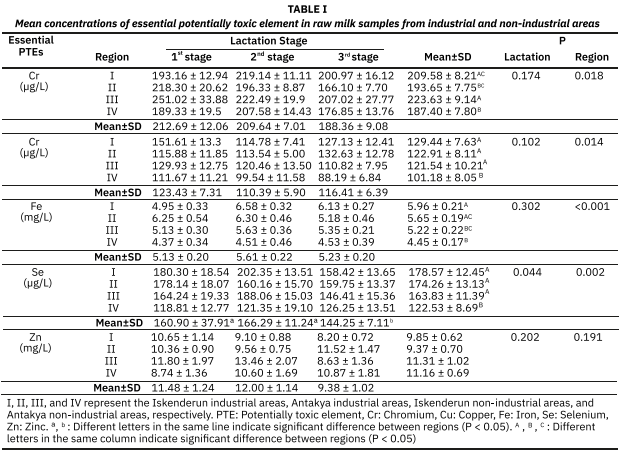
En este estudio, se tuvo como objetivo comparar las concentraciones de elementos potencialmente tóxicos esenciales y no esenciales (Al, As, Cd, Cr, Cu, Fe, Hg, Ni, Pb, Se y Zn) en muestras de leche recolectadas en diferentes etapas de lactación de vacas criadas en zonas industriales y no industriales de Hatay, determinar las posibles vías de contaminación de los elementos potencialmente tóxicos en la leche cruda y revelar el riesgo potencial de exposición a estos elementos a través del consumo de leche en adultos. Con este propósito, se recolectaron un total de 216 muestras individuales de leche cruda de vaca, 72 muestras de agua de bebida y 72 muestras de alimento de 24 granjas lecheras. Los niveles de los elementos potencialmente tóxicos seleccionados se midieron mediante espectrometría de masas con plasma acoplado inductivamente. La evaluación del riesgo para la salud se reveló mediante el cálculo de la ingesta diaria estimada y el cociente de riesgo objetivo. Todos los elementos, excepto Cd y Hg, fueron detectados en todas las muestras analizadas. Los valores de cociente de riesgo objetivo calculados para todos los elementos, excepto Al, se encontraron por debajo de 1. Estos resultados destacan que la exposición al aluminio a través del consumo de leche en esta región puede conducir a riesgos para la salud en adultos.
Descargas
Citas
Miclean M, Cadar O, Levei EA, Roman R, Ozunu A, Levei L. Metal (Pb, Cu, Cd, and Zn) Transfer along Food Chain and Health Risk Assessment through Raw Milk Consumption from Free-Range Cows. Int. J. Environ. Res. Public Health. [Internet]. 2019; 16(21):4064. doi: https://doi.org/gnh4n4
Boudebbouz A, Boudalia S, Bousbia A, Gueroui Y, Boussadia MI, Chelaghmia ML, Zebsa R, Affoune AM, Symeon GK. Determination of Heavy Metal Levels and Health Risk Assessment of Raw Cow Milk in Guelma Region, Algeria. Biol. Trace Elem. Res. [Internet]. 2023; 201:1704-1716. doi: https://doi.org/gsbx9n
Tola AT, Geleta GS, Feyissa GR. Assessment of essential and potentially toxic metals in raw cow milk from Mukaturi town, Oromia Regional State, Ethiopia. Sci. Total Environ. [Internet]. 2024; 926:171987. doi: https://doi.org/qrf8
Castro-González NP, Calderón-Sánchez F, Pérez-Sato M, Soní-Guillermo E, Reyes-Cervantes E. Health risk due to chronic heavy metal consumption via cow’s milk produced in Puebla, Mexico, in irrigated wastewater areas. Food Addit. Contam. B Surveill. [Internet]. 2019; 12(1):38-44. doi: https://doi.org/gnvbv8
El Sayed EM, Hamed AM, Badran SM, Mostafa AA. A survey of selected essential and heavy metals in milk from different regions of Egypt using ICP-AES. Food Addit. Contam. B Surveill. [Internet]. 2011; 4(4):294-298. doi: https://doi.org/fdbpcb
Zhou X, Qu X, Zhao S Wang J, Li S, Zheng N. Analysis of 22 Elements in Milk, Feed, and Water of Dairy Cow, Goat, and Buffalo from Different Regions of China. Biol. Trace Elem. Res. [Internet]. 2017; 176:120-129. doi: https://doi.org/f9v5vg
Forcada S, Menéndez-Miranda M, Boente C, Rodríguez Gallego JL, Costa-Fernández JM, Royo LJ, Soldado A. Impact of Potentially Toxic Compounds in Cow Milk: How Industrial Activities Affect Animal Primary Productions. Foods. [Internet]. 2023; 12(8):1718. doi: https://doi.org/j83c
Pšenková M, Toman R, Tancin V. Concentrations of toxic metals and essential elements in raw cow milk from areas with potentially undisturbed and highly disturbed environment in Slovakia. Environ. Sci. Pollut. Res. [Internet]. 2020; 27:26763-26772. doi: https://doi.org/gnh4nq
Iftikhar B, Arif S, Siddiqui S, Khattak R. Assessment of Toxic Metals in Dairy Milk and Animal Feed in Peshawar, Pakistan. Biotechnol. J. Int. [Internet]. 2014; 4(8):883-893. doi: https://doi.org/qt8c
Shahbazi Y, Ahmadi F, Fakhari F. Voltammetric determination of Pb, Cd, Zn, Cu and Se in milk and dairy products collected from Iran: An emphasis on permissible limits and risk assessment of exposure to heavy metals. Food Chem. [Internet]. 2016; 192:1060-1067. doi: https://doi.org/gk5853
Qu XY, Zheng N, Zhou XW, Li SL, Wang JQ, Zhang WJ. Analysis and Risk Assessment of Seven Toxic Element Residues in Raw Bovine Milk in China. Biol. Trace Elem. Res. [Internet]. 2018; 183:92-101. doi: https://doi.org/gdfj7p
Zhou X, Zheng N, Su C, Wang J, Soyeurt H. Relationships between Pb, As, Cr, and Cd in individual cows’ milk and milk composition and heavy metal contents in water, silage, and soil. Environ. Pollut. [Internet]. 2019; 255(2):113322. doi: https://doi.org/gnh4n2
Chirinos-Peinado D, Castro-Bedriñana J, Ríos-Ríos E, Castro-Chirinos G, Quispe-Poma Y. Lead, Cadmium, and Arsenic in Raw Milk Produced in the Vicinity of a Mini Mineral Concentrator in the Central Andes and Health Risk. Biol. Trace Elem. Res. [Internet]. 2024; 202:2376-2390. doi: https://doi.org/qrf3
Simsek O, Gültekin R, Öksüz O, Kurultay S. The effect of environmental pollution on the heavy metal content of raw milk. Mol. Nutr. Food Res. [Internet]. 2000; 44(5):360-363. doi: https://doi.org/d32wjx
Ayar A, Sert D, Akin N. The trace metal levels in milk and dairy products consumed in middle Anatolia Turkey. Environ. Monit. Assess. [Internet]. 2009; 152:1-12. doi: https://doi.org/b72mqb
Dogu Akdeniz Kalkinma (DOGAKA). Hatay, Türkiye: DOGAKA. 2017 [cited 28 Sep 2025]. Available in: https://goo.su/eObHDd
Nordisk Metodikkomité For Næringsmidler Nordic Committee On Food Analysis. Metals. Determination by atomic absorption spectrophotometry after wet digestion in a microwave oven. Method no. 161. Bergen, Norway: Nordic-Baltic Committee on Food Analysis. 1998 [cited 28 Sep 2025]. Available in: https://goo.su/HzzX4
Turkish Standards Institution (TSI). Milk, milk products, infant formula and adult nutritionals. Determination of minerals and trace elements-Inductively coupled plasma mass spectrometry (ICP-MS) method. 2020 [cited 12 Dec 2025]; TS EN ISO 21424:1-44. Available in: https://goo.su/wJJ3i
United States Environmental Protection Agency (USEPA). Determination of Trace Elements in Waters and Wastes by Inductively Coupled Plasma-Mass Spectrometry. Method 200.8, Revision 5.4, EMMC Version. 1994 [cited Dec 12 2025]. p. 1-57. Cincinnati, Ohio: U.S. Environmental Protection Agency. Available in: https://goo.su/mn64D
Turkish Statistical Institute (TURKSTAT). 2022 [cited 12 Apr 2025]. Çankaya, Ankara, Türkiye: Turkish Statistical Institute. Available in: https://goo.su/U0rywL
Turkish National Dairy Council. Milk Report, Dairy Sector Statistics in the World and Türkiye. 2020 [cited 19 Apr 2025]. Türkiye: Turkish National Dairy Council. 110 p. Available in: https://goo.su/SN9BBZP
Smith RL. EPA Region III Risk-Based Concentration Table. United States Environmental Protection Agency.. 1995 [cited 19 Dec 2025]. Washington, D.C, USA: Environmental Protection Agency. 24 p. Available in: https://goo.su/bdq24
United States Environmental Protection Agency (USEPA). Risk-Based Concentration Table. 2010 [cited Mar 22 2025]. Available in: https://goo.su/P2Mqx6
United States Environmental Protection Agency (USEPA). Regional Screening Level (RSL) Summary Table. 2015 [cited Mar 22 2025]. Available in: https://goo.su/7h169xi
United States Environmental Protection Agency (USEPA). 2020 [cited Mar 22 2025]. Available in: https://goo.su/BEzuZ3
IBM Corp. IBM SPSS Statistics for Windows, Version 23.0. Armonk, New York, USA: IBM Corp.. 2015 [cited 15 Apr 2025]. Available in: https://goo.su/9jUcQfK
Yasotha A, Dabadé DS, Singh VP, Sivakumar T. Risk assessment of heavy metals in milk from cows reared around industrial areas in India. Environ. Geochem. Health. [Internet]. 2021; 43:1799-1815. doi: https://doi.org/gwbr8h
Su C, Gao Y, Qu X, Zhou X, Yang X, Huang S, Han L, Zheng N, Wang J. The Occurrence, Pathways, and Risk Assessment of Heavy Metals in Raw Milk from Industrial Areas in China. Toxics. [Internet]. 2021; 9(12):320. doi: https://doi.org/gzgwwm
Sai-Chaithanya M, Bhaskar D, Vidya R. Metal transfer and related human health risk assessment through milk from cattle grazing at an industrial discharge area. Food Addit. Contam. Part A. [Internet]. 2022; 39(2):295-310. doi: https://doi.org/qrf7
Monteverde V, Camilleri G, Arfuso F, Pennisi M, Perillo L, Patitò G, Gioia G, Castronovo C, Piccione G. Heavy Metal Levels in Milk and Serum of Dairy Cows from Different Farms Located near an Industrial Area. Animals. [Internet]. 2022; 12(19):2574. doi: https://doi.org/qrf5
Zyambo G, Yabe J, Muzandu K, M'kandawire E, Choongo K, Kataba A, Chawinga K, Liazambi A, Nakayama SMM, Nakata H, Ishizuka M. Human Health Risk Assessment from Lead Exposure through Consumption of Raw Cow Milk from Free-Range Cattle Reared in the Vicinity of a Lead–Zinc Mine in Kabwe. Int. J. Environ. Res. Public Health. [Internet]. 2022; 19(8):4757. doi: https://doi.org/qrgf
Meshref AMS, Moselhy WA, Hassan NEHY. Heavy metals and trace elements levels in milk and milk products. J. Food Meas. Charact. [Internet]. 2014; 8:381-388. doi: https://doi.org/gmdjqw
Kazi TG, Brahman KD, Afridi HI, Arain MB, Talpur FN, Akhtar A. The effects of arsenic contaminated drinking water of livestock on its total levels in milk samples of different cattle: Risk assessment in children. Chemosphere. [Internet]. 2016; 165:427-433. doi: https://doi.org/gwjznx
Abdou KA, Meshref AMS, Srour SM, Mahmoud HA, Mahmoud NH. Concentrations of Lead, Cadmium, Copper and Iron in Raw Cow’s Milk in Beni Suef Province, Egypt. Eur. J. Acad. Essays. [Internet]. 2017 [cited 24 Dec 2025]; 4(11):239-250. Available in: https://goo.su/HuC6S